WEEK EIGHT-NINE: DATE:………………
Topic: Equal area of planefigures
Content:
- Examples on equivalent area of plane figures.
- Triangles equal in area to given polygons
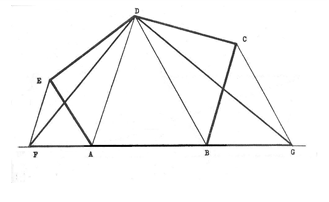 Example1: To construct a triangle equal in area to a given polygon with interior angle less than 1800
Method:
- Construct the polygon ABCDE using the given data.
- Extend the base line AB in both directions.
- Join DA and DB.
- Since angle E is opposite to line DA, draw a line from point E parallel to line DA to meet BA extended at point F. Repeat same for point C to get point G.
- Join DF and DG.
- Therefore, FGD is the required triangle.
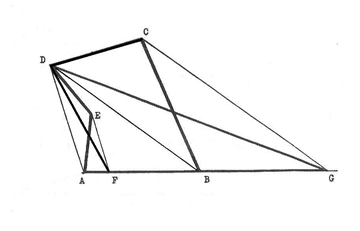 Example 2 To construct a triangle equal in area to a given polygon with an interior angle greater than
1800.
Method:
(i) Construct the polygon ABCDE using the given data.
(ii) Extend the base line AB.
(iii) Join DA and DB.
(iv) Since angle E is opposite to line DA, draw a line from
point E parallel to line DA to meet line AB atpoint F.
Similarly, from point C draw a line parallel to DB
and this meets AB produced at point G.
(v) Join DF and DG.
(vi) Therefore, FGD is the required triangle.
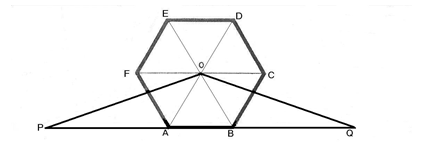 Example 3 To draw a triangle equal in area to a given regular polygon.
Method:
- Construct the polygon ABCDEF using the given data.
- Draw the diagonals of the polygon to intersect at point O.
- Extend the base line AB in both directions to points P and Q respectively. Where PQ = sum of the length of sides of the polygon ie perimeter of the polygon.
- Join OP and OQ to obtain the required triangle OPQ .
- A triangle equal in area to a given parallelogram
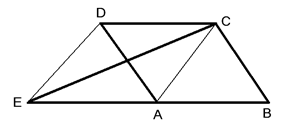 Example 4 To construct a triangle equal in area to a given parallelogram.
Method:
- Construct the parallelogram ABCD using the given data.
- Join point C to A.
- Draw the base line BA produced.
- Draw a line from point D parallel to CA and this meets BA produced Point E.
- Join CE to obtain the required triangle CEB.
- A parallelogram equal in area to a given triangle.
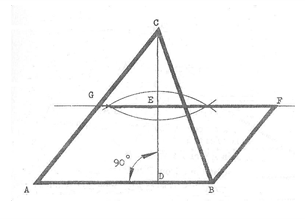 Example 5: To draw a parallelogram equal in area to a given triangle.
Method:
- Draw the triangle ABC using the given data.
- Draw a perpendicular line from the apex C to meet the base AB at point D.
- Bisect line CD to get the mid point E.
- Extend the bisector to both directions to locate point G.
- Draw a line from point B parallel to AG and this meets the bisector at F.
- ABFG is the required parallelogram.
- A triangle equal in area to a given triangle but on a different base
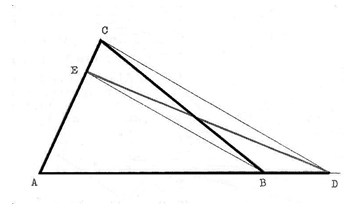 Example 6: To construct a triangle equal in area to a given triangle, but having a different base.
Method:
- Construct the triangle ABC using the given data.
- Extend the base AB by an amount equal in length to the base of the required triangle ie AD.
- Join C to D.
- Draw a line from B parallel to DC and this meets side AC at point E.
- Join ED. Therefore, ADE is the required triangle.
- A triangle constructed from its known area
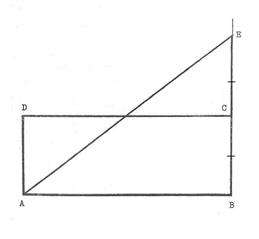 Example7: To construct a triangle when given the area.e.g let the given area be 41/2cm.
Method:
- Draw any rectangle ABCD equal to the given area- 3cm x 11/2cm = 41/2cm.
- Draw BC produced and mark off CE equal to BC on it.
- Draw a line from E to A. Therefore, ABE is the required triangle.
- A rectangle of different side equal in area to a given rectangle.
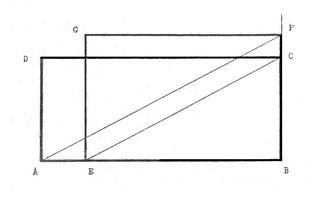 Example 8: To draw a rectangle of different side but equal in area to a given rectangle.
Method:
- Construct the given rectangle ABCD.
- Mark off BE on line AB where BE is the required different side.
- Join EC.
- Draw line BC produced.
- Draw a line from A parallel to EC and this meets BC produced at F.
- FB is the other side of the required rectangle. Complete the required rectangle EBFG.
- A square equal in area to a given rectangle.
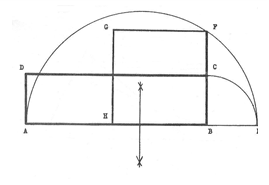 Example 9: To draw a square equal in area to a given rectangle.
Method:
- Construct the rectangle ABCD using the given data.
- Draw line AB produced.
- With B as centre and radius BC, swing an arc to cut AB produced at E.
- Draw a semicircle on line AE and this cuts line BC produced at F.
- BF is the length of side of the square.
- With B as centre and radius BF, swing an arc on line BA to locate point H.
- With H and F in turn as centres and same radius, locate point G.
- HBFG is the required square.
- A rectangle equal in area to a given triangle.
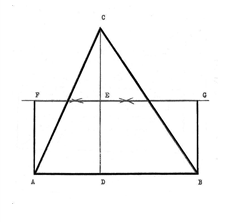
Example 10: To draw a rectangle equal in area to a given triangle.
Method:
- Construct the triangle ABC using the given data.
- From the apex C, draw a perpendicular line to
meet AB at point D.
- Bisect line CD to locate the mid point E.
- Draw a line through point E parallel to Line AB.
- Erect perpendiculars at points A and B and these
meet the parallel line through E at points F and G respectively.
- ABGF is the required rectangle.
- A square equal in area to a given parallelogram.
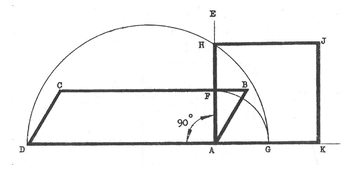 Example 11: To draw a square equal in area to a given parallelogram.
Method:
- Construct the given parallelogram ABCD.
- Draw DA produced.
- Construct a perpendicular at point A and this cuts CB at F.
- With A as centre and radius AF, swing an arc to cut DA produced at G.
- Construct a semicircle on DG and this cut the perpendicular AE at H.
- AH is the length of side of the required square.
- With A as centre and radius AH, locate point K.
- With H and K in turn as centres and same radius AH, locate point J.
- AKJH is the required square.
- Division of a triangle into a number of equal areas by parallel lines
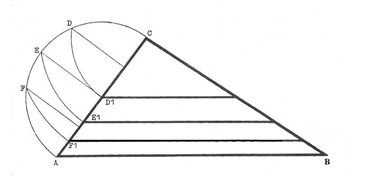 Example 12: To divide any triangle in a given number of equal areas eg four (4) by lines
drawn parallel to one side.
Method:
(i) Construct the given triangle ABC.
(ii) Construct a semicircle on side AC.
(iii) Divide AC into 4 equal parts to produce four (4) equal areas. Three or two parts will produce 3 or 2
equalareas respectively.
(iv) Draw perpendiculars to AC from these 4 divisions and these cuts the semicircle at points F,E and D.
(v) With C as centre and radius CD, CE and CF in turn, swing arcs to touch AC respectively D1, E1 and
F1.
(vi) Draw lines from these points on AC parallel to line AB.
- Division of a triangle into two equal areas by a perpendicular line.
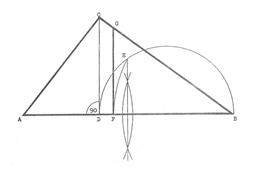 Example 13: To divide any triangle into two equal areas by a line perpendicular to one side.
Method:
- Construct the triangle ABC using the given data.
- Draw a perpendicular line from the vertex C to meet AB at point D.
- Construct a semicircle on DB.
- Draw the bisector of line AB and this cut the semicircle at point E.
- With B as centre and radius BE, swing an arc to cut AB at point F.
- Draw a line from F parallel to DC and this meets line CB at G.
- The line FG divides the triangle into two equal areas.
Division of a triangle into two equal areas by a line drawn from a given point on one side.
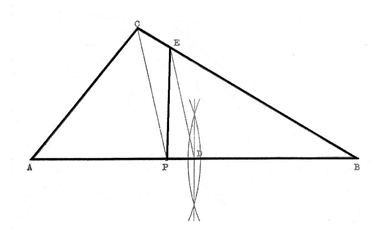 Example14: To divide any triangle into two equal areas by a line drawn from a given point
on one of its sides.
Method:
- Draw the given triangle ABC indicating the given point P.
- Draw a line from this point P to connect the vertex C.
- Bisect line AB to obtain the mid point D.
- Draw a line from point D parallel to PC and this meets CB at E.
- Join EP which divides the given triangle into two equal areas.
- A circle of equal area to the sum of two given circles.
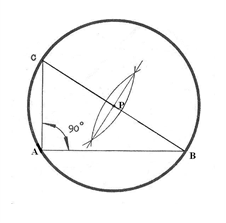 Example 15: To draw a circle equal in area to the sum of two given circles.
Method:
- Draw a line AB equal in length to the diameter of one of the given circles.
- Draw another line AC at right angle to AB equal in length to the diameter of the second given circle.
- Join BC.
- Bisect line BC so as to locate the centre P.
- With P as centre and radius PA or PB or PC, draw the required circle.
- A Square of equal area to the sum of two given Squares.
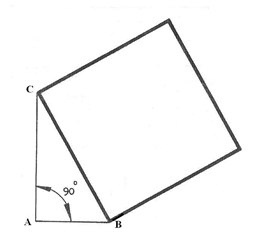 Example 16: To draw a square equal in area to the sum of two given squares
Method:
- Draw a line AB equal in length to the side of one of the square.
- Draw another line AC perpendicular to AB and equal to the length of the side of the other square.
- Join BC. Then, construct a square on side BC. This is the required Square.
- A Square of equal area to the difference of two given Squares.
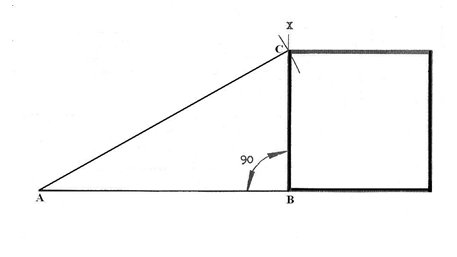 Example 17: To draw a square equal in area to the difference of two given squares.
Method:
- Draw a line AB equal to the length of side of the given smaller square.
- Erect a perpendicular at B.
- With A as centre and radius equal to the length of side of the given larger square, draw an arc to cut the perpendicular at point C.
- Construct a square on BC. This is the required square.
- A square twice the area of a given square.
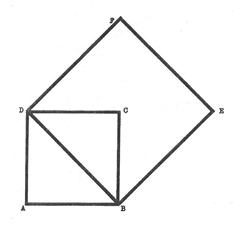 Example 18: To draw a square having Twice the area of a given square.
Method:
- Draw the given square ABCD.
- Draw the diagonal BD. This is the length of side of the required square.
- Construct the square BDEF. This is the required square.
Evaluation questions
1. An irregular polygon is shown in the figure below.
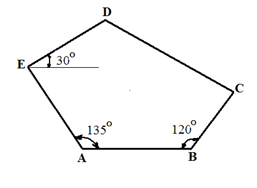
AB = 70
BC = 40
DE = 75
AE = 80
(a) Construct
(i) the pentagon;
(ii) a square equal in area to the given pentagon.
(b) Draw and state the length of a diagonal of the square in (a)(ii) above.
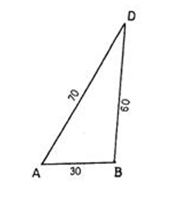 2. In the figure below, AD and BD are the diagonals of a pentagon ABCDEwhose sides are BC = 40,
CD =35, DE = 55 and < DEA =900. (a) construct the pentagon
(b) state the length of side AE of the pentagon.
(c) reduce the pentagon in (i) above to a triangle of equal area
3. Construct a triangle ABC of sides AB = 50mm, AC = 60mm and BC = 55mm. Construct a
parallelogram equal in area with the triangle.
4. Construct a square equal in area to a rectangle whose length and breadth are respectively 60mm and
35mm.
5. Three equilateral triangles have their sides 40mm, 55mm and 65mm respectively. Construct another
trianglewhose area is equal to the sum of the areas of these triangles. State the length of its sides.
Reading assignment
Technical drawing by JN Green. Pages 80-92.
Weekend Assignment
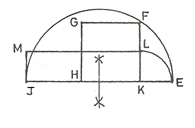 Objective
1. In the figure above, the area of rectangle JKLM is equal to A. half the area of semi-circle JFE. B. the area of square KFGH. C. half the area of square KFGH. D. the area of semi-circle JFE.
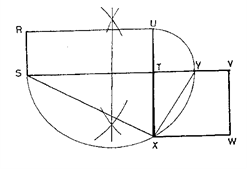 Use the figure below to answer questions 2 and 3.
2. What is the ratio of the areas of rectangle RSTU and square TVWX? A. 1:1 B. 1:2 C. 1:3 D. 1:4.
3. What is the value of angle < SXY? A. 450. B. 600. C. 750. D. 900.
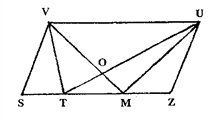 4. Which two triangles have the same area in the figure below?
A. VTM and TUM.
B. TOM and MZU.
C. MUT and VST.
D. MOU and MVU.
5. Which of the following is equal in area to the polygon BCDEG shown below. A. CDG. B. CDGB.
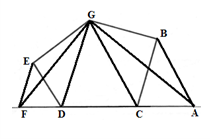 C. ABGEF.D. AGF.
Theory
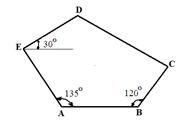 1. An irregular polygon is shown in the figure below.
AB = 70
BC = 40
DE = 75
AE = 80
(a) Construct
(i) the pentagon;
(ii) a square equal in area to the given pentagon.
(b) Draw and state the length of a diagonal of the square in (a)(ii) above.
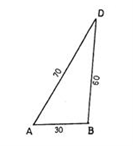 2. In the figure below, AD and BD are the diagonals of a pentagon ABCDEwhose sides are BC = 40,
CD =35, DE = 55 and < DEA =900. (a) construct the pentagon
(b) state the length of side AE of the pentagon.
(c) reduce the pentagon in (i) above to a triangle of equal area