WEEK SIX AND SEVEN DATE:………………
Topic: Reduction of plain figures
Content:
- Reduction of similar figures
- Enlargement of similar figures
Reduction of similar figures
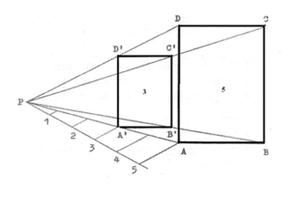 Example 1: Draw a rectangle A1B1C1D1 similar to another rectangle ABCD reduced in the proportion
3:5
Method:
(i) Draw the given rectangle ABCD.
(ii) Mark a point P at a convenient distance to the drawn rectangle.
(iii) Radiate lines from point P to the four corners of rectangle ABCD.
(iv) Since we are to draw a reduced figure, it means that from the given proportion (3:5), the actual size
is 5 while the reduced size is 3. Therefore, divide line PA into 5 equal parts.
(v) At the third (3) part, draw a line A1D1 parallel to AD.
(vi) Repeat same for the remaining sides to obtain the required reduced rectangle A1B1C1D1.
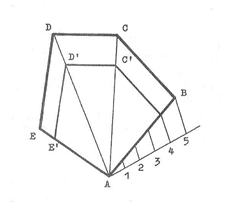
Example 2: Draw a polygon AB1C1D1E1 similar to another polygon ABCDE reduced in the proportion
4:5
Method:
(i) Construct the given polygon ABCDE using the data provided.
(ii) Radiate lines from point A through B, C, D, and E respectively.
(iii)Divide line AB into 5 equal parts.
(iv)From the fourth division, draw lines B1C1, C1D1 and D1E1 parallel to BC, CD and DE respectively to
complete the required reduced polygon.
Example 3: Draw a similar polygon of ratio 3:5 in area to a given polygon. Note that 3:5 is a reduction scale.
 Method:
(i) Draw the given polygon ABCDE.
(ii) Radiate lines from point B to points D and E.
(iii) Extend line AB from point B.
(iv) Mark off on this line 5 equal unit of any convenient length.
(v) Draw semicircles on lines A-5 and A-3.
(vi) Erect a perpendicular at point B and this cut the two previously drawn
semicircles at 31 and 51 respectively. Join 51 to A since 5 is the actual size.
(vii) Draw a line from 31 parallel to line 51-A to meet line AB at A1.
(viii)From A1, draw a line A1E1 parallel to AE and repeat same to get the
remaining sides E1D1 and D1C1. This completes the polygon.
Evaluation questions
- Construct a regular hexagon of side 40mm and reduce it by the ratio of 3:5
- A photo frame is 40 by 60 in dimensions. Reduce it by the ratio of 4:7
Enlargement of similar figures
The method of enlarging similar figures is the same as that of reducing them. But it should be clearly
understood that while reduction reduces the size of the original object, enlargement increases it.
e.g2: 5 is a reduction scale while 5: 2 is an enlargement scale

Example 1: Draw a similar polygon of ratio 5:3 in area to a given polygon. Note that 5:3 is an enlargement scale.
Method:
(i) Draw the given polygon ABCDE.
(ii) Radiate lines from point B through points D and E.
(iii) Extend line AB to both sides.
(iv) Mark off on AB extended 5 equal unit of any convenient length.
(v) Draw semicircles on lines A-5 and A-3.
(vi) Erect a perpendicular at point B and this cut the two previously drawn
semicircles at 31 and 51 respectively. Join 31 to A since 3 is the actual size.
(vii) Draw a line from 51 parallel to line 31-A to meet line BA extended at A1.
(viii)From A1, draw a line A1E1 parallel to AE and repeat same to get the remaining sides E1D1 and
 D1C1.This completes the polygon.
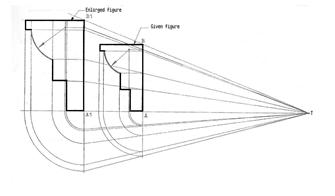
Example 2: To draw an enlarged figure similar to a given figure.
Method:
(i) Draw the given figure of height AB.
(ii) Extend its base line in both directions and indicate
the pole T on it at a convenient distance from the
given figure.
(iii) Radiate lines from point T through all the visible edges
of the figure which are traced perpendicularly to side AB.
(vi) The radiated line through points A and B forms the range
to which the height A1B1 of the required enlargement is drawn.
(v) With A as centre and radius equal to the distance between A and each vertical projection of the
visible edges on the base line, draw arcs to locate points on BA produced.
(vi) Radiate lines from T through each point on BA produced and these lines meet B1A1 produced at
points whichwill help to locate their respective points on the enlarged figure.
(vii)With A1 as centre and radius equal to each point on B1A1 produced, draw arcs to touch the base
line.
(viii)Project these lines upwards to locate points on the enlarged figure.
Evaluation questions
- Construct a regular pentagon ABCDE of sides 30mm. Enlarge it in the ratio of 3:2
General evaluation/ revision questions
1. Construct a pentagon ABCDE whose sides are AB = 40, BC = 35, CD = 65, AE = 45, ED = 55, < ABC = 1200
and< BAE = 1050. Draw a similar pentagon of ratio 3:5 in area to the one constructed.
2. On the same base of length 30mm, construct the following regular polygons; square, pentagon, hexagon,
heptagon, octagon, nonagon and decagon.
3. Construct a nonagon when given the distance across corners A/C = 40mm.Draw a similar nonagon of ratio
5:4 in areato the constructed one.
4. An irregular hexagon ABCDEF has the following dimensions. AB = 51, BC = 30, CD = 23, DE = 36
EF = 30, AD = 70, AF = 38, < FAB = 1100, < ABC = 880. Use the information above to construct the
 hexagon. Draw a similar hexagon of ratio 3:5 in area to the one constructed.
5. The figure above shows an irregular pentagon. Construct (i) the pentagon. (ii) a similar pentagon reduced in
area in the ratio 5:7
Reading assignment
Technical drawing by JN Green. Pages 28-33,38,63,76-79.
Weekend Assignment
Objectives
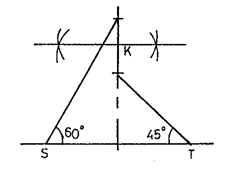
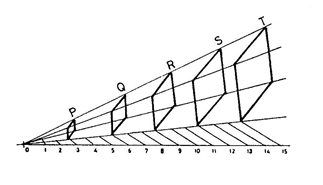 1. What type of polygon could be constructed with K as the centre in the figure above? A. Square.
B. Pentagon.C. Hexagon. D. Heptagon.
2. Which of the labeled quadrilaterals in the diagram above have their sides in ratio 1:4?A. P and Q.
B. Q and R.C. P and S.D. R and T.
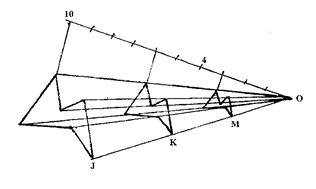 3. The figure below shows three irregular hexagons J, K and M. What is the ratio of their sides?
A. 10 : 4 : 3
B. 10 : 6 : 3
C. !0 : 2 : 3
D. 10 : 3 : 4
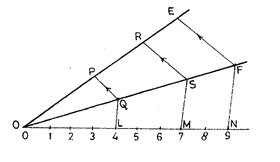 4. In the method of enlargement shown below, point O is taken at A. 10mm from point P.B. 20mm from point Q. C. a distance equal to the length of PQL. D. any convenient distance from L.
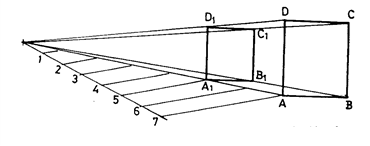 5. In the diagram below, the ratio of the sides of rectangle ABCD to the sides of rectangle A1B1C1D1 is A. 7:5
B. 5:7 C. 5:2 D. 4:7
Theory
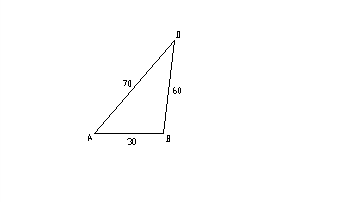 1. In the diagram shown below, AD and BD are the two diagonals of a pentagon ABCDE whose sides are
BC= 40, CD = 35, DE = 55 and angle DEA = 900. (i) construct the pentagon. (ii) state the length AE of the
pentagon.
2. An irregular pentagon ABCDE has the following dimensions. AB = 51, BC = 30, CD = 23, DE = 36
EA = 38, < EAB = 1100, < ABC = 880.
(a) Use the information above to construct the pentagon.
(b) Construct a similar figure A1B1C1D1E1 which has an area of ratio 5:3 to ABCDE.