WEEK TEN DATE:………………
Topic: Tangency involving circles, arcs and lines.
Content:
(i) Principles of tangency.
Principles of tangency.
(i) To join an arc to a straight line or two straight lines inclined at different angles.
(ii) To join two arcs together externally.
(iii) To join two arcs together internally.


1(a) To join an arc of known radius R to a straight line AB.
Method:
(i) Draw the straight line AB.
(ii) Draw another straight line A1B1 parallel to line AB but at a distance R apart.
(iii) With compass pin at any given point on A1B1ie point C and radius R, draw an arc to touch line
AB.
1(b) To join an arc of known radius R to two straight lines inclined at right angle.
Method:
(i) Draw lines respectively at distance R parallel to the two given straight lines.
(ii) The point of intersection Q of these parallel lines in (i) marks the centre of the arc that would be
tangential to the two lines.
(iii) With Q as centre and radius R, draw an arc to just touch the two lines at their tangent points T.
Note :The procedures for drawing figures 1(c) and 1(d) are the same as figure 1(b) except that the two straight lines are inclined at acute and obtuse angles respectively.
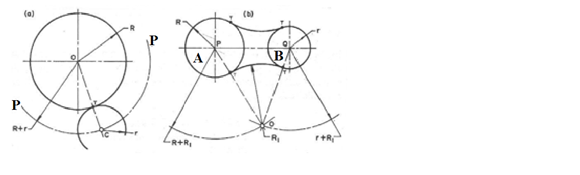
Fig. 2
2(a) To join two arcs of known radius externally.
Example: Given two arcs of radius r and R to be joined externally.[ R + r ]
Method:
(i) Draw the arc or circle of radius R.
(ii) With the same centre, draw another arc P-P of radius R + r where r is the radius of the arc or circle meant to have an external touch with the given circle or arc.
(iii) With the compass pin at any point on arc P-P and radius r, draw an arc to just touch the arc or circle of radius R at point T.
2(b) To draw an arc of radius R1 to touch two circles externally.
Method:
(i) Draw the two given circle A of radius R and circle B of radius r.
(ii) Join their centers ie P-Q.
(iii) With P as centre and radius R1+ R (where R1 is the radius of the arc meant to make an external
contactwith the two circles), draw an arc.
(iv) Also with Q as centre and radius R1+ R, draw another arc to intersect the former one at point O.
(v) Draw straight lines from point O to centers P and Q which cut both circles at their respective
tangentPointsT.
(vi) With O as center and radius OT, draw an arc to just touch circles A and B.
To join two arcs together internally.
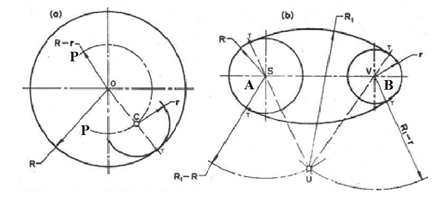
Fig. 3
3(a) To join two arcs of known radius internally.
Method:
(i) Draw the arc or circle of radius R.
(ii) Draw another arc P-P of radius [R – r] where r is the radius of the arc that is meant to touch the
other one internally.
(iii) With the compass pin at any point on arc P-P and radius r, draw an arc to just touch the arc or circle
ofradius R at point T internally.
3(b) To draw an arc of radius R1 to touch two circles internally.
Method:
(i) Draw the two given circles A of radius R and B of radius r.
(ii) Join their centresie S-V.
(iii) With S as centre and radius R1– R (where R1 is the radius of the arc that is meant to make internal contact), draw an arc.
(iv) Also with V as centre and radius R1 – r, draw another arc to intersect the former one at point U.
(v) Draw straight lines from point U through centers S and V to the tangent points T.
(vi) With U as centre and radius UT, draw an arc to just touch circles A and B at their respective
tangentpoints.
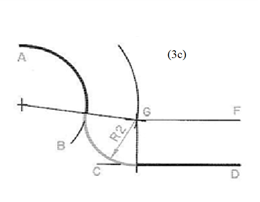
 To join an arc R2 externally with another arc AB and a straight line CD.
Method:
(i) Draw an arc parallel to arc AB and of radius equal to the radius of arc AB + R2.
(ii) Draw a line FG parallel to line CD at a distance equal to radius R2 to intersect the previous arc at G.
(iii) This point of intersection marks the centre of the arc of radius R2 that will connect the given arc AB and straight line CD.
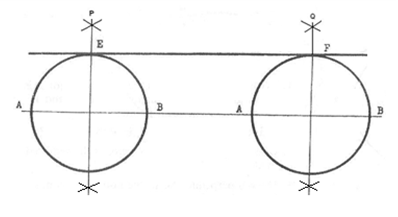 To draw a common external tangent to two circles of equal diameters.
Method:
(i) Draw the two given circles.
(ii) Draw a line through the centers of the two circles.
(iii)Bisect the horizontal diameters AB of the two circles.
(iv)These bisectors which are respectively P and Q cuts each circle at points E and F.
(v) Draw a line through E and F. This is the required tangent.
To draw a common external tangent to two circle of unequal diameters.
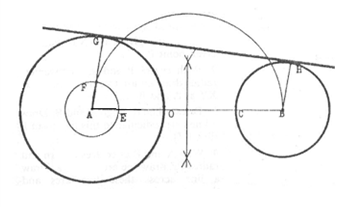
Method:
(i) Draw the two given circles.
(ii) Join the centers of the circles ie join A to B.
(iii) With O as centre and radius CB, mark off point E on line AB.
(iv) With A as centre and radius AE, draw a circle.
(v) Construct a semi-circle on AB and this cuts the previous circle at point F.
(vi) Draw a line from A through F and cutting the circumference of the larger circle at G.
(vii) Draw BH parallel to AG.
(viii)Draw a line through G and H. This is the required tangent.
 To draw a common internal tangent to two equal circles.
Method:
(i) Draw the two given circles.
(ii) Join the centers A and B of the two circles.
(iii)Bisect AB to get point C.
(iv)Construct a semi-circle on AC and this cuts the circle of centre A at point D.
(v) With C as centre and radius CD, draw an arc to cut the second circle at point E.
(vi)Draw a line through D and E. This is the required tangent.
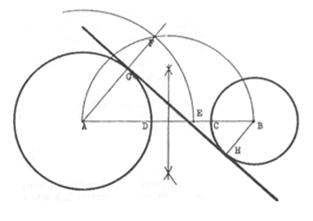
 To draw a common internal tangent to two unequal circles.
Method:
(i) Draw the two given circles.
(ii) Join the centers of the circles A and B.
(iii)With D as centre and radius CB, mark the point E on AB.
(iv)With A as centre and radius AE, draw an arc.
(v) Construct a semi-circle on AB to cut the previous arc at F.
General evaluation/revision questions
1. (a) Construct full size, the template shown below, showing clearly the
(i) centres of the arcs;
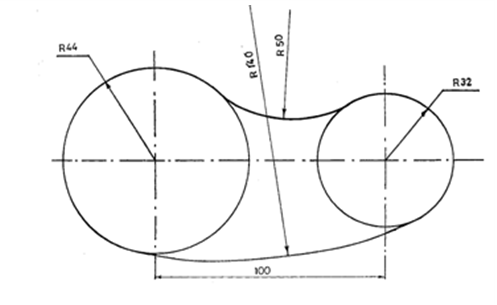 (ii) points of tangency.
(b) Two circles P and Q, diameters 50 and 40 respectively, touch each other tangentially. Draw:
(i) the circles;
(ii) an arc R150, to include circles P and Q tangentially at the upper part;
(iii)an arc, radius 20, to exclude circles P and Q tangentially at the lower point.
2. Construct full size, the spanner shown below, showing clearly the (i) centres of the arcs; (ii) points
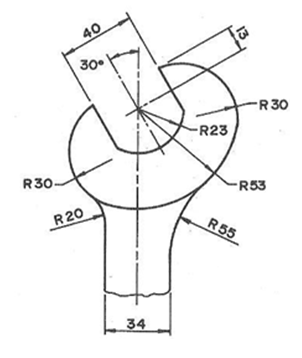 of tangency.
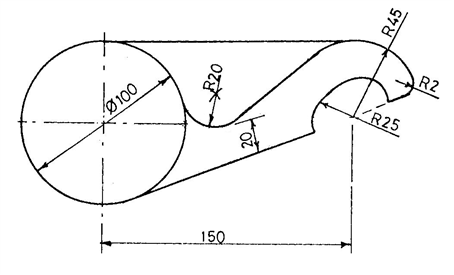
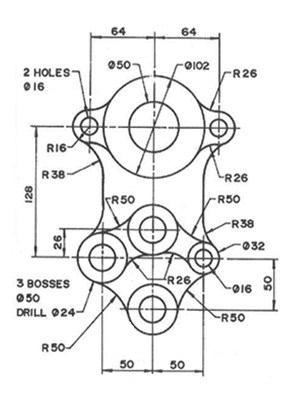 3. Construct half full size, the machine part shown below, showing clearly the (i) centres of the arcs;
(ii) points of tangency.
 4. Construct full size, the template shown below, showing clearly the (i) centers of the arcs; (ii) points
of tangency.
Reading assignment
Technical drawing by J.N Green,Pages 58 and 59
Weekend Assignment
Objective
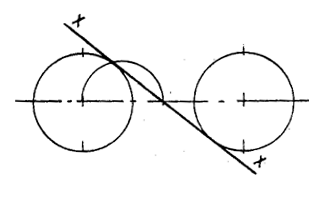 1. Line X-X in the figure below is a common A. bisector. B. normal. C. external tangent. D. internal tangent.
2. Which of the following equations is correct about the figure below? A. Rc+ Rx = Rz
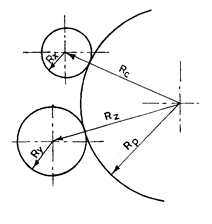 B. Rp + Ry = RzC. Rp + Ry = RcD. Rz– Ry= Rc
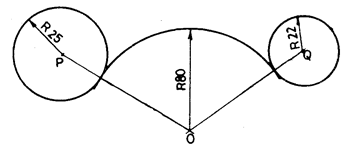 3. What are the lengths of PO and QO respectively in the diagram below? A. 105 and 102 B. 65 and
62C. 130 and 124 D. 57 and 55.
4. What type of tangency does the given arc of radius 80 in question 3 above make with the two circles?
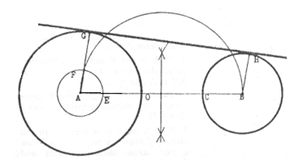 A. External. B. Internal. C. Vertical. D. Horizontal.
5. The figure shown above is the construction of a common A. external tangent. B. internal tangent.
C. bisector. D. normal.
Theory
1. Construct full size, the template shown below, showing clearly the (i) centres of the arcs;
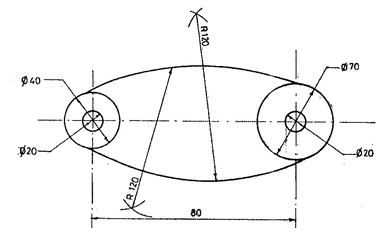 (ii) points of tangency.
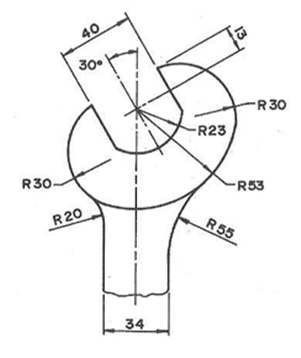 2. Construct full size, the spanner shown below, showing clearly the (i) centres of the arcs; (ii) points
of tangency.
Further evaluation questions
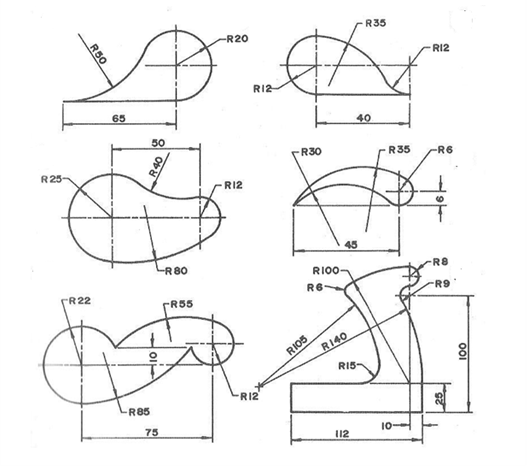 Draw full size, each of the tangency problems shown below, showing centres and points of tangency.