WEEK FIVE DATE:………………
Topic: Diagonal and chordal scale and their uses.
Content:
(i) Meaning and construction of diagonal scales.
(ii) Scale of chords and its construction.
Meaning and construction of diagonal scales.
Diagonal scale: Diagonal scales unlike plain scale can measure to a fine degree of accuracy with three units of measurement; centimeters, millimeters and tenths of a millimeter. This is the singular advantage of diagonal scale over plain scale.
Construction of diagonal scale
To construct a diagonal scale of centimeters to read up to 7cm in millimeters and tenths of a millimeter.
Method:
(i) Draw a line 7cm long and divide it into 7 equal parts.
(ii) Divide the first part into 10 equal units
(iii) Draw the height AC of the scale rule to any convenient length and divide it into 10 equal parts.
Transfer same10 division to the first part AD
(iv) Project horizontal lines from each of these 10 divisions on the height AC.
(v) Project vertical lines from each of the division on line AB. Draw diagonal lines in between the 10
vertical lines of the first part as shown above.
Note: Diagonal scale is read from the highest unit to the smallest. The value of S is 4.66cm or 46.6mm
(4cm + 6mm + 6/10mm => 40mm + 6mm + 0.6mm)
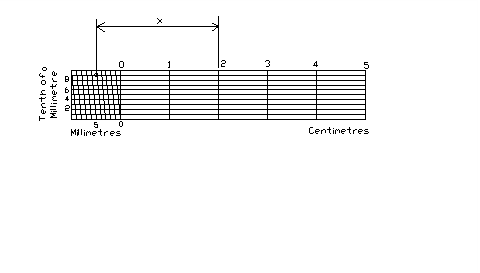 To construct a diagonal scale of twice full size to read up to 6centimetre in millimeters and tenth of a millimeter.
Method:
 (i) Draw a line 12cm long i.e. (2×6)cm and divide it into 6 equal parts.
(ii)Follow the same procedure as above. The value of X is 2.49cm or 24.9mm.
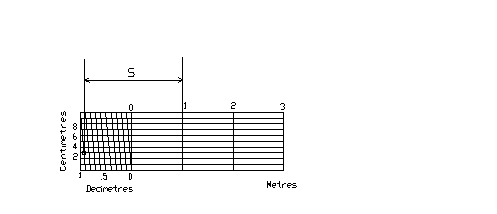
To construct a diagonal scale of 3centimetres equal to 1metre and to read up to 4metres in decimeters and centimeters.
 Method:
(i) Draw a line 12cm long i.e. (3×4) cm and divide it into 4 equal parts.
(ii) Same procedure as above. The value of S is 1.93m or 19.3dm or 193cm.
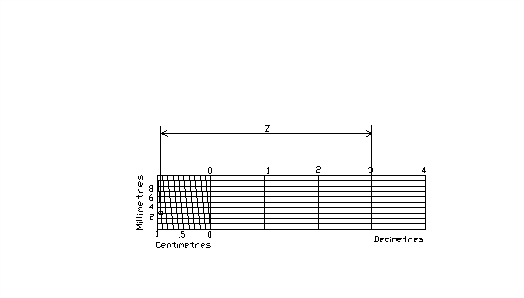
To construct a diagonal scale of 1/4 full size to read up to 5dm in centimeters and millimeters
Method:
(i) Draw a line of length equal to 125mm i.e. (1/4x 5)dm => 1.25dm or 12.5cm or 125mm.
(ii) Same procedure as above. The value of Z is 3.93dm or 39.3cm or 393mm.
Evaluation Questions
 1. What is diagonal scale?
2. Construct a diagonal scale of 2/5 full size to read up to 3 dm in centimeters and millimeters.
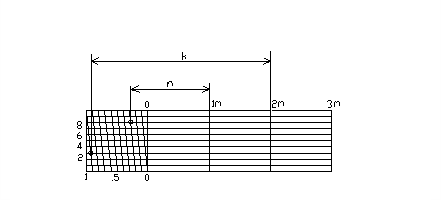
3. What is the difference between the values of k and n in the figure shown below?
The chordal scale: The chordal scale is used to construct angles that cannot easily be constructed using a ruler and a pair of compasses .For instance, to construct angles which are multiples of 50, a scale of chords showing a distance of 50 is constructed.
Construction of the scale of chords
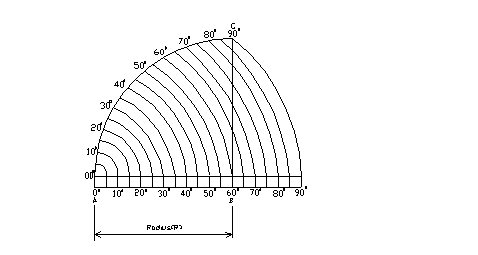 To draw a scale of chords to show distances of 50
Method:
(i) Draw a quadrant ABC of any radius and divide the arc AC into 18 equal parts i.e. 50x18 = 900 which
is the angle in a quadrant.
(ii) Extend the base line AB of the quadrant to the right.
(iii) With 000 as centre and radius equal to each of the 18 divisions in turn, draw
arcs to touch the base line AB of the quadrant and its extension.
 (iv) Construct the scale which could be of any convenient height below the quadrant.
This scale is used to construct the required angle.
Example 1
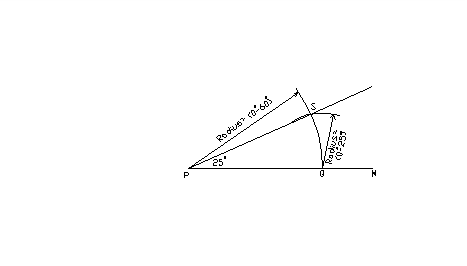
Construct angle 250 using scale of chords.
(i) Draw a line PM of any convenient length.
(ii) With P as centre and radius R of length equal to the radius of the quadrant (00-600), draw an arc to cut
line PM at Q.
(iii) With Q as centre and radius r of length equal to the required angle (00-250) measured from the
constructed scale, draw an arc to cut the previous one at S.
(iv) Draw a line from P through S. <SPM is the required angle. Scale of chord is a type of scale that
can be used to construct angles other than the ones done with a pair of compasses eg 240, 370
etc.
General evaluation/ revision questions
1. Construct a scale of 4cm equals 2dm to read up to 5dm in centimeters.
2. Construct angle 400 using the scale of chords.
3. Construct angle 270 using the scale of chords.
4. Construct the following angles (i) 150 (ii) 750 (iii) 1050(iv) 1200 (v) 1500
Reading assignment
Technical drawing for school certificate and G.C.E by J.N Green Page 11-13.
Weekend Assignment
Objective
1. Which of the following scale can be used to construct angle 270 ? A. Plain scale B. Scale of chord
C. Diagonal scale. D. Linear scale.
2. Which of the following scale has the highest degree of accuracy? A. Plain scale B. Diagonal scale
C. chordal scale. D. Enlargement scale.
3. Which of the following scale has three units of measurement? A. Chordalscale B. diagonal scale
C. Reduction scale. D. Plain scale.
4. Centimeters, millimeters and tenths of a millimeter are units of measurement for A. diagonal scale
B. plain scale C. chordal scale. D. enlargement scale.
5. Which of the following is a reduction scale? A. 3 : 4 B. 5 : 4 C. 2 : 1 D. 3 : 2
Theory
1.Construct angle 500 using the scale of chords.
2. Construct a diagonal scale of 2/5 full size to read up to 3 dm in centimetres
andmillimetres.