CLASS; J S S 2 WEEK 8
TOPIC; INTERVALS.
Interval (music)
.
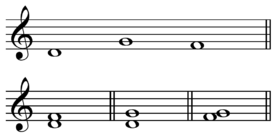
Melodic and harmonic intervals.
In music theory, an interval is the difference between two pitches. An interval may be described as horizontal, linear, or melodic if it refers to successively sounding tones, such as two adjacent pitches in a melody, and vertical or harmonic if it pertains to simultaneously sounding tones, such as in a chord.
In Western music, intervals are most commonly differences between notes of a diatonic scale. The smallest of these intervals is a semitone. Intervals smaller than a semitone are called microtones. They can be formed using the notes of various kinds of non-diatonic scales. Some of the very smallest ones are called commas, and describe small discrepancies, observed in some tuning systems, between enharmonically equivalent notes such as C♯ and D♭. Intervals can be arbitrarily small, and even imperceptible to the human ear.
In physical terms, an interval is the ratio between two sonic frequencies. For example, any two notes an octave apart have a frequency ratio of 2:1. This means that successive increments of pitch by the same interval result in an exponential increase of frequency, even though the human ear perceives this as a linear increase in pitch. For this reason, intervals are often measured in cents, a unit derived from the logarithm of the frequency ratio.
In Western music theory, the most common naming scheme for intervals describes two properties of the interval: the quality (perfect, major, minor, augmented, and diminished) and number (unison, second, third, etc.). Examples include the minor third or perfect fifth. These names describe not only the difference in semitones between the upper and lower notes, but also how the interval is spelled. The importance of spelling stems from the historical practice of differentiating the frequency ratios of enharmonic intervals such as G–G♯ and G–A♭.
Main intervals.
The table shows the most widely used conventional names for the intervals between the notes of a chromatic scale. A perfect unison (also known as perfect prime)
is an interval formed by two identical notes. Its size is zero cents. A semitone is any interval between two adjacent notes in a chromatic scale, a whole tone is an interval spanning two semitones (for example, a major second), and a triton is an interval spanning three tones, or six semitones (for example, an augmented fourth). Rarely, the term denote is also used to indicate an interval spanning two whole tones (for example, a major third), or more strictly as a synonym of major third.
Intervals with different names may span the same number of semitones, and may even have the same width. For instance, the interval from D to F♯ is a major third, while that from D to G♭ is a diminished fourth. However, they both span 4 semitones. If the instrument is tuned so that the 12 notes of the chromatic scale are equally spaced (as in equal temperament), these intervals will also have the same width. Namely, all semitones will have a width of 100 cents, and all intervals spanning 4 semitones will be 400 cents wide.
The names listed here cannot be determined by counting semitones alone. The rules to determine them are explained below. Other names, determined with different naming conventions, are listed in a separate section. Intervals smaller than one semitone (commas or microtones) and larger than one octave (compound intervals) are introduced below.
| Number ofsemitones | Minor, major,or perfect intervals | Short | Augmented ordiminished intervals | Short | Widely usedalternative names | Short | Audio |
| 0 | Perfect unison[5][7] | P1 | Diminished second | d2 |  Play (help info) Play (help info) | ||
| 1 | Minor second | m2 | Augmented unison[5][7] | A1 | Semitone,[8] half tone, half step | S |  Play (help info) Play (help info) |
| 2 | Major second | M2 | Diminished third | d3 | Tone, whole tone, whole step | T |  Play (help info) Play (help info) |
| 3 | Minor third | m3 | Augmented second | A2 |  Play (help info) Play (help info) | ||
| 4 | Major third | M3 | Diminished fourth | d4 |  Play (help info) Play (help info) | ||
| 5 | Perfect fourth | P4 | Augmented third | A3 |  Play (help info) Play (help info) | ||
| 6 | Diminished fifth | d5 | Triton[6] | TT |  Play (help info) Play (help info) | ||
| Augmented fourth | A4 | ||||||
| 7 | Perfect fifth | P5 | Diminished sixth | d6 |  Play (help info) Play (help info) | ||
| 8 | Minor sixth | m6 | Augmented fifth | A5 |  Play (help info) Play (help info) | ||
| 9 | Major sixth | M6 | Diminished seventh | d7 |  Play (help info) Play (help info) | ||
| 10 | Minor seventh | m7 | Augmented sixth | A6 |  Play (help info) Play (help info) | ||
| 11 | Major seventh | M7 | Diminished octave | d8 |  Play (help info) Play (help info) | ||
| 12 | Perfect octave | P8 | Augmented seventh | A7 |  Play (help info) Play (help info) |