WEEK 8AND 9 PROBABILITY
PROBABILITY
Probability is the measure of the likelihood that an event will occur. Probability is quantified as a number between 0 and 1 (where 0 indicates impossibility and 1 indicates certainty). The higher the probability of an event, the more certain we are that the event will occur. A simple example is the tossing of a fair (unbiased) coin. Since the coin is unbiased, the two outcomes (“head” and “tail”) are equally probable; the probability of “head” equals the probability of “tail.” Since no other outcome is possible, the probability is 1/2 (or 50%) of either “head” or “tail”. In other words, the probability of “head” is 1 out of 2 outcomes and the probability of “tail” is also, 1 out of 2 outcomes.
The probability of an event A is written as  ,
,  , or
, or  .[24] This mathematical definition of probability can extend to infinite sample spaces, and even uncountable sample spaces, using the concept of a measure.
The opposite or complement of an event A is the event [not A] (that is, the event of A not occurring), often denoted as  , or
, or  ; its probability is given by P(not A) = 1 − P(A). As an example, the chance of not rolling a six on a six-sided die is 1 – (chance of rolling a six)
 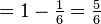 . If two events A and B occur on a single performance of an experiment, this is called the intersection or of A and B, denoted as
  .
.
Independent events
If two events, A and B are independent then the joint probability is

for example, if two coins are flipped the chance of both being heads is  .[26]
.[26]
Mutually exclusive events
If either event A or event B occurs on a single performance of an experiment this is called the union of the events A and B denoted as  . If two events are mutually exclusive then the probability of either occurring is

For example, the chance of rolling a 1 or 2 on a six-sided die is 
Not mutually exclusive events
If the events are not mutually exclusive then

For example, when drawing a single card at random from a regular deck of cards, the chance of getting a heart or a face card (J,Q,K) (or one that is both) is  , because of the 52 cards of a deck 13 are hearts, 12 are face cards, and 3 are both: here the possibilities included in the “3 that are both” are included in each of the “13 hearts” and the “12 face cards” but should only be counted once.
| Event | Probability |
| A |  |
| not A |  |
| A or B |  |
| A and B |  |
| A given B |  |
PROBABILITY SCALE AND TERMS
- EVENT: An event is something that happens. Example tossing a coin or throwing a dice is an event.
- OUTCOME: An outcome is the result of an event. Example if you toss a coin, you will either get a Head or Tail. This means there are 2 possible outcomes.
- IMPOOSSIBLE: An event that is impossible will definitely happen is given a probability of 0.
- UNLIKELY:
When the probability tends towards 0, then there is less chances that an event will happen.
- LIKELY: When the probability tends towards 1, then there is a likely chance that is 50-50
APPLICATION
EXAMPLES:
Each of the following numbers are writing on a piece of paper and then put in a bag. 3, 4, 6, 3, 5, 7, 5, 10, 5, 12, 7, 8 , 9 ,7, 5, 3, 9, 6, 6, 11, 12, 11, 5
What is the probability of a picking at random
- An odd number
- An even number
SOLUTION
Picking an odd number is 3, 5, 7, 11, successful outcome is 3, 3, 3, 5, 5, 5, 5, 5, 7, 7,7, 9, 9, 11, 11 = 15 outcome.
Pro. Of odd no = 15/24 = 5/8
Picking an even number is 4, 4, 6, 6, 6, 8, 10, 12, 12 = 9 outcome
Pro. Of even number is 9/24 = 3/8
Example 2: There are 7 red balls, 8 white balls and 5 blue balls in a box. Find the probability thst the ball is
- White
- Red
- Blue or red
- Neither red nor white
- green
Solution:
- Total number of balls = 7+ 8+ 5
= 20
White ball = 8, pro. Of selecting a white ball is = 8/20 = 2/5
- Number of red balls = 7
Pro. Of selecting a red balls = 7
7/20
- Number of blue and red balls = 5+ 7 = 12
Pro. Of selecting a blue or red ball = 12/ 20
3/5 - If the ball is neither red nor white, then it must be blue. Pro. Of selecting a blue ball = 5/20 = ¼
- There are no green balls therefore the pro. Of green is 0
Example 3: A card is selected from a well shuffled standard pack of 52 cards. What is the probability of getting,
- A diamond
- A queen
- An ace
- A red card
- The ace of spades
- Any card other than an ace
NOTE: A PACK OF CARDS ARE IN 4 SUITS. EACH SUIT HAS 13 DIAMONDS, 13 HEARTS, 13 SPADES, 13 CLUBS. THE DIAMOND AND THE HEART ARE BOTH RED WHILE THE CLUB AND THE SPADE ARE BLUE. THE SIZE OF NUMBERS ON THE CARD ARE: A 2, 3, 4, 5, 6, 7, 8, 9, 10, J, Q, K.
WHERE A = ACE, Q = QUEEN, K = KING, J = JACK. THERE ARE 12 PICTURE CARDS, NAMELY; 4 KINGS, 4 QUEENS, 4 JACKS.
Solution
Total numbers of possible outcomes = 52
(a). pro. (diamond) = 13/52
= ¼
(b). pro (Queen) = 4/52
= 1/13
(c). pro. (Ace) 4/52
= 1/13
(e). pro. (red card) = 26/52
= ½
(f). pro. (any card other than an ace) = 1- 1/13
= 12/ 13
DO THESE
- A bag contains the following: 90 blue balls, 3 red balls, 50 yellow balls, 57 brown balls 100 green balls. What is the probability of picking at random:
- A blue ball
- A yellow ball
- A brown ball
- A red balls
- A white ball
- A green ball
- A card is selected from a well shuffled standard pack of 52 cards. What is the probability of getting:
- A club
- The ace of diamond
- A jack of hearts
- A diamond or a spade
- A die has six faces numbered 1 to 6. If the die is rolled once, find the probability of:
- Obtaining the number 6
- Obtaining the number 10
- Not obtaining the number 6
- Obtaining the numbers 1, 2, 3, 4, 5, or 6
ASSIGNMENT
PAGE 308 EXERCISE 24.3 NO 1, 3, 4, 5, 6, 7, AND 8