WEEK SIX-SEVEN:
Topic: Perspective drawing
Content:
- Meaning and types
Perspective drawing
Perspective drawing: This is a pictorial drawing that shows the object as the eyes sees it when looking from a particular point through an imaginary plane called the Picture plane (PP). In Perspective drawing instead of the receding lines remaining parallel as in isometric or oblique drawing, they rather tend to converge at a point called the vanishing point. There are three types of perspective drawing and these are: Parallel or One- point, Angular or Two- point and the Oblique or Three-point perspectives respectively. We shall consider the most common of these (one-point and two point) perspectives in this lesson. Perspective drawing is characterized by the following elements which include: Station Point
(SP), Picture Plane (PP), Ground Line (GL), Horizon Line (HL) and the Vanishing Point (VP).
Station Point: This is the eye of the observer. It is noted on drawings as SP. It is the point from which projectors or the rays from the eyes originate.
Picture Plane: This is the plane directly opposite the observer on which the object is projected. It is noted on drawings as PP.
Ground Line: The ground line is the line of intersection between the ground plane and picture plane. It is noted on drawings as GL.
Horizon Line: This is the line at a distance on which the visual rays from the eyes of the observer meets. It is noted on drawings as HL.
Vanishing Point: this is the point where all receding lines converge on the horizon. It is noted on drawings as VP, VPL or VPR where L or R indicates left or right vanishing point.
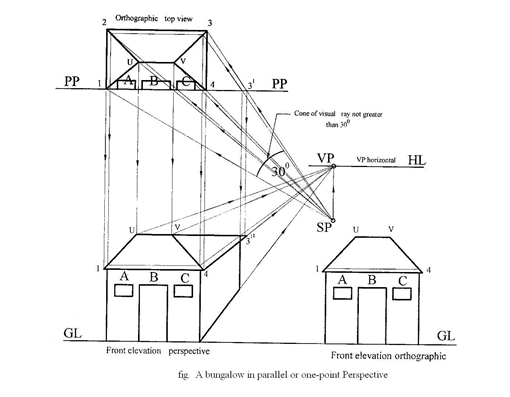 Parallel or One-point Perspective: This drawing is similar to Oblique drawing. The only difference is that the receding lines converge at a point called the vanishing point on the horizon. In practice, one face of the object is placed on the picture plane so that its true shape and size can be accurately drawn. Below is the diagram illustrating a Bungalow building drawn in Parallel or one-point perspective

Method:
(i) Draw the Ground Line GL and layout the front elevation of the Bungalow on it.
(ii) Draw the Picture Plane PP and layout the top orthographic view of the Bungalow on it; showing
the positions of the wall, door and windows as shown in the above diagram.
(iii) Draw the Horizon Line at any convenient distance from the Ground Line.
(iv) Locate the station point SP such that the cone of visual rays will enclose the top view at an angle
not greater than 300.
(v) Draw a vertical line from the station point to meet the horizon in order to locate the vanishing point.
(vi) Draw visual ray lines from the station point to all points on the top view.
(vii) From these points where the visual ray lines meet the top view, drop or project vertical lines downward
towards the ground line.
(viii)Project horizontal lines from the front orthographic view to intersect the vertical lines from the top
orthographic view.
(ix) Project lines from the front perspective view to the vanishing point VP.The intersection of projections lines
from the top view, front orthographic view and the front perspective view gives the required shape of the
Bungalow in one-point perspective drawing.
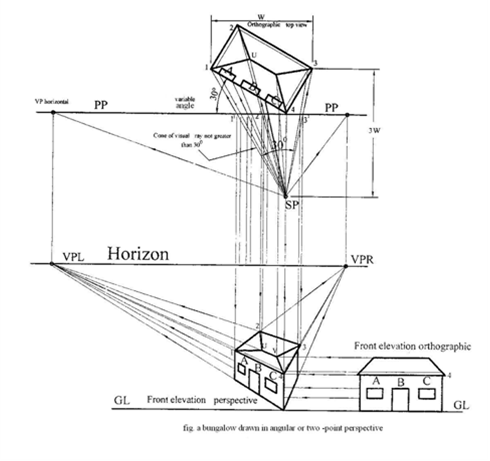 Angular or Two-point Perspective: Angular or Two-point perspective drawing is similar to axonometric projection whose complementary angles are 450 and 450 or 300 and 600 as its principal axes. The only difference is that the receding lines of the angular perspective converge at two vanishing points located on the horizon. Below is the diagram illustrating a Bungalow building drawn in Angular or two-point perspective.
Method:
(i) Draw the Ground Line, the Horizon Line and the Picture Plane.
(ii) Draw the front orthographic view on the Ground Line.
(iii) Draw the top orthographic view on the Picture Plane at variable angles preferably 300 and mark the
position of the wall, windows and door on it as show in the figure.
(iv) Locate the Station Point at a distance twice the width of the building and drop a perpendicular from the
edge as shown in the top orthographic view.
(v) Locate the two vanishing points by first drawing lines from the Station Point to the Picture Plane such that
they are parallel to the edge lines of the top orthographic view of the building.
(vi) Draw perpendiculars from the Picture Plane line to the Horizon and this will give the two vanishing points
VPL and VPR.
(vii) Draw the visual ray lines from the station point to all the top points in the top orthographic view
as shown by the arrow heads.
(viii) Extend vertical lines downward from the bottom point of the top orthographic view as well as where the
visual ray lines intersect the Picture Plane line.
(ix) Project horizontal lines from the front orthographic view to intersect the vertical lines from the
top orthographic view.
(x) Project lines from the front perspective view to the vanishing points VPL and VPR. The intersection of
projection lines from the top view, front orthographic view and the front perspective view will give the
required shape of the Bungalow in Two-point perspective drawing.
Evaluation Questions
1. Explain the following types of perspective drawing. (a) Parallel or one- point. (b) Angular or two-points
2. Draw a bungalow in parallel perspective. Use suitable dimensions.
General Evaluation/Revision Questions
1. State 6 dimensioning techniques.
2. Classify the following tools : Hammer, File, Chisel, A pair of dividers, Protractor, A pair of odd-
leg calipers, Vernier Caliper, Scriber, Saw, Centre punch, Screw driver, Surface plate, Spanner,
Steel rule, T- square, Tri-square into (i) Marking out tools (ii) Cutting tools
(iii) Driving tools (iv) Measuring tools.
 3. An irregular polygon is shown in the figure below.
AB = 70
BC = 40
DE = 75
AE = 80
(a) Construct
(i) the pentagon;
(ii) a square equal in area to the given pentagon.
(b) Draw and state the length of a diagonal of the square in (a)(ii) above.
Reading assignment
Engineering drawing 1 by M.A.Parker and F.Pickup pages 43 – 64
Weekend Assignment
Objective
1. The type of pictorial drawing in which one of the receding axis is drawn at right angle is called ——-
A. isometric. B. oblique. C. perspective D. axonometric.
2. Which of the following types of oblique projection has its receding axis drawn full length? ——-
A. cabinet B. cavalier C. Oblique D. offset.
3. Vanishing point is the characteristics of which of the following types of pictorial drawing?——-
A. isometric B. perspective C. oblique D. axonometric.
4. Which of the following pairs are types of perspective drawing?———- A. parallel and angular
B. ordinate and grid C. vertical and horizontal D. pictorial and orthographic.
5. The receding lines of an isometric drawing are drawn at what angle to the horizontal? A. 600 B. 450 C. 300
D. 900
Theory
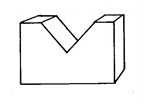 1. Draw the block shown below in Parallel perspective. Use suitable dimensions
2. Draw full size in isometric projection the object shown below.