WEEK THREE
Topic: Building foundation.
Content:
(i) Meaning of building foundation.
(ii) Types of building foundation.
The meaning of building foundation
Foundation sometimes called footing or the sub-structure is designed to support the walls and the roof and to provide a solid base on which to build a house. The type of foundation chosen will depend on two distinct variables which include: the total building load ie weight of the house and the type and quanlity of the sub-soil. In addition, different weather conditions and soil types may reduce the effectiveness of foundation. Frost heave for instance is common in sandy soil where water in the ground freezes and pushes upwards as it expands into ice. Also, drought which causes shrinking of the land is most common in clay soil. Both conditions can seriously affect the foundations; causing disturbance and making them to crack. These problems could easily be avoided by digging deep into the soil. Usually, at least two-third of a metre is suitable.
EVALUATION
1. Explain what you understand by building foundation.
2. Discuss the factors to be considered in the choice of foundation made for any building.
Types of building foundations
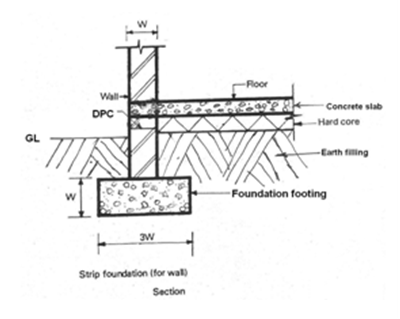 1. Strip foundation: Strip foundations are created by excavating a trench deep enough until clay is reached. The bottom of the trench is covered with at least 150mm thick concrete. Note that if the site is sloppy, one or more steps may be built into the concrete with forms that guides the depth. Once the footings are complete, cavity walls are built up to finished ground level using bricks or blocks. The trench and cavity are back filled up to finished ground level.
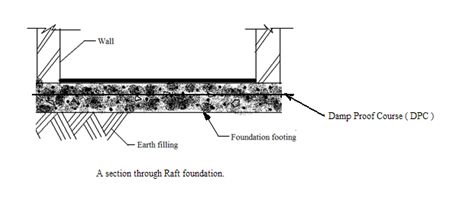
2. Raft foundation: This type of foundation covers an area at least the same size as the base of the building. They are used on soft compressible sub-soil such as soft clay or peat. However, it is important that they are well reinforced to resist the effect of ground movement.
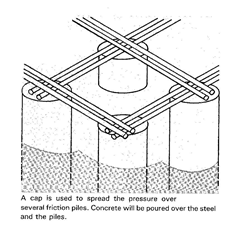
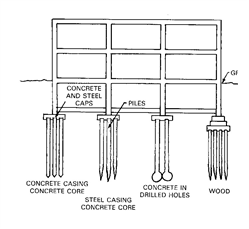
3. Pile foundation: Pile foundation are used to support buildings in subsoil conditions such as shrinkable clays, infill or waste tips, slopes and sites with a high water table in a poorly drained region. A basic pile foundation is a series of stilts or columns which rest on a solid load bearing layer of the soil up to 4m or more below the surface depending on the nature of the soil. Piles are driven into the soil by pile drivers.
4. Pier foundation: Piers transmit the weight of the structure to a bearing surface. They are larger in
diameter than most piles and are of different shapes. They are used to support buildings or utility projects
such as overhead bridges built over large volume of water.
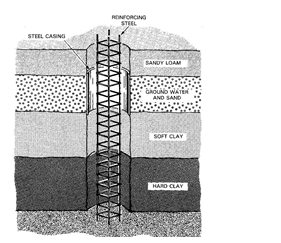
 5. Pad foundation: This type of foundation is mostly used when columns are needed to raise the structure of
the building. They are reinforced with iron mesh and rods as seen in the figure below.
GENERAL EVALUATIONS
1. Mention 4 types of foundation.
2. Advice as a civil engineer the type of foundation suitable in a swampy land.
3. Explain the importance of caps used in pile foundation.
READING ASSIGNMENT
Visit www.google.com for building foundations.
Exploring construction by Richard M. Henak pages 169-173.
WEEKEND ASSIGNMENT
Objective
1. What type of foundation is suitable for building bridges? A. Raft. B. Pad. C. Pile. D. Wide strip.
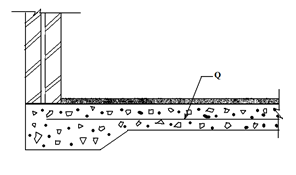 The figure below shows a section through a foundation. Use it to answer Questions 2 and 3.
2. What type of foundation is shown above? A. Stepped. B. Raft. C. Pad. D. Strip.
3. The part labelled Q is called A. reinforcement. B. ground level. C. damp proof course. D. blinding.
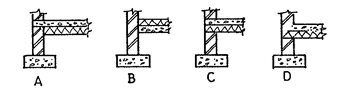
4. Which of the following is the correct sectional representation of a foundation?
5. What type of foundation would you suggest as best for a 3-bedroom bungalow which is to be built on a solid
stony soil? A. Raft. B. Pile. C. Strip. D. Pad.
Theory
1. Draw a fully labelled section through a strip foundation.
2. Differentiate between the following: GL, FL and DPC in a foundation.