Week 2 Belt and chain drive
Difference Between Chain Drive and Belt Drive
• Categorized under Technology | 
Chain Drive vs. Belt Drive
Both a chain drive and a belt dive are part of mechanisms that allow locomotion and a transfer of power within a particular piece of machinery. The usual application of a chain drive and a belt drive is to transfer power or as a method to move objects, like hoisting or conveying. Chain drives and belt drives are often used in many vehicles (like bicycles, motorcycles, and automobiles) as well as other mSechanical applications, including garage doors.
Both chain drives and belt drives are designed as continuous and endless loops that move when the engine is running or in use. The chain drive, as its name implies, is made up of chains with special structures like teeth on one side and a corresponding etch on the other side (drive shafts). The chain drive works when the two sides link together, which encourages the movement of the chain as well as power. The designs and structures also allow the chain to keep and hold it in one place and one direction.
On the other hand, the belt drive is a smooth and wide span of synthetic material. The belt drive itself can be made from rubber, plastic, and other synthetic substances.Each kind of drive has its own set of advantages and disadvantages.
The chain drive is stronger and more durable because it is made of metal. It is also more dependable to use and easier to repair. Moreover, it is easier to change gears in the instance when the chain is broken. However, the chain drive’s downsides include requiring lubrication to run smoothly and seamlessly, and the fact that the chain can get stuck in the links or mangle itself while on the run. Simple chain drives usually contain two gears; the more complicated designs tend to have two or more gears in the design. The additional gears are called “idle gears” and usually don’t contribute to the drive and its overall ratio. The only thing that impacts the gear ratio is the number of teeth in the first and last gears.
Chain drives are usually seen in bikes, motorcycles, and automobiles. They are also used in many industries such as the military (for tanks) and in the mining industry. The classification for a chain drive is as follows: roller chain, double pitch roller chain, silent (inverted tooth) chain, detachable link chain, and engineering steel chain. There are also three types of load classification for chain drives: smooth load, moderate shock load, and heavy shock load.On the other hand, a belt drive is best used for machines and is very useful in inspection for damage or wear. The surface of the belt can more easily show evidence of the mentioned imperfections and can be an indication that purchasing a replacement may be neccesarry. Another advantage of the belt drive is that it requires fewer adjustments and is quieter, cleaner, and runs more smoothly compared to the chain drive. This type of drive doesn’t require lubrication, which can be considered as an added cost to a machine’s maintenance. The bad thing about belt drives is the fact that they often expire earlier compared to the chain drive. Belt drives can also slip or snap if the belt isn’t maintained or at least inspected for signs of damage and wear.
The types of belt drives are diverse. The list of their kinds include flat belts, round belts, vee belts, multi-groove belts, ribbed belt, film belts, metal belts, endless round belts, timing belts, specialty belts, rolling roads, and flying rope.
Summary:
1.Both chain drives and belt drives are methods to transfer power and objects within a machine. The main difference between the two drives is that a chain drive is powered by a chain loop, while a belt drive is powered by a belt.2.Another notable difference is the material of the drive. Chain drives are made of metal, which makes them more durable and stronger compared to a belt. The metal chain is designed to have a design that corresponds to the other side. On the other hand, the belt drive is made of synthetic materials,
ADVANTAGES OF BELT DRIVE
- Belt drives are simple are economical.
- They don’t need parallel shafts.
- Belts drives are provided with overload and jam protection.
- Noise and vibration are damped out. Machinery life is increased because load fluctuations are shock-absorbed.
- They are lubrication-free. They require less maintenance cost.
- Belt drives are highly efficient in use (up to 98%, usually 95%).
- They are very economical when the distance between shafts is very large.
DISADVANTAGES OF BELT DRIVE-
- In Belt drives, angular velocity ratio is not necessarily constant or equal to the ratio of pulley diameters, because of slipping and stretching.
- Heat buildup occurs. Speed is limited to usually 35 meters per second. Power transmission is limited to 370 kilowatts.
- Operating temperatures are usually restricted to –35 to 85°C.
- Some adjustment of center distance or use of an idler pulley is necessary for wearing and stretching of belt drive compensation.
- Belt drives are simple are economical.
- They don’t need parallel shafts.
- Belts drives are provided with overload and jam protection.
- Noise and vibration are damped out. Machinery life is increased because load fluctuations are shock-absorbed.
- They are lubrication-free. They require less maintenance cost.
- Belt drives are highly efficient in use (up to 98%, usually 95%).
- They are very economical when the distance between shafts is very large.
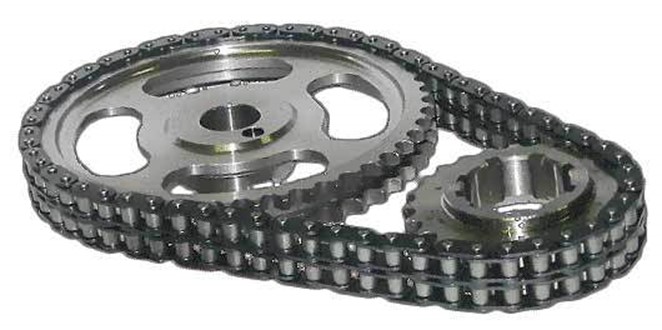
ADVANTAGES OF CHAIN DRIVE-
- • Positive non-slip drives
- • Efficiency is high
- • Employed for small as well as large centre distances up to 8m.
- • Permit high velocity ratio up to 8:1
- • Transmit more power than belt drives
- • They produce less load on shafts compared to belt drives
DISADVANTAGES OF CHAIN DRIVE-
- • Driving and driven shafts should be in perfect alignment.
- • Requires good lubrication
- • High initial cost
GEAR DRIVE→
Gear drives find a very prominent place in mechanical power transmission. Gear drives are preferred when considerable power has to be transmitted over a short distance positively with a constant velocity ratio.
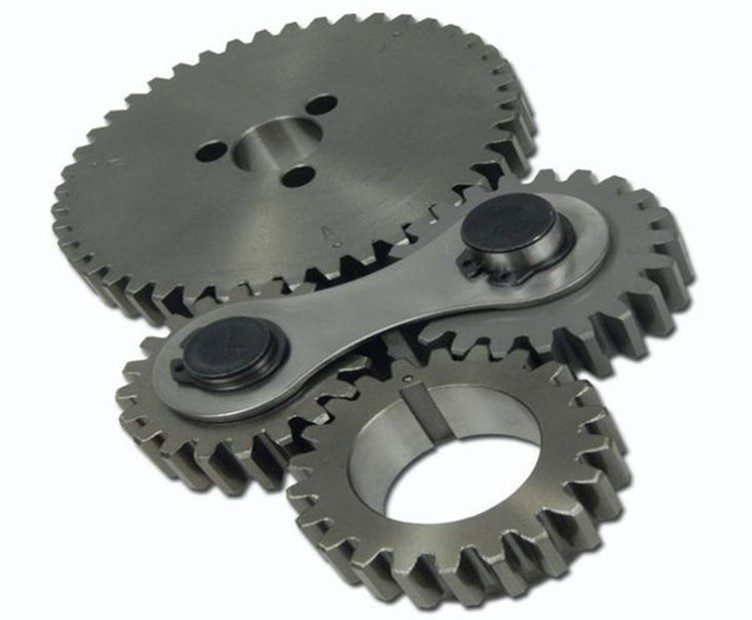
ADVANTAGES OF GEAR DRIVE-
- They are positive non-slip drives.
- Most convenient for very small centre distances.
- By using different types of gears, it will be possible to transmit the power when the axes of the shafts are not only parallel, but even when nonparallel, intersecting, non-intersecting and co- planar or non-coplanar.
- The velocity ratio will remain constant throughout.
- They can be employed conveniently for low, medium and high power transmission.
- Any velocity ratio as high as, even up to 60:1 can be obtained.
- They have very high transmission efficiency.
- Gears can be cast in a wide range of both metallic and non-metallic materials.
- If required gears may be cast integral with the shafts.
- Gears are employed for wide range of applications like in watches, precision measuring instruments, machine tools, gear boxes fitted in automobiles, aero engines, etc.
DISADVANTAGES OF GEAR DRIVE-
- They are not suitable for shafts of very large centre distances.
- They always require some kind of lubrication.
- At very high speeds noise and vibrations will be more.
- They are not economical because of the increased cost of production of precision gears.
- Use of large number of gear wheels in gear trains increases the weight of the mach
Questions
- What are the advantages of using a belt drive over a chain drive?
- Why would you use a belt drive instead of a chain drive?
- Which is more efficient: gear drive or belt drive?What are the advantages of gear drives?What is slip in belt drives?Ask New QuestionAnswered 1d ago
Gear drives are used for short distance power transmission, chain drive and belt drive are used for power transmission in a longer distance. Chain drive is used for power transmission with more efficiency, in belt drive sometimes slip occurs.
The advantage of gear drives is the power transmission with high efficiency means it can transmit almost all the power from driven to driver in very high speed. And its disadvantage is that we can not transmit the power to a longer distance.
In chain drive the basic advantage is that we can transmit the power with good efficiency to a longer distance.
Belt Drive:- It is Type of Power transmission which done through by using belt mounted on two pulley made up of rubber, Cot
Disadvantages:-
1.Slip And Creep Occur
2.Wear of belt
3. Elongation of belt after continuous used
Chain Drive :- It is one of the type of power transmission by means of chain mounted on sprockets.
Advantages:-
1.More Power Transmission
2. No slip and creep occur
3.ast power transmission
Disadvantages:-
1.Lubrication Required
2. Noisy Transmission
3. Complicated
4. Can transmit power upto 500mm
Gear Drive:- It is a type of power transmission by means of two gears mesh to transmit a power from one shaft to another.
Advantages:-
1.Quick Transmission
2. No Slip and creep occur
3. Widely used in Automobile
Disadvantages:-
1.Lubrication Required
2. Wear occur
3. Can transmit power upto 300mm