Jss2 Basic technology 3rd term e-note
| Week 1 revision of last term works |
| Week 2 belt and chain drive |
| Week 3 belt and chain drives (cont) |
| Week 4 Gears |
| Week 5 Gear ratio and speed |
| Week 6 hydraulie and pneumatics machine |
| Week 7 building construction |
| Week 8 setting out |
| Week 9 building service |
| Week10; building project |
| Week11; revision |
| Week12; exam |
Week1 . revision of last term work
vpolygon is a plane figure that is bounded by a finite chain of straight line segments closing in a loop to form a closed polygonal chain or circuit. These segments are called its edges or sides, and the points where two edges meet are the polygon’s vertices (singular: vertex) or corners. The interior of the polygon is sometimes called its body. An n-gon is a polygon with n sides; for example, a triangle is a 3-gon. A polygon is a 2-dimensional example of the more general polytope in any number of dimensions.
The basic geometrical notion of a polygon has been adapted in various ways to suit particular purposes. Mathematicians are often concerned only with the bounding closed polygonal chain and with simple polygons which do not self-intersect, and they often define a polygon accordingly. A polygonal boundary may be allowed to intersect itself, creating star polygons and other self-intersecting polyg
Quadrangles – Four Sides
Four-sided polygons, or quadrangles, include squares, rectangles and rhombuses depending on the lengths of their sides and the angles between their sides.
The internal angles of all quadrangles add up to 360°.


Squares, rectangles and rhombuses are all types of parallelograms: they have opposite sides that are equal in length and opposite and equal angles.

More than Four Sides
A five-sided shape is called a pentagon.
A six-sided shape is a hexagon, a seven-sided shape a heptagon, while an octagon has eight sides…
There are names for many different types of polygons, and usually the number of sides is more important than the name of the shape.
There are two main types of polygon – regular and irregular.
A regular polygon has equal length sides with equal angles between each side. Any other polygon is an irregular polygon, which by definition has unequal length sides and unequal angles between sides.
Circles and shapes that include curves are not polygons – a polygon, by definition, is made up of straight lines. See our pages on circles and curved shapes for more.



Angles Between Sides
The angles between the sides of shapes are important when defining and working with polygons. Angles.here is a useful formula for finding out the total (or sum) of internal angles for any polygon, that is:
(number of sides – 2) × 180°

Example:
For a pentagon (a five-sided shape) the calculation would be:
5 – 2 = 3
3 × 180 = 540°.
The sum of internal angles for any (not complex) pentagon is 540°.
Furthermore, if the shape is a regular polygon (all angles and length of sides are equal) then you can simply divide your answer, from above,with the number of sides to find each internal angle.
540 ÷ 5 = 108°.
A regular pentagon therefore has five angles each equal to 108°.

The Length of the Sides
As well as the number of sides and the angles between sides, the length of each side of shapes is also important.
The length of the sides of a plane shape enables you to calculate the shape’s perimeter (the distance around the outside of the shape) and area (the amount of space inside the shape).
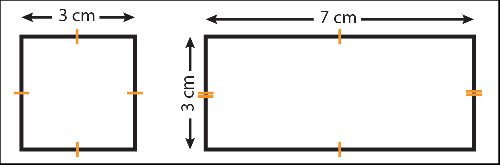
If your shape is a regular polygon (such as a square in the example above) then it is only necessary to measure one side as, by definition, the other sides of a regular polygon are the same length. It is common to use tick marks to show that all sides are an equal length.
In the example of the rectangle we needed to measure two sides – the two unmeasured sides are equal to the two measured sides.
It is common for some dimensions not to be shown for more complex shapes. In such cases missing dimensions can be calculated.
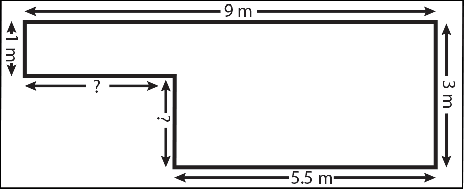
In the example above, two lengths are missing.
The missing horizontal length can be calculated. Take the shorter horizontal known length from the longer horizontal known length.
9m – 5.5m = 3.5m.
The same principle can be used to work out the missing vertical length. That is:
3m – 1m = 2m.

Bringing All the Information Together: Calculating the Area of Polygons
The simplest and most basic polygon for the purposes of calculating area is the quadrangle. To obtain the area, you simply multiple length by vertical height.
For rhombuses, note that vertical height is NOT the length of the sloping side, but the vertical distance between the two horizontal lines.
This is because a rhombus is essentially a rectangle with a triangle cut off one end and pasted onto the other:
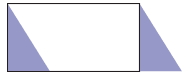
You can see that if you remove the left hand blue triangle, and stick it onto the other end, the rectangle becomes a rhombus.
The area is length (the top horizontal line) multiplied by height, the vertical distance between the two horizontal lines.
To work out the area of a triangle, you multiple length by vertical height (that is, the vertical height from the bottom line to the top point), and halve it. This is essentially because a triangle is half a rectangle.
To calculate the area of any regular polygon, the easiest way is to divide it into triangles, and use the formula for the area of a triangle.
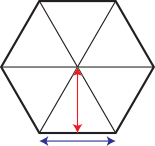
So, for a hexagon, for example:
You can see from the diagram that there are six triangles.
QUESTIONS
1.Define polygon
2.draw pentagon [AB 50MM]