WEEK FOUR DATE:………………
Topic: Plain scales and their uses
Content:
(i) Meaning of plane scale.
(ii) Construction of plane scales.
Meaning of plane scale
A scale is used to measure or lay out a line on a drawing in full size, or larger or smaller than full size. The term scale also refers to the ratio of the size of a drawing to the actual object. This ratio or fraction is called the Representative Fraction of a scale.
Representative fraction (RF) = distance or size drawn
distance or size represented
The representative fractions of the most commonly used scales are as follows:
1:1{full size}
1:2{half full size}
1:5{one-fifth full size}
1:10{one-tenth full size}
2:1{twice full size}
5:1{five times full size}
The most commonly used scales are plain and diagonalscxles
Plain scale: A plain scale has two units of measurement. They are metres and decimetres. Scales such as 1:2, 1:5, and 1:100 can be used direct from a standard scale rule. Other scales, for example, 1:21/2, would need to be constructed
Evaluation Questions
 1. Define representative fraction.
2. What is a plain scale?
Construction of plain scale.
To construct a plain scale of 1: 21/2 to show a maximum of 400mm and a minimum of 10mm.
Method:
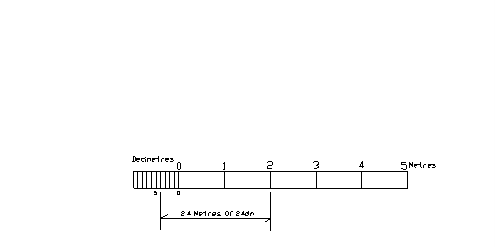 (i) Workout the total or maximum length of the scale. 1: 21/2 x 400mm = 160mm
(ii) Draw a line 160mm long and divide it into four (4) equal parts of 40mm units each. (iii) The height of the scale can be any convenient height.
(iv) Divide the first part (40mm) into 10 equal parts.
(v) Print the scale ratio and number the divisions.
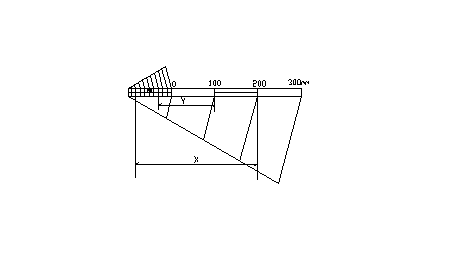
Note: the scale is used by taking hundreds to the right of zero and tens to the left. It is best to use
dividers to mark sizes from the scale. The values of X and Y are respectively 280mm and 130mm.
To construct a scale of 2cm equals 1metre to read up to 6m in decimeter
Method:
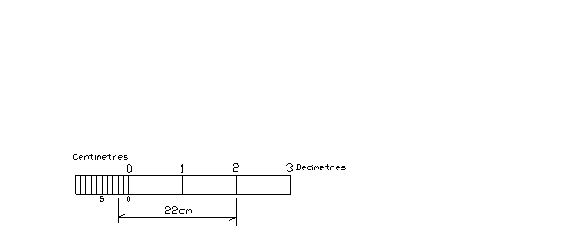 Every 2cm drawn is equal to 1m (100cm) of the actual object. Therefore scale ratio = 2 : 100 or 1 : 50
(i) Calculate the total length of the scale rule : If every 2cm on the scale rule is
equivalent to 1m, therefore a scale rule that could read up to 6m will have
a total length equal to (2 x 6) cm i.e. 12cm or 120mm.( 2/100 x 600) = 12cm = 120mm.
(ii) Draw a line 120mm long and divide it into 6 equal parts of 20mm units each.
(iii) The height of the scale rule could be any convenient length
(iv) Divide the first unit into 10 equal parts.
To construct a scale of 3cm Equals 1dm (10cm) to read up to 4dm in centimeters.
Method:
Every 3cm drawn is equal to 1dm (10cm) of the actual object. Therefore, scale ratio = 3 : 10 or 1 : 31/3
(i) Calculate the total length of the scale rule : If every 3cm on the scale rule is equivalent to 1dm,
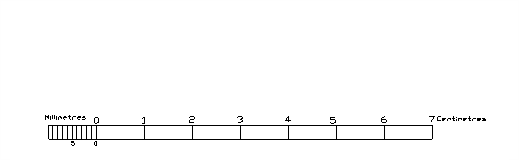 therefore a scale rule that could read up to 4dm will have a total length equal to (3 x 4) cm i.e. 12cm
or 120mm.( 3/10 x 40 ) = 12cm = 120mm
(ii) Draw a line 120mm long and divide it into 4 equal parts of 30mm units each.
(iii)The height of the scale rule could be any convenient length
(iv)Divide the first unit into 10 equal parts.
To construct a scale of 11/2 times full size to read up to 8cm in millimeters
Method:
Scale ratio = 11/2 x 1 (full size = 1:1)
(i) Draw a line of length equal to (11/2x 8) cm i.e 12cm or 120mm and divide it into 8 equal parts.
(ii) The height of the scale rule could be any convenient length.
(iii) Divide the first unit into 10 equal parts.
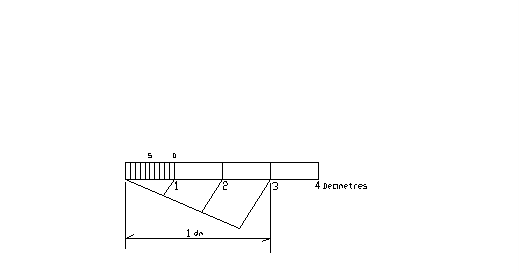
To construct a scale of 1/3 to read up to 4dm in centimeters.
Method:
1/3 in this case, means to divide 1dm into three equal parts.
(i) Draw a line 1dm long and divide it into 3 equal parts, each of which will represent 1dm on the scale.
(ii) Step off one of these parts to give the required 4dm
(iii) The height of the scale rule could be any convenient length.
(iv) Divide the first unit into 10 equal parts.
General valuation/revision Questions
1. Define representative fraction.
2. Construct a scale of 4cm equals 2dm to read up to 5dm in centimeters.
3. Construct a scale of 21/2 times full size to read up to 6cm in millimeters
4. Construct a scale of 1/4 to read up to 7dm in centimeters.
5. The length of a piece of land is 6.50km. If the land is measured on a scale of 1:500, what will be the
reading in mm on the scale rule?
6. Construct a scale of 20cm equals 1m to read up to 6m in millimeters. Use the scale
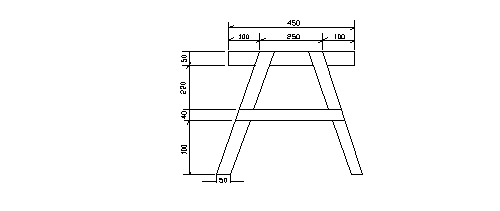 to draw the figure shown below.
Reading assignment
Technical drawing for school certificate and G.C.E by J.N Green Page 36-37
 Weekend Assignment
Objective
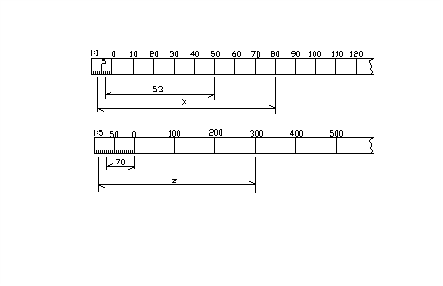
1. What are the readings on the following scale rule marked X and Z ?A. 87 mm and 390 mm
B. 86 mm and 380mm C. 85 mm and 370 mm.D. 68mm and 290mm.
2. What is the length of a line 3m long on a scale of 1:50. A. 25mm B. 60mm C. 45mm. D. 52mm.
3. How many units of measurement has a plain scale? A. 3 B. 2 C. 5 D. 4
4. The rulers in your mathematical set were constructed to measure to a scale ratio of A. 1:2
B. 1: 1 C. 2:3 D. 1:5
 5. Which of the following is not an enlargement scale? A. 5: 3 B 3: 4 C. 2:1 D. 3:2.
Theory
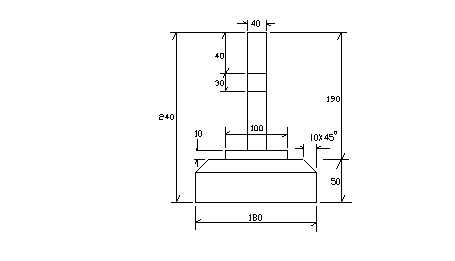
1. Draw the diagram below to a scale of 1:2.
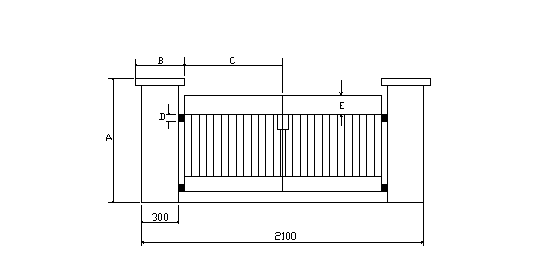 2. The only measurements available on the drawing of an ornamental gate shown below
are 2100mm and 300mm sizes. Find the scale of the drawing and measure the other
sizes; A, B, C, D and E. (Hints: R.F = drawn/ actual size)