WEEK THREE DATE:………………
Topic:Polygons and irregular figures
Content:
(i) Meaning and types of polygon.
(ii) Construction of polygons.
Meaning and types of polygon
Polygons could be defined as plane figures whose interior and exterior angles add up to
[(n – 2) x 180]0 and [4 right angles ]0 respectively. ( n is the number of sides of the polygon). Polygons could either be regular or irregular. Regular polygons have equal sides and angles. Examples include equilateral triangle, square, etc. Irregular polygons do not have all the sides and angles equal. An example of irregular polygon is re-entrant polygon which has one of its interior angles greater than 1800. See diagrams below for further illustration.


Polygons are named based on the number of sides they have. A polygon with three sides is called triangle, four sides is quadrilateral, pentagon 5, hexagon 6, heptagon 7, octagon 8, nonagon 9 and decagon 10 sides. These could either be regular or irregular.
Evaluation Questions
1. Define a polygon. Give examples.
2. With the aid of suitable diagrams, state three types of polygon.
Construction of polygons.
There are two methods of constructing polygons and these include (i) Exterior angle method. (ii) Circumscribing circle method. In the external angle method, the number of sides, N of the required polygon is used to divide 3600 in order to determine the exterior angle to which that particular polygon is to be drawn. For instance, a regular pentagon with 5 sides will have its sides drawn to an exterior angle of 720
Similarly, a regular hexagon with six sides will have its exterior angle drawn at 600, heptagon 520, octagon 450, nonagon 400 etc.
The circumscribing circle method has the polygon enclosed in a circle of known diameter.
 To construct a regular pentagon using the exterior angle method.
Method:
(i) Divide 3600 by the number of sides N which in this case is 5 to obtain an exterior angle of 720.
(ii) Draw a line AB equal to the length of one side of the regular pentagon.
(iii)With a protractor at point A, measure in a clockwise direction angle 720. Draw the line AQ and mark
off the given length on it to obtain point D.
(iv) Repeat same for point B in an anti-clockwise direction to obtain point C.
(v) Repeat the same for points C and D to obtain point E. ABCDE is the required pentagon.
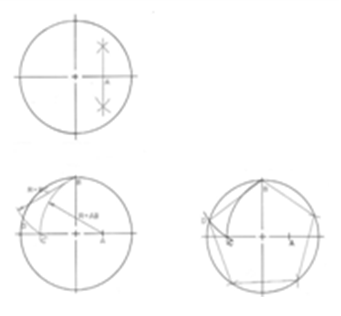 To construct a regular pentagon using the circumscribing circle method.
Method:
(i) Draw the given circle that will
circumscribe the pentagon.
(ii) Bisect the radius to locate point A.
(iii)With A as centre and radius AB, swingan
arc to cut the horizontal diameter line at point C.
(iv)With B as centre and radius BC, swing an arc
to cut the circle at point D.
(v) Join DB which is the length of one side of the pentagon.
(vi)Step- off the length DB round the circle to obtain the remaining sides of the pentagon.
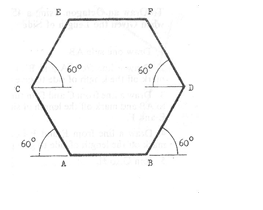 To construct a regular hexagon using the exterior angle method when given the length of one side.
Method:
(i) Determine the size of the exterior angle by dividing 3600 by 6 (hexagon) which gives 600.
(ii) Draw a line AB equal in length to the given side.
(iii)Using 600 setsquare or protractor, draw lines AC, BD, CE, DF and EF of equal length with AB to
complete the hexagon.
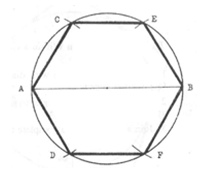 To construct a regular hexagon when given the distance across corners using circumscribing circle method.
Method:
(i) Draw a circle of radius equal to the given length of side.
(ii) Draw a horizontal diameter AB.
(iii)With A and B in turn as centre and radius equal to the radius of the circle, swing arcs C and D and
arcs E and F respectively.
(iv)Join AC, AD, BE, and BF to complete the hexagon.
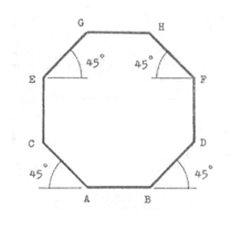 To construct a regular octagon when given the length of side using the exterior angle method.
Method:
(i) Determine the size of the exterior angle thus: .
(ii) Draw a line AB equal to the length of one side of the regular octagon.
(iii) Draw a line from A and B in turn at 450 and mark off the given length of side on each to give points
C and D.
(iv) Draw a line from C and D in turn perpendicular to AB and mark off the given length of side on each
line to give points E and F.
(v) Draw a line from E and F in turn at 450 and mark off the given length of side on each line to obtain
points G and H.
(iv)Join GH to complete the required octagon.
 To construct a regular octagon using the circumscribing circle method when given the distance across flats.
Method:
(i) Draw a circle of diameter equal to the distance across flats.
(ii) Draw centre lines (vertical and horizontal).
(iii)Draw horizontal lines on each side of the circle tangent to the circle at the vertical centre line.
(iv)Draw vertical lines on each side of the circle tangent to the circle at the horizontal centre line.
(v) Complete the octagon by drawing the remaining four lines tangential to the circle and in a way that they intersect the horizontal and vertical lines previously drawn.
 To construct a regular octagon by bisecting the four quadrants when given distance across corners.
Method:
(i) Draw the circle of diameter equal to the given distance across corners.
(ii) Draw the horizontal and vertical diameters respectively AB and CD to obtain the four quadrants.
(iii)Bisect each of the quadrants to obtain points 1, 2, 3 and 4 on the circumference of the circle.
(iv)Join all the points to complete the octagon.
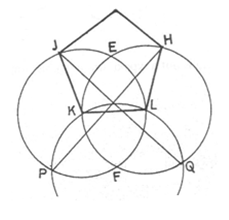
 To construct any polygon when given the diagonals e.g a regular pentagon.
Method:
(i) Draw a line AB of any length.
(ii) Mark any point C on the line and construct a semi-circle of convenient radius at this point.
(iii) Divide the semi-circle by trial method into the same number of equal parts depending on the
number of sides of the required polygon.
(iv) Radiate lines from point C through point 2, 3 and 4. Note that the first line must always be drawn
through the second division.
(v) Draw CE and CF equal to the given diagonals.
(vi) Bisect CE and CF and their bisectors intersect at point G.
(vii)With G ascentre and radius CG, draw a circle which cuts lines CP, CQ, CR, and CB at points H, E,
F, and J respectively. Join HE, EF and FJ to complete the regular pentagon.
GENERAL METHODS OF CONSTRUCTING POLYGONS
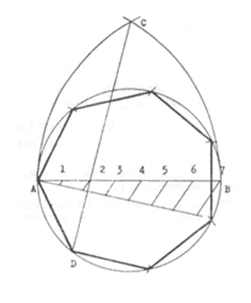 To construct a regular heptagon when given the distance across corners.
Method:
(i) Draw the circle using the given distance across corners, (d/c). Divide the horizontal diameter AB intoequal number of sides of the polygon you are required to construct. In this case, divide it into 7 equalparts.
(ii) With points A and B in turn as centre and radius AB, draw arcs to intersect at point C.
(iii) Draw a line from point C through the second division to touch the circle at point D.
(iv) Join AD which represents one side of the heptagon.
(v) Step off the length AD round the circumference of the circle to obtain the remaining sides.
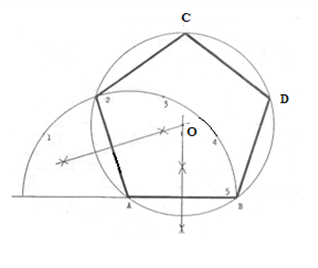
To construct any polygon when given the length of side.
Method:
(i) Draw one side AB and extend it to the left.
(ii) With A as centre and radius AB, draw a
semi-circle and divide it by trial into as many
equal parts astherequired polygon has.
(iii) Join A-2 which is the second division on the semi-circle.
(iv) Draw the bisectors of AB and A-2 and these bisectors intersect at point O.
(v) With O as centre and radius equal to OA or OB, draw a circle.
(vi) Mark-off the length AB or AD round the circumference of the circle to get points C and D.
Join 2C andCD to obtain the required polygon.
 To construct a number of polygons on a given base.(two– triangle method)
Method:
(i) Draw a line AB equal in length to the given base.
(ii) Draw the perpendicular bisector of line AB ie line C-C.
(iii)Construct two triangles with base angles of 450 and 600
on line AB. The apices of these triangles marked
4 and 6 are respectively the centers that will circumscribe
a regular polygon with four and six sides oflength AB respectively.
(iv)Bisect the distance between 4 and 6 to obtain point 5 which is the
centre for the circle that will circumscribe a regular polygon with five sides of length AB.
(v) Step off the distance between 4 and 5 or 5 and 6 along the bisector C-C to obtain centers for circles
thatwill circumscribe a heptagon, octagon, nonagon etc.
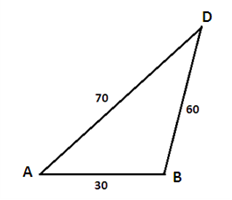 Evaluation Questions
1. In the diagram shown above, AD and BD are the two diagonals of a pentagon ABCDE whose
sides are BC= 40, CD = 35, DE = 55 and angle DEA = 900. (i) construct the pentagon.
(ii) state the length AE of the pentagon.
2. On the same base of length 30mm, construct the following regular polygons; square, pentagon,
hexagon, heptagon, octagon, nonagon and decagon.
3. Construct a nonagon when given the distance across corners A/C = 40mm. Use a general method.
4. An irregular hexagon ABCDEF has the following dimensions. AB = 51, BC = 30, CD = 23,
DE = 36 EF = 30, AD = 70, AF = 38, < FAB = 1100, < ABC = 880. Use the information above to
constructthehexagon.
General evaluation/ revisional questions
- On the same base of length 40mm, construct the following regular polygons; square, pentagon, hexagon, heptagon, octagon, nonagon and decagon.
- Determine graphically the circumference of a circle, diameter 35mm.
- Construct a pentagon when given a diagonal of 70mm.
Reading assignment
Technical drawing by JN Green. Pages 28-33,38,63.
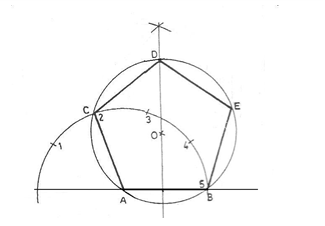 Weekend Assignment
Objective
1. The figure above shows a general method of constructing a regular polygon when given the
A. numberof sides. B. diagonal. C. diameter. D. length of sides.
2. Which of the following is required to construct the polygon below? A. Distance across flats.
 B. Distance across corners. C. Internal angle. D. Length of one side.
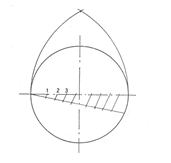 3. The figure below shows the beginning of the construction of a/an A. cylinder. B. triangle.
C. regularpolygon. D. circle.
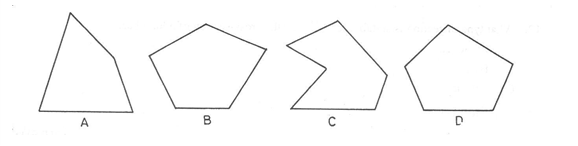 4. Which of the following polygons shown below is refered to as re-entrant polygon?
5. Which of the following will be produced by completing the construction below? A. Hexagon.
B. Octagon. C. Pentagon. D. Decagon.

Theory
1. In the diagram shown below, AD and BD are the two diagonals of a pentagon ABCDE whose
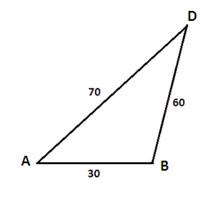 sides are BC= 40, CD = 35, DE = 55 and angle DEA = 900. (i) construct the pentagon.
(ii) state the length AE of the pentagon.
2. An irregular hexagon ABCDEF has the following dimensions. AB = 51, BC = 30, CD = 23,
DE = 36EF = 30, AD = 70, AF = 38, < FAB = 1100, < ABC = 880. Use the information above to
construct thehexagon.