WEEK NINE
TOPIC:
Electric Field – Line of Forces, Properties of Line of Force, Description and Properties of Force Field
CONTENT
- Electric Field
- Line of Force and properties
- Electric Field
Electric field is defined as any region where a charge experiences a force of electrical origin. There are two types of charges namely : positive and negative charges.
Lines of Force
An electric field has been defined as a region where an electric force is experienced. Electric fields can be mapped out by electrostatic lines of force. An electrostatic line of force may be defined as a line whose tangent is in the direction of the force on small positive charge at that point. Arrows on the lines of force show the direction of the force on a positive charge. The force on a negative charge is in the opposite direction.
Since the direction of a field varies from point to point, lines of force are usually curves.
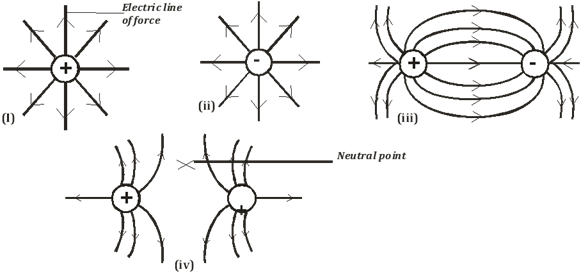


Fig 4.1: Lines of Electrostatic force
(i) Isolated positive charge (ii) Isolated negative charge
(iii) Unlike charges – positive and negative charges (iv) like charges – positive and positive charges
Properties of Lines of Force
1. Lines of force never intersect.
2. Lines of force are usually curves, as the direction of a field varies from point to point.
3. In a uniform field, the lines of force are straight, parallel and uniformly spaced.
4. No lines of force originate or terminate in the space surrounding a charge.
5. Every lines of force in an electrostatic field is a continuous line terminated by a positive charge at one end and a negative charge at the other end.
Coloumb’s Law states that the force experience by two charges Q1Q2 separated by a distance r is directly proportional to their product of their charges and inversely proportional to the square of their distance apart. It is also known as inverse square law.
 Q1 Q2
Q1 Q2
F α Q1Q2
Fα 1/r2
 F α Q1Q2
r²
 F = K Q1Q2 __________ (i)
r²
K = 9 x 10⁹ Nm² C-2 ⁄ f/m
K = 1
 4ΩЄ0
4ΩЄ0
(Permitivity of Free Space vacuum)
EVALUATION
- State four properties of line of force.
- State coulomb’s law.
- Electric Field Intensity (E)
It is simply the force per unit charge. It is a vector quantity and measured in
E = F/Q _________ (iii) - Electric Field Potential (V)
It is the work done in moving a unit positive charge from it point of infinity to a point in the field. It can also be defined as work done per unit charge, it is a scalar quantity and measured in joules per coloumb or volt.
V = W
Q
- Flux Density D.
It is denoted by D. It is simply charge by unit area. It is measured in Cm-2/ Clm²
D = Q
 A
AEVALUATION
 A
A- Define A. electric field intensity B. electric field potential
- Differentiate between electric potential and electric potential energy
Reading Assignment
New School Physics pg 72 & 73WEEKEND ASSIGNMENT
- The SI unit of flux density is A. Cm2 B. Cm C. Cm-2 D. C
- Electric potential is a scalar quantity A. true B. false C. cannot say D. none of the above
- Electric field intensity is a scalar quantity A. true B. false C. cannot say D. none of the above
- The SI unit of electric potential energy is ………. A. volt B. Joules per coulomb
C. Joules D. Cm2
- Line of force are maginary A. true B. false C. cannot say D. none of the above
THEORY
- The force acting on an electron carrying a charge of 1.6X10⁻¹⁹ C in an electric field of intensity 5X10⁸ Vm-1.
- 1f 20MJ of work is done in moving a 5µC of charge between two points in an electric field, the potential difference between the two points is?