WEEK EIGHT
WAVES
- Production of waves
- Propagation of waves
WAVES
A wave is a disturbance which travels through a medium transferring energy from one point to another without causing any permanent displacement of the medium
A wave motion is process of transferring a disturbance from one point to another without any transfer of particles of the medium.
Types of waves
Waves are broadly classified into two types
- Based on the medium of propagation: mechanical wave and electromagnetic wave
- Based on the comparison of the wave direction with the direction of vibration of the particle: transverse
wave and longitudinal
wave
Production and Propagation of waves: Based on the medium of propagation
- Production and propagation of mechanical waves
A mechanical wave is the wave that requires material medium for its mode of propagation (or for it to transfer energy away from the source). Examples are waves travelling through springs, water waves, and sound waves
- Production and propagation of electromagnetic waves
Electromagnetic waves are waves that do not need material medium for its mode of propagation (or for it to transfer energy away from the source). Examples are radio waves, visible light, ultra-violet rays, x-rays, gamma rays. Electromagnetic waves travels at the speed of light (3.0×10⁸m).
A wave which travels along a medium transferring energy from one part of the medium to another is called a progressive wave. The progressive wave can be divided into transverse and longitudinal waves
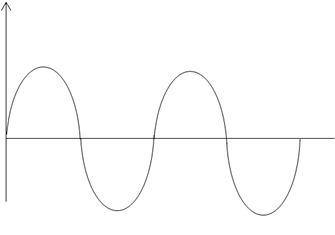
y
Direction of wave motion

Progressive or travelling wave
A standing or stationary wave: this is formed when two waves travelling in the opposite direction meets or by superimposition of incident wave and its reflection. The amplitude of the standing wave varies along the wave.
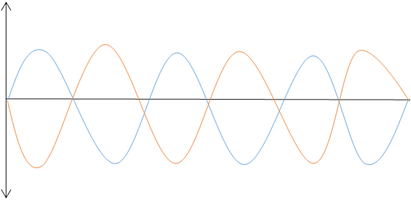
Incident wave reflected wave
Standing or stationary wave
Production and Propagation of waves: Based on the comparison of the wave direction with the direction of vibration of the particle
- Transverse waves
A transverse wave is a wave in which travel perpendicularly to the direction of the vibrations producing the waves.
- Longitudinal wave
Longitudinal waves are waves which travel in a direction parallel to the vibrations of the medium.
TERMS USED IN DESCRIBING WAVES
- Phase
– particles which are at the same vertical direction from their positions of rest and are moving in the same direction are said to be in phase. - Cycle – is a complete to-and-fro movement or oscillation of a vibrating particle
- The amplitude (A) – is the maximum displacement of a particle from its rest or mean position. It is measured in meter (m).
- The period (T) – is the time required for a particle to perform one complete cycle or oscillation
—1
—2 - Frequency (f) – is the number of complete cycles made in one seconds. It is measured in Hertz (Hz)
- Wavelength (λ) – is the distance covered by the waves after one complete oscillation. For transverse waves, it is the distance between successive crests or troughs while for longitudinal wave, it is the distance between successive compressions or rarefactions. It is measured in meter (m).
- Wave-velocity (v) is the distance traveled by the waves in one second. The S.I unit is m/s
Displacement
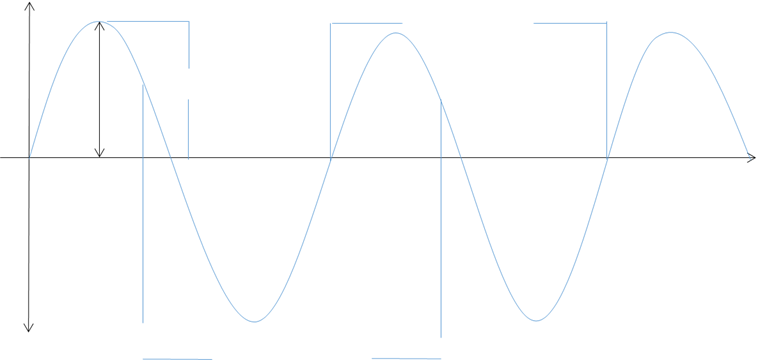
Crest complete oscillation or one cycle
Amplitude
Distance(x)
Trough
One wavelength
MATHEMATICAL RELATIONSHIP
—3
—4
From equation 1,
We have:
—5
—6
—7
Worked example
A radio station broadcasts at frequency of 300 KHz. If the speed of the wave is 3 x 10⁸ ms-1, calculate the period and wavelength of the wave?
Mathematical representation of wave motion – Progressive wave
The general equation for stationary wave is given by:
—8
Where
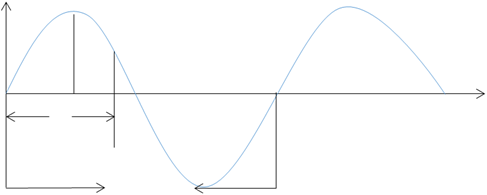
A
P
O Φ π 2π t
x
λ
Considering O and P that are out of phase by Φ, then we have
—8
Where:
—9
—10
But
—11
Substituting equation 11 into equation 8 gives:
—12
—13
Also from equation 12, putting we can have
—14
Recall that
Thus, equation 12 can be re-written as:
—15
Example: A plane progressive wave is given by the equation
Calculate: (i) The wavelength of the wave (ii) The speed (iii) The frequency (iv) The period
Solution:
By comparing the given equation with the standard equation
We have for:
(i) The wavelength of the wave
2ft=2000t
f=1000Hz
(ii) The speed
λ=2π×2
λ=12.57m
(iii) The frequency
v=f λ
v=1000 × 12.57
v=12570m/s
(iv) The period
t=10-3s-1
CLASSWORK 8
- What is wave?
- Elias radio station broadcasts at a frequency of 21MHz. If the speed of light in the air 3×10⁸ms-1, calculate the wavelength of the broadcast.
- Define stationary wave
ASSIGNMENT 8
SECTION A
- An electromagnetic radiation has a speed of 3×10⁸ms-1 and a frequency of 106Hz, calculate its wavelength (a) 3.3×10³m (b) 3.0×10²m (c) 3.0×10⁻²m (d) 3.3×10⁸m (e) 3.3×10⁻³m
- A body oscillates in simple harmonic motion according to the equation where x is expressed in meters. What does 0.05 represents? (a) velocity (b) frequency (c) period (d) amplitude (e) none of the above
- Which of the following is not a mechanical wave (a) wave propagated in stretched string (b) waves in a closed pipe (c) radio waves (d) water waves (e) sound waves
- The maximum displacement of particles of wave from their equilibrium positions is called (a) wave velocity (b) period (c) amplitude (d) wavelength (e) frequency
- D(cm)

0 0.05 0.10 0.15 0.20 0.25 t(s)
The diagram above represents the displacement D versus t graph of a progressive wave. Deduce the frequency of the wave
(a) 20Hz (b) 10 Hz (c) 5 Hz (d) 4 Hz (e) 50 Hz
SECTION B
- (a) What is wave motion?
(b) The equation represents a wave train in which y is the vertical displacement of a particle at a distance x from the origin in the medium through which the wave travelling. Explain, with the aid of a diagram, what A and λ represents.
- A radio waves transmitted from a certain radio station is represented by the wave equation:
Calculate the (i) wavelength of the wave (ii) frequency of the wave (ii) velocity of the wave. Where x, y are in meters while t is in seconds