Week 7. Basic electricity
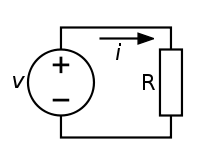
An electric circuit is a path in which electrons from a voltage or current source flow.
Components of electric circuit
The three basic principles for this lesson can be explained using electrons, or more specifically, the charge they create:
Voltage is the difference in charge between two points.
Current is the rate at which charge is flowing.
Resistance is a material’s tendency to resist the flow of charge (current).
An electronic
circuit is composed of individual electronic
components, such as resistors, transistors, capacitors, inductors and diodes, connected by conductive wires or traces through which electric current can flow.
An electric current is a flow of electric charge. In electric circuits this charge is often carried by moving electrons in a wire.
Definition
Ohm’s Law
Ohm’s Law is the mathematical relationship among electric current, resistance, and voltage. The principle is named after the German scientist Georg Simon Ohm.
In directyt-current (DC) circuits, Ohm’s Law is simple and linear. Suppose a resistance having a value of R ohms carries a current of I amperes. Then the voltage across the resistor is equal to the product IR. There are two corollaries. If a DC power source providing E volts is placed across a resistance of R ohms, then the current through the resistance is equal to E/R amperes. Also, in a DC circuit, if E volts appear across a component that carries I amperes, then the resistance of that component is equal to E/I ohms.
Mathematically, Ohm’s Law for DC circuits can be stated as three equations:
E = IR
I = E/R
R = E/I
Type of current Electric current has two types: alternating current, or AC, and direct current, or DC. Both types have their own specific uses in terms of power generation and use, although AC is the more common type in home use. The difference is that direct current only flows in one direction, while alternating current switches directions rapidly. Electricity
Electricity is a result of the movement of electrons. In all substances, the negatively charged electrons in atoms move around randomly. When the electrons begin to flow in a particular direction within a substance, or from one object to another, the result is electricity. The movement of electrons can be harnessed for energy. Electron movements occur when two objects are rubbed together and electrons are transferred from one to another, which is static electricity. When electrons flow in a current, such as through through a conductor like copper wire, the electricity is called electric current.
Current
Electric current is the flow of electrons, but electrons do not jump directly from the origin point of the current to the destination. Instead, each electron moves a short distance to the next atom, transferring its energy to an electron in that new atom, which jumps to another atom, and so on.The individual electrons do not move quickly, but the current itself moves at the speed of light. Current flow heats up the conductor. This mechanic produces light in lightbulbs and heat in electric stovetops.
Direct Current
Direct current is electric current that only flows in one direction. A common place to find direct current is in batteries. A battery is first charged using direct current that is then transformed into chemical energy. When the battery is in use, it turns the chemical energy back into electricity in the form of direct current. Batteries need direct current to charge up, and will only produce direct current.
Alternating Current
Alternating current, as the name implies, alternates in direction. Alternating current is used for the production and transportation of electricity. This is because when electricity is produced in large scale, such as in a power plant, it has dangerously high voltage. It is easier and cheaper to downgrade this current to lower voltage for home use when the current is AC. However, there Westinghouse successfully lit the 1893 Chicago World’s Fair using AC. Since then, alternating current powers homes and anything else that draws on the current in power lines.
1.define transformer
2,what is the function of stablizers