WEEK SEVEN
REVISION AND MID TERM EXAMINATION
WEEK 8
OPERATIONS IN ALGEBRAIC FRACTIONS
- Simplify
=
- Simplify
=
Factorize each term to obtain
Change to x and then invert to obtain
But x – y = -1(y – x)
= – (2x + y) = -2x – y
WRAP UP AND ASSESSMENT
You can simplify fractions by adding, subtracting, multiplying or dividing them. To simplify a fraction means to reduce it to its lowest term. To do this, factorize both the numerator and denominator fully.
Then cancel the common factors.
Simplify
Ii. iii.
 iv. v.
TICKET OUT
i. if = x, evaluate
ii.
iii. if x:y = 12:5 evaluate
WEEK 9
LOGIC
A Proposition is a statement or sentence that either true or false but not both. A simple statement or proposition is a statement containing no connectives. In other words a proposition is considered simple. If it cannot be broken up into sub-propositions.
On the other hand, a compound proposition is made up of two or more propositions joined by the connectives. These connectives are and, or, if ….. Then, if and only if. They are also called logic operators.
Logic operator symbol
And ^
Or ˅
 If…..then
If and only if ⇔
not
IF P AND Q ARE TWO STATEMENTS (OR PROPOTIONS) THEN {CONDITIONAL STATEMENTS AND INDIRECT PROOFS}
- The statement p ^ q is called the conjunction of p ^ q. This, p ^ q means p and q.
- The statement p v is called the disjunction of p and q. This, p v q means either p or q or both p and q.
 The statement p is called the conditional of p and q. a conditional is also known as implication p q means if p then q or p implies q.
 The converse of the conditional statement if p then q is the conditional statement if q then p, (ie) the converse of p q is q p.
- The inverse of the conditional statement if p then q is the conditional statement if not p then not q. i.e. The inverse of p q is
p q  The contra positive of the conditional statement if p then q is the conditional statement if not q then not p. i.e the contra positive of p q is q p.
- The statement p ⇔ q is called the bi conditional of p and q, where the symbol ⇔ means if and only if (or if for short). This, p⇔q means p q means p q and q p
- The statement
p is known as the negation of p Thus
p means not p or “it is false that p ……’ or “it is not true that p…’ - When a compound proposition is always true for every combination of values of its constituent statements. It is called a TAUTOLOGY. On the other hand, when the compound proposition is always false it is called a CONTRADICTION.

 The statement p is called the conditional of p and q. a conditional is also known as implication p q means if p then q or p implies q.
 The converse of the conditional statement if p then q is the conditional statement if q then p, (ie) the converse of p q is q p.
 The inverse of the conditional statement if p then q is the conditional statement if not p then not q. i.e. The inverse of p q is
 The contra positive of the conditional statement if p then q is the conditional statement if not q then not p. i.e the contra positive of p q is q p.

 The statement p ⇔ q is called the bi conditional of p and q, where the symbol ⇔ means if and only if (or if for short). This, p⇔q means p q means p q and q p
 THE TRUTH TABLES
The Truth or falsify of a proposition is its truth values. A proposition that is true has a truth value T and a proposition that is false has a truth value of F.
| CONJUCTION | DISJUNCTION | CONDITIONAL |
| P q p ^ q | P q p v q |  P q p q P q p q |
| T T T | T T T | T T T |
| T F F | T F T | T F F |
| F T F | F T T | F T T |
| F F F | F F F | F F T |
| P ^ Q is true when both p and q are true | P v q is false when both p and q are false |  P is false when p is T & q is F P is false when p is T & q is F |
| BICONDITIONAL | NEGATION |
| P q p ⇔ q | P P |
| T T T | T F |
| F T F | F T |
| F F T |   Recall that other symbols used instead of are pI or p p Recall that other symbols used instead of are pI or p p |
| P ⇔ q is true when both p and q are either both true and both false. |
ASSOCIATED TERMS IN ALGEBRA OF SETS AND ALGEBRA OF PROPOSITIONS
The structure of algebra of sets and the algebra of propositions look the same. The associated term are given in the table below.
| Algebra of sets | Algebra of Proposition |
| Sets A, B, C | Propositions p, q, r, |
| Union U | Disjunction V |
| Intersection | Conjunction ^ |
| Complement A’ | Negation P |
| Universal set | Tautology, t |
| Nill (empty) set | Self-contradiction f |
| Is a subject of C |  Implies Implies |
| Equals = | Is equivalent to |

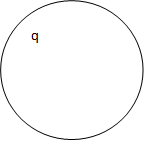


 For example in,
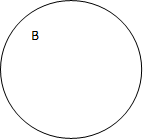


 A C B p q means p implies q
Means A is a proper subset of B
THE VALIDITY OF AN ARGUMENT
There are two forms of reasoning used in mathematics namely, inductive reasoning and deductive reasoning.
Inductive reasoning usually lacks generality because not all possibilities have been exhausted, when we use inductive reasoning, we base our conclusions on observation or experiences.
On the other hand, deductive reasoning is the process of showing that certain statements are accepted as true. In deductive reasoning all possibilities have been exhausted and therefore a generalized conclusion can be made.
Valid argument may be referred to a deductive arguments because deductive reasoning is based on conclusions reached from valid arguments. In deductive reasoning, we start with assumptions (also called hypotheses or premises) and then draws a conclusion based on those assumptions.
An argument may be described as a set of statements or proposition called the premises which leads to a conclusion. Let P1, P2, P3 ………..Pn represent the premises of an argument and C represents the conclusion. A valid argument is one in which if the premises P1, P2, P3…… Pn are all true, the conclusion C will always be true. In other words, an argument is said to be valid if the conjunction of the compound statement i.e P1 ^ P2 ^ P3…… ^ Pn is tautology. If an argument is not valid, it is called invalid or a fallacy. This, argument is valid if the conclusion follows from the hypotheses.
WRAP UP AND ASSESSMENT
A Proposition is a statement that is either true (T) or False (F) but not both.
A compound statement or proposition is made up of two or more simple statements joined by the connectives. Ex 10.1 No 1, 2
TICKET OUT
Ex 10.1 No 3, 4