WEEK SIX
TOPIC: ELECTRIC CHARGES→ Production, Types, Distribution and Storage
CONTENT
- Production of Charges
- Types of Charges
- Distribution of Charges
- Storage of Charges
- Production of Charges
If a plastic pen is rub vigorously on the hair or on a coat and it is hold near a very small piece of paper, the paper will be attracted by the pen. Some substances are found to poses the ability to attract light objects once they are rubbed. The light object as well as the rubbed material are said to be charged or electrified with static electricity.
Electrostatics is the study of charges at rest. It is a type of electricity that does not move from one point to another in the substance in which it is produced.
- Types of Charges
There are two types of charges – positive and negative charges.
Positive charge is obtained when a glass rod is rubbed with silk, or cellulose acetate
with silk, while negative charge is obtained when an ebonite rod is rubbed with fur or polythene with fur.
These two rods with positive and negative electrification attract each other when brought close. Repulsion occurs if two similar rods are brought close.
FUNDAMENTAL LAW OF ELECTROSTATICS
The law states that like charges repel, unlike charges attract.
CONDUCTORS AND INSULATORS
Conductors are materials that allow electrons to pass through them easily. Examples of conductors are metals, damp air, graphite, acids, salt solutions, the earth, and the human body.
Insulators are materials that do not allow electrons to pass through them easily. Examples of insulators are plastic, polythene, Bakelite, ebonite, paper, dry hair, silk, oils, glass, sulphur and wood.
EVALUATION
- State the fundamental law of electrostatic.
- What is electrostatic?
- Distribution of Charges
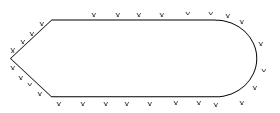 Experimental works have shown that charges are distributed where there is a sharp curve. The densities of these charges are greater at the surface of sharp curve. The charge per unit area of a charged surface is called surface density.
Fig. 2.3 Charge Distribution is greater at the edge (sharp edge)
- Storage of Charges
The electrophorus is a device for transferring and storing charges. It produces electric charges by electrostatic induction. Another device for the storage of electric charges is the capacitor
EVALUATION
- With the aid of a diagram, explain charge distribution.
- Name two devices that can store charge.
Reading Assignment
New School Physics pg 56 – 58, 63 – 65WEEKEND ASSIGNMENT
- Electophorus and capacitor can store charges A. true B. false C. cannot say
D. none of the above
- When an ebonite rod is rub with fur, the fur becomes A. positively charge
B. negatively charge C. neutral D. none of the above
- The ebonite rod in question 2 becomes A. positively charge B. negatively charge C. neutral D. none of the above
- Like charges A. attract B. repel C. disappear D. evaporate
- Charges are unusually concentrated at places where the surface is ………….
A. straight B. sharply curved C. oval in shape D. none of the above
THEORY
- State the fundamental law of electrostatic.
- What is electrostatic?