WEEK 6 PLANE SHAPES AND THEIR PROPERTIES
Identify Plane Shapes and Solid Shapes: Overview
Geometry and spatial relationships are a part of children’s daily lives. Understanding an object’s position in space and learning the vocabulary to describe position and give directions are important. Simple terms like above, below, left, right, or between, enable children to order and describe the world around them. They can apply these terms as they describe plane and solid shapes in the classroom.
Most of the objects that we encounter can be associated with basic shapes. A closed, two-dimensional or flat figure is called a plane shape. Different plane shapes have different attributes, such as the numbers of sides or corners. A side is a straight line that makes part of the shape, and a corner is where two sides meet. In this chapter, children will learn to identify, describe, sort, and classify plane shapes by these attributes.
Although children are familiar with the most common shapes, up until now they may not have been able to verbalize what distinguishes a square from a rectangle or a circle from a triangle. They will learn to describe shapes in terms of their sides and corners. A triangle is a shape with three sides and three corners. A rectangle is a shape with four sides and four corners. They may notice that opposite sides are the same length. A square is a rectangle in which all four sides are of equal length. A circle is a round shape that has no sides or corners. These attributes, as well as size, can be used to sort and classify shapes.
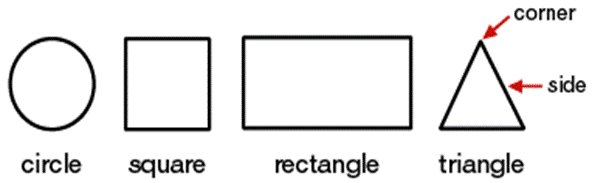
PROPETIES OF PLANE SHAPES
Square
- A square has four sides, but not just any four sides. A square’s four sides are all the same length. A square with one-inch sides is smaller than a square with three-inch sides because one is less than three. A square also has four corners. Opposite side are equal, the diagonal bisect at right angles. It has four line of symmetry.
Rectangle
- a rectangle has two equal sides of one length and two equal sides of a different length. A rectangle is like a stretched square.. Both figures have four corners, but no longer four equal sides for the rectangle. Write their findings on the board under headings “square,” “rectangle” and “both.” The diagonal are equal, and they bisect each other. it has two line of symmetry.
Triangle
Two side are equal, the base angles are equal (isosceles triangle). All the three sides are equal, all the angles are equal which is 60, it has three line of symmetry. (equilateral triangles)
Circle
- Give each child a piece of string. Ask them to make circles with the string on their desks. Discuss how many sides and corners a circle has: none. Let each child pick a piece of construction paper. Fold it in half and show them how to trim the edges; open it up and it’s a circle. For homework, tell the class to take home their circle, find unneeded items that are circles and glue them on the construction paper. The next day post the artistic circles on the bulletin board.