WEEK SIX
Review of the first half term’s work and periodic test
WEEK SEVEN
TOPIC: TRIGONOMETRIC RATIOS
CONTENT
- Sine,Cosine and Tangent of acute angles
- Use of tables of Trigonometric ratios
- Determination of lengths of chord using trigonometric ratios.
- Graph of sine and cosine for angles
Sine, Cosine and Tangent of acute angles
Given a right angled triangle, the trigonometric ratio of acute angles can be found as shown below


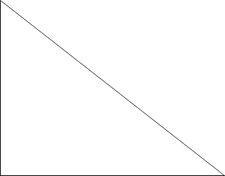


In the figure above, ABC is any triangle, right-angled at A
tan B = b tan C = c(tan : Opp)
c b Adj
Sin B = b Sin C =c Sin ;Opp
aaHyp
Cos B = c Cos C = b ( Cos : Adj)
 aaHyp
aaHyp
InABC, B and C are complementary angles i.e B + C = 90o
If B = Ө then C = 90o – Ө.


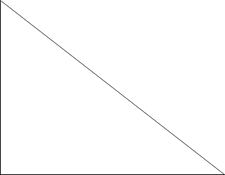


In the figure above sin Ө =cos ( 90-Ө ) = b
a
Cos Ө = Sin (90- Ө) = c
a
Note: Always remember SOH CAH TOA
i.e Sin θ = Opp
Hyp
Cos θ= Adj
Hyp
Tan O =Opp
Adj.
Examples
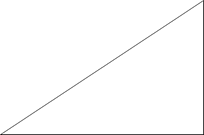
- A triangle has sides 8cm and 5cm and an angle of 90o between them .Calculate the smallest angle of the triangle
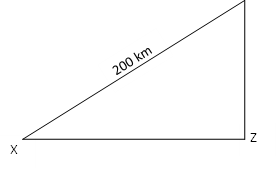
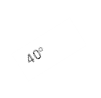
- A town Y is 200km from town X in a direction 40o. How far isY east of X ?
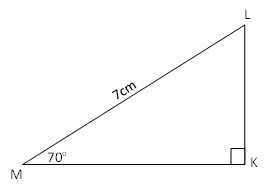
- In the figure below, LK is perpendicular to MN. Calculate< MNL





Solutions

 (1)
(1)


tan θ = 8cm = 1.600
5cm
Ө = tan-1 1.6000
Ө = 58o.
The 3rd angle in the right angled triangle above = 90o – 58o = 32.
Hence, the smallest angle of the given triangle = 32o

Y
 2)
2)


From the diagram drawn above the distance of Y east of X = ZY
Using the right angled triangle XZY
Sin 40o =ZY
200km
 ZY = 200km x sin 40o
= 200km x 0.6428
= 128.56km
= 128.6km to 1d.p
3)

In the given diagram,
LK = Sin 70o
7cm
LK = 7cm x sin 70o ………… i
LK = 7cm x 0.9397
LK = 6.5779cm
In right angled triangle LKN
LK = sin MNL
21
i.e 7cm x 0.9397 = Sin MNL
21cm
- = Sin MNL
3
0.3132 = Sin MNL
Sin-10.3132 = MNL
18. 290 = MNL
i.e MNL = 18.3o
EVALUATION
A ladder 20cm long rests against a vertical wall so that the foot of the ladder is 9m from the wall.
(a) Find, correct to the nearest degree, the angle that the ladder makes with the wall
(b) Find correct to 1.dp the height above the ground at which the upper end of the ladder touches the wall. Use of tables of trigonometric ratios.
Determination of lengths of chords using trigonometric ratios
Trignometric ratios can be used to find the length of chords of a given circle. However, in some cases where angles are not given, Pythagoras theorem is used to find the lengths of chords in such cases. Pythagoras theorem is stated as follows:
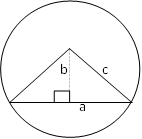
It states that c2 = a2 + b2
Pythagoras theorem states that in a right angled triangle, the square of the length of the hypotenuse is equal to the sum of the square of the lengths of the other two sides.
Examples
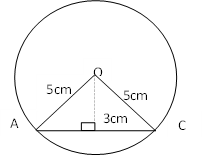
- A chord is drawn 3cm away from the centre of a circle of radius 5cm. Calculate the length of the chord.
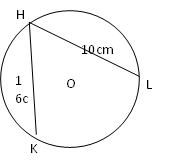
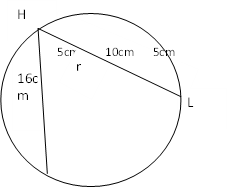
- In the figure below, O is the centre of circle, HKL. HK = 16cm, HL = 10cm and the perpendicular from O to the HK is 4cm. What is the length of the perpendicular from O to HL?

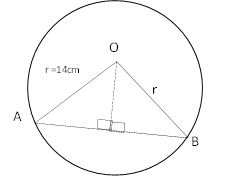
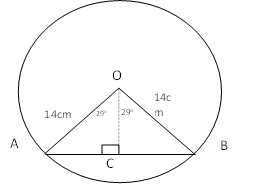
- Given the figure below, calculate the length of the chord AB.

58o
 Solutions
1
B
From the diagram above in right-angled triangle ABO:


AB 2 + 32 = 52 ( Pythagoras theorem)

 AB 2= 52 – 32

 AB 2 = 25 – 9

 AB 2 = 16
AB = √16 = 4cm
Since B is the mid point of chord AC then
Length of chord AC = 2 x AB
= 2x 4cm =8cm
2)



0


Let the distance from O to HL= xcm
In right-angled triangle OMH:


OH 2 = HM 2 + MO 2


OH 2= 82 + 42
= 64 + 16

 = 80
= 80
:. OH = √80


:. OH = √80cm

 but OH = radius of the circle


i.e r= OH = OL = √80cm
In right-angled triangle ONL


OL 2 = ON 2 + NL 2
 i.e( √80)2 = x2 + 52
80- 25 = x2
55 = x2

 Take square root of both sides
√55 = √x2
 √55 = x = 7. 416cm
:. The length of the perpendicular from O to HL is 7.416cm
3)
The perpendicular from O to AB divides the vertical angle into 2 equal parts and also divides the length of chord AB into two equal parts.

 In right-angled triangle ACO:
AC = Sin 29o

 OA 1
OA 1
Cross multiply
AC = OA x sin 29o
AC = 14cm x Sin 29o
AC = 14cm x 0. 4848
AC = 6.787cm
AB = 2 x 6.787 cm
AB = 13.574cm
:. The length of the chord AB = 13.6cm to 1 d.p
EVALUATION
- A chord 30cm long is 20cm from the centre of a circle . Calculate the length of the chord which is 24cm from the centre .
- Q is 1.4km from P on a bearing 023o. R is 4.4 Km from P on a bearing 113o. Make a sketch of the positions of P, Q and R and hence, calculate QR correct to 2 s.f.
GRAPH OF SINE AND COSINE FOR ANGLES
 In the figure below, a circle has been drawn on a Cartesian plane so that its radius, OP, is of length 1unit. Such a circle is called unit circle.
 The angle Ѳ that OP makes with Ox changes according to the position of P on the circumference of the unit circle. Since P is the point (x,y) and /OP/ = 1 unit,
Sin Ѳ = y/1 = y
Cos Ѳ = x/1 = x
Hence the values of x and y give a measure of cos Ѳ and sin Ѳ respectively.
If the values of Ѳ are taken from the unit circle, they can be used to draw the graph of sin Ѳ. This is done by plotting values of y against corresponding values of Ѳ as in the figure below.
In the figure above, the vertical dotted lines gives the values of sin Ѳ corresponding to Ѳ = 30o, 60 o,
90 o,……., 360 o.
To draw the graph of cosѲ , use corresponding values of x and Ѳ. This gives another wave-shaped curve, the graph of cos Ѳ as in the figure below.
As Ѳ increases beyond 360o, both curves begin to repeat themselves as in the figures below.
Take note of the following:
1)All values of sin Ѳ and cos Ѳ lie between +1 and -1.
2)The sine and cosine curves have the same shapes but different starting points.
3)Each curve is symmetrical about its peak(high point) and trough(low point). This means that for any value of sin Ѳ there are usually two angles between 0 o and 360 o; likewise for cos Ѳ. The only exceptions to this are at the quarter turns, where sinѲ and cosѲ have the values given in the table below
| 0o | 90o | 180o | 270o | 360o | |
| SinѲ | 0 | 1 | 0 | -1 | 0 |
| CosѲ | 1 | 0 | -1 | 0 | 1 |
Examples
1) Referring to graph on page 194 0f NGM Book 1, a)Find the value of sin 252o, b)solve the equation 5 sin Ѳ = 4
Solution
a)On the Ѳ axis, each small square represents 6. From construction a) on the graph:
Sin 252o = -0.95
b)If 5 sin Ѳ = 4
then sin Ѳ = 4/5 = 0.8
From construction b) on the graph: when sin Ѳ = 0.8, Ѳ = 54o or 126o
EVALUATION
1)Using the same graph used in the above example, find the values of the following
a)sin 24o b) sin 294o
2)Use the same graph to find the angles whose sines are as follows:
a) 0.65 b)-0.15
GENERAL EVALUATION
- Express the following in terms of sin, cos or tan of an acute angle:
- sin 2100
- tan 2400
- cos(-350)
- If cos = -0.6428, find the value of between 00 and 3600
READING ASSIGNMENT
NGM SS BK 1 pg 114- 123, Ex 11a .
NOS 10 and 25 pg 117 -118
WEEKEND ASSIGNMENT
- If Sin A = 4/5, what is tan A? A 2/5 B. 3/5 C. ¾ D. 1 E. 4/3
- Use tables to find the value of 8 Cos 77. A. 5.44 B. 6.48 C. 9.12 D 7.57 E. 1.80
- If cos θ = sin 33 o, find tan θ. A. 1.540 B. 2.64 C.0.64 D. 1.16 E. 1.32
- If the diagonal of a square is 8cm, what is the area of the square? A 16cm2B. 2cm2 C. 4cm2D. 20cm2E. 10cm2
- Calculate the angle which the diagonal in question 4 makes with any of the side of the square. A. 65oB. 45oC. 35oD. 25oE. 75o
THEORY
- From a place 400m north of X, a student walks east wards to a place Y which is 800m from X. What is the bearing of X from Y?
 In the figure below, the right angles and lengths of sides are as shown. Calculate the value of K .
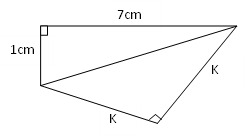 In the figure below, the right angles and lengths of sides are as shown. Calculate the value of K .