WEEK 5
TOPIC: Cubic equations and their factorization , graphs of cubic equations
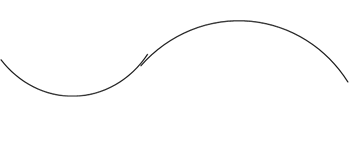
Polynomials of degree three have the general form y = ax3 + bx2 + cx + d(a ≠ 0). The curve is usually called a cubical parabola.
A cubical parabola has two shapes depending on whether a > 0 or a < 0.
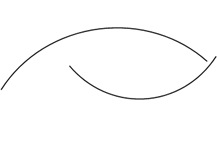
a> 0
a< 0
Sketch each of the following curves represented by the following functions:
(a) y = x3 + 2x2 – 5x – 6
(b) y = 12 + 4x – 3x2 – x3
Solution
(a) y = x3 + 2x2 – 5x – 6
Using the factor theorem and long division the expression can be factorized as:
y = (x – 2)(x + 1)(x + 3)
The zeros of the polynomial are therefore x = 2, x = -1 and x = 3, hence the x – intercepts are (2, 0), (-1, 0) and (-3, 0).
The y – intercept is (0, -6).
Next, we shall consider the behaviour of the function at different intervals along the x – axis. This will enable us to see whether the curve is above or below the axis.
Mark the x – intercepts on the x – axis.
 x–axis
(-3, 0) (-1, 0) (2, 0)
The intervals we shall consider are:
(a) x< -3
(b) -3 < x < -1
(c) -1 < x < 2
(d) x> 2
We shall examine the signs (+ve or –ve) in each of the intervals.
x = -4 is in the intervals x < -3
f(-4) = -18 < 0
Hence the part of the graph in the interval x < -3 is below the axis.
x = -2 is in the interval -3 < x <-1
f(-2) = 4 > 0
Hence the part of the graph in the interval -3 < x < 2 is above the x – axis x = 0 is in the interval -1 < x < 2
f(0) = -6 < 0.
Hence the part of the graph in the interval -1 < x < 2 is below the x – axis.
x = 3 is in the interval x > 2
f(3) = 24 > 0
Hence the part of the graph in the interval is above the x – axis.
The intercept on the axis coupled with the behaviour of the function at different intervals on the x – axis will enable us to get the shape of the curve.
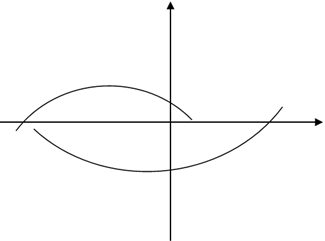 y
y
x
(-3, 0)(-1, 0) (2, 0)
(0, 6)
(b) y = 12 + 4x – 3x2 – x3
Using the factor theorem and long division method
y = (2 – x)(2 + x)(3 + x)
The zeros of the polynomial are x = 2, x = -2 and x = -3, hence the x – intercepts are (2, 0), (-2, 0) and (-3, 0).
The y – intercept is (0, 12).
Mark the x – intercept on the axis.
 x – axis
(-3, 0) (-1, 0) (2, 0)
The intervals we shall consider are:
(a) x< -3
(b) -3 < x < -1
(c) -1 < x < 2
(d) x> 2
x = -4 is in the interval x < -3
f(-4) = 12 < 0,
hence the part of the graph within this interval is above the x – axis.
x = -2.5 is in the interval -3 < x < -2
f(-2.5) =
hence the part of the graph within this interval -3 < x < -2 is above the axis.
x = 0 is in the interval -2 < x < 2
f(0) = 12 > 0,
hence the part of the graph within this interval -2< x <2 is above the axis.
x = 3 is in the interval x > 2
f(3) = -30< 0,
hence the part of the graph within the interval r > 2 is below the x – axis.
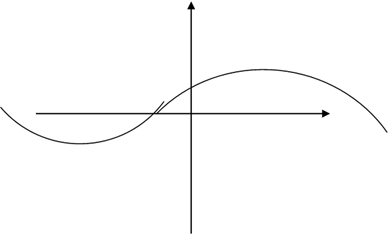 y
y
(0, 12)
(-3, 0) (-2, 0) (2, 0)
Evaluation
Sketch the curve of these equations
(a) y = x3 – 6x2 + 11x – 6 (b) y = x3 + 3x2 – 6x – 8
General Evaluation
(1) Factorise the following completely
(a) x3 + 10x2 + 23x + 14 (b) x4 – 1
Weekend Assignment
Given that a cubic equation x3 + 2x2 – 19x – 20 = 0 has 4 as one its roots, find the
(1) Second root (a) -1 (b) 1 (c) 2 (d) 3
(2) Third root (a) 5 (b) -8 (c) 3 (d) 2(3) Sum of the second and third roots (a) -4 (b) 6 (c) 4 (d) -6
(4) Product of the second and third roots (a) 6 (b) 5 (c) -6 (d) -5
(5) Find the zeros of x2 – 1 (a) 2 or -2 (b) 1 or 2 (c) -1 or 1 (d) 1 or -2
Theory
(1) If (x + 1) is a factor of f(x) = x3 + kx2 + 3x + 10, find the value of the constant k.
(2) Factorise f(x) completely.