week 5; processing metal
Metal processing
What is a Metal ?
Structures of Metals
Metal Properties
In industry, molten metal is cooled to form the solid. The solid metal is then mechanically shaped to form a particular product. How these steps are carried out is very important because heat and plastic deformation can strongly affect the mechanical properties of a metal.
Grain Size Effect:
It has long been known that the properties of some metals could be changed by heat treating. Grains in metals tend to grow larger as the metal is heated. A grain can grow larger by atoms migrating from another grain that may eventually disappear. Dislocations cannot cross grain boundaries easily, so the size of grains determines how easily the dislocations can move. As expected, metals with small grains are stronger but they are less ductile. Figure 5 shows an example of the grain structure of metals.
Quenching and Hardening:
There are many ways in which metals can be heat treated. Annealing is a softening process in which metals are heated and then allowed to cool slowly. Most steels may be hardened by heating and quenching (cooling rapidly). This process was used quite early in the history of processing steel. In fact, it was believed that biological fluids made the best quenching liquids and urine was sometimes used. In some ancient civilizations, the red hot sword blades were sometimes plunged into the bodies of hapless prisoners! Today metals are quenched in water or oil. Actually, quenching in salt water solutions is faster, so the ancients were not entirely wrong.
Quenching results in a metal that is very hard but also brittle. Gently heating a hardened metal and allowing it to cool slowly will produce a metal that is still hard but also less brittle. This process is known as tempering. (See Processing Metals Activity). It results in many small Fe3C precipitates in the steel, which block dislocation motion which thereby provide the strengthening.
Cold Working:
Because plastic deformation results from the movement of dislocations, metals can be strengthened by preventing this motion. When a metal is bent or shaped, dislocations are generated and move. As the number of dislocations in the crystal increases, they will get tangled or pinned and will not be able to move. This will strengthen the metal, making it harder to deform. This process is known as cold working. At higher temperatures the dislocations can rearrange, so little strengthening occurs.
You can try this with a paper clip. Unbend the paper clip and bend one of the straight sections back and forth several times. Imagine what is occurring on the atomic level. Notice that it is more difficult to bend the metal at the same place. Dislocations have formed and become tangled, increasing the strength. The paper clip will eventually break at the bend. Cold working obviously only works to a certain extent! Too much deformation results in a tangle of dislocations that are unable to move, so the metal breaks instead.
Heating removes the effects of cold-working. When cold worked metals are heated, recrystallization occurs. New grains form and grow to consume the cold worked portion. The new grains have fewer dislocations and the original properties are restored.
metal alloy
An alloy is a material made by melting one or more metals together with other elements. This is an alphabetical list of alloys grouped according to the base metal of the alloy. Some alloys are listed under more than one element, since the composition of the alloy may vary such that one element is present in a higher concentration than the others.
ALUMINUM ALLOYS
- AA-8000: used for building wire
- Al-Li (aluminum, lithium, sometimes mercury)
- Alnico (aluminum, nickel, copper)
- Duralumin (copper, aluminum)
- Magnalium (aluminum, 5% magnesium)
- Magnox (magnesium oxide, aluminum)
- Nambe (aluminum plus seven other unspecified metals)
- Silumin (aluminum, silicon)
- Zamak (zinc, aluminum, magnesium, copper)
- Aluminum forms other complex alloys with magnesium, manganese, and platinum
properties of metals
| Metals: | Non-metals: |
| Strong | Brittle |
| Malleable and ductile | Brittle |
| React with oxygen to form basic oxides | React with oxygen to form acidic oxides |
| Sonorous | Dull sound when hit with hammer |
| High melting and boiling points | Low melting and boiling points |
| Good conductors of electricity | Poor conductors of electricity |
| Good conductors of heat | Poor conductors of heat |
| Mainly solids at room temp. Exception mercury – liquid at room temp. | Solids, liquids and gases at room.temp. |
| Shiny when polished | Dull looking |
| When they form ions, the ions are positive | When they form ions, the ions are negative – except hydrogen that forms a positive ion, H+. |
| High density | Low density |
Common Metals and Non-Metals
| Metals: | Non-metals: |
| Calcium | Sulphur |
| Potassium | Oxygen |
| Lead | Chlorine |
| Copper | Hydrogen |
| Aluminium | Bromine |
| Zinc | Nitrogen |
| Lithium | Helium |
Uses of metals and non-metals
Metals
The uses of metals are related to their properties:
They are made into jewellery due to their hard and shiny appearance.
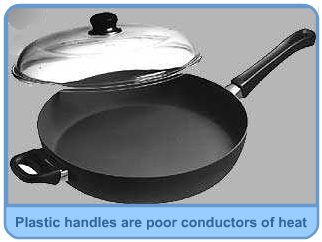
They are used to make pans, since they are good conductors of heat.
They are used in electrical cables, because they are malleable, ductile and good conductors of electricity.
They are strong so used to build scaffolding and bridges.
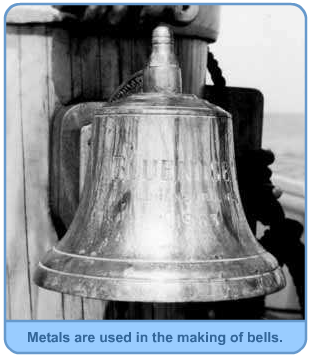
They make a ringing sound, sonorous, hence their use in bell making.
Non-metals
Used as insulating material around wire cables since they do not conduct electricity.
Used to make pan handles as they are poor conductors of heat.
question;
describe 5 properties of metals
state 5 uses of metals