WEEK FIVE
TOPIC : MECHANICS ; VECTORS OR CROSS PRODUCT ON TWO OR THREE DIMENSION , CROSS PRODUCT OF TWO VECTORS AND APPLICATION OF CROSS PRODUCT
Vector Product of two vectors
Given two vectors andwhose directions are inclined at an angle, their vector productis defined as a vector whose magnitude issinand whose directions is perpendicular to both and and also being positive relative to a rotation from themvector and also being positive relative to a rotation from the vectorto the re
ctor.
The vector product ofand b is designated
b
Thus:
= x =|| || sin . whereis a unit vector perpendicular to the plane of and .
Properties of vector Product
- x = |b||a| sin(-) 0 <<
= – |a||b| sin (-)
= – b
Thus the vector product of two vectors is not commutative . - (k) x = x (k )
= k (x)
= k |||| sin )
Where k is a scalar. - x ( + c) = x + x c
Distribute law
- x = x = x
x = = – x , x k = =
- x
x = – x
- |a x b| = area of parallelogram with sides
and .
- If x = 0 and and b are non zero vectors, then a and b are parallel
- If a = a1 i+ a2i + a3k
b = b1 + b2i +b3k then


i j k
a ba1 a2 a3
b1 b2 b3
We shall make use of the following important result in determinant of order 2 x 2 and order 3 x 3 defined respectively as follows.
 a b
a b
c d = ad – bc


a b c e f – b d f + c d e
d e f = a h I g I g h
g h i
The expansion of the determinant of order 3 x 3 is along the first row.
Notwithstanding it can be along any other row or any column.Example 1
Find the vector of a andb where:
a = 4I – 3j + 2k, b = i + 2 j – 5k
Solution
a = 4 I – 3 j + 2 k
b = I + 2j – 5k

a x b = i j k
4 -3 2
1 2 -5

=i -3 2 4 2 4 -3
–j +k
2 -5 1 -5 1 2= I (15 -4) –j (-20 -2) + k (8 + 3)
= 11i + 20j + 11k
If p =2i – 3j + 4k
q =5i – 4j – 3k
Find : - p x q;
- |p x q|
Solution
- p x q = i j k
2 -3 4
5 4 -3
=i -3 4 2 4 2 -3
–j +k
4 -3 5 -3 5 4= i (9 – 8) –j (- 6 -20) + k (8 + 15)
=i + 26j + 23 k
- |p x q| = |I + 26j + 23k|
=
=
` =
=
=
Example
Show that (a x b)2 = a2b2 – (a.b)2
Solution
(a x b)2 = (absin)2
= a2 b2 sin2
= a2 b2 (1 – cos2 )
= a2 b2 – a2 b2 cos2
= a2 b2 – (a.b)2
Hence
(a x b)2 = a2 b2 – (a.b)2
EVALUATION
Given that p = 2i + 3j +4k and q= 5i – 6j +7k find ; (1) p x q ( 2) (p + q ) . ( p-q)
Application of vector product
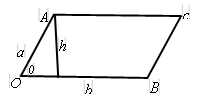
Area of a parallelogram Example
Show that the area of parallelogram with sides a andb is.
 Solution
Area of parallelogram
OAC B= h/b
=/a/ sin /b/
=/a/ /b/sin
=/a x b/
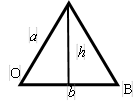
Area of angle
Example
 Show that the area of a triangle with sides a and b is |a x b|
 Solution
Area of = OAB = |b| x h
= |b||a| Sin
= |a||b| Sin
= (a x b)
Example
The adjacent sides of a parallelogram are
= 2 i – j – 6k and = i + 3 j – k . Find
the area of the parallelogram. Solution
AB = 2 i – j – 6k
AC = i + 3 j – k

 Area of parallelogram = |AB x AC|
= x
i j k
2 -1 -6
1 3 -1
x


= i -1 -6 –j 2 -6 +k 2 -1
3 -1 1 -1 1 3
= I (1 + 18) –j (-2 + 6) + k (6 + 1)
= 19 I – 4 j + 7 k
|AB x AC| = |19i – 4j + 7k|
=
=
=
Hence
Area of parallelogram = sq. UnitsGENERAL EVALUATION
1) Find the vector product of a= 4i -3j +4k and b = -I + 2j +7k
2) Given that p = 7i + 2j + k and q = 3i – 2j + 4k find ; (i) p x q (ii) | p x q | (iii) the unit vector perpendicular to both p and q
3) Find the sine of the angle between the vectors : a = I – j + k and b = 8i + 2j + 3k
4) The adjacent sides of a parallelogram are PQ= 4i + 3j + k and PR = -5i + 2j +3k find the area of the parallelogram
5) The position vectors OA, OB and OC are 2i – 3j + 4k , 6i + 4j -8k and 3i + 2j + 5k respectively find (i) vector AB (ii) vector BA (iii) vector BC (iv) AB x BC
Reading Assignment: New Further Maths Project 2 page 216 – 222WEEKEND ASSIGNMENT
Given that a = I + 2j + k and b = 2i +3j- 5k
1) find ( a x b ) . a a) 0 b) 1 c) 2 d) 3
2) find ( a x b ) . b a) 1 b) 2 c) 0 d) 3
Given that p = I + 5j + 6k and q = – 2i + j + 3k
3) find p x q a) 15i +11j -11k b) 11i – 15j + 11k c) 11i – 11j + 15k d) 11i- 15j -11k
4) find q x p a) -11i + 15j – 11k b) 11i – 15j + 11k c) 15i – 11j-11k d) 15i+11j+11k
5) Given that a = i – j+ 3k and b = 6i + 2j – 2k find ( a + b ) . ( a x b ) a) 1 b) 0 c) 2 d) 3THEORY
1) AB = 4i +3j+5k and AC= 2i-3j+k are two sides of a triangle ABC , find the area of the triangle
2) PQ = 2i+5j+3k and PR = 3i-3j + k are two adjacent sides of a parallelogram, find the area of the parallelogram.
WEEK SIX
REVIEW OF HALF TERM WORK


 a b
a b


 =i -3 2 4 2 4 -3
 Solution


 =i -3 4 2 4 2 -3
 Solution
 Show that the area of a triangle with sides a and b is |a x b|
 Solution
 Solution
 Area of parallelogram = |AB x AC|
 = x
= x i j k
i j k


