WEEK 5 AND 6
TOPIC: IDENTIFICATION AND PROPERTIES OF ANGLES
TYPES AND PROPERTIES OF ANGLES
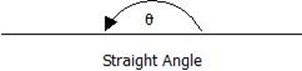
Straight Angles
Angles which measure exactly 180° (degrees) are straight angles. Therefore, straight angles are straight lines. Angles are represented by the sign ϴ, called theta. That is, for straight angles, ϴ= 180°.
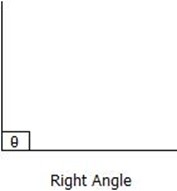
Right Angles
Angles which measure exactly 90° are right angles, that is, ϴ = 90°.
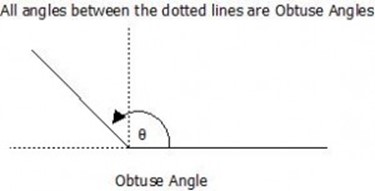
Obtuse Angles
Obtuse angles are those which are greater than 90° but less than 180°, that is, 90° <ϴ< 180°.
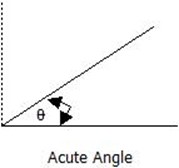
Acute Angles
Acute angles are angles which are greater than 0° but less than 90°, that is, 0° <ϴ< 90°.
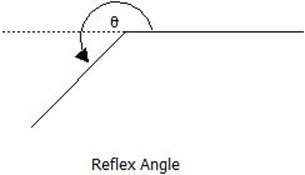
Reflex Angles
Reflex angles are angles which are greater than 180° but less than 360°, that is, 180° <ϴ< 360°.
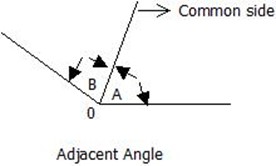
Adjacent Angles
Two angles which share the same vertex (centre, usually represented by 0) and have a common side (line) are called adjacent angles.
Complementary Angles
Complementary angles are two angles which when summed equals 90°.
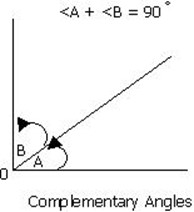
Note: <A and <B, are ‘angle A’ and ‘angle B’ respectively.
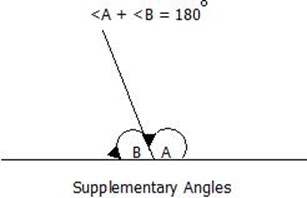
Supplementary Angles
Supplementary angles are two angles which when summed equals 180°.
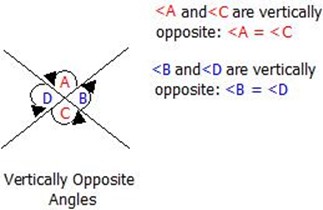
Vertically Opposite Angles
Vertically opposite angles are the angles opposite to each other when two straight lines intersect. Their defining property is that, vertically opposite angles are equal in magnitude.
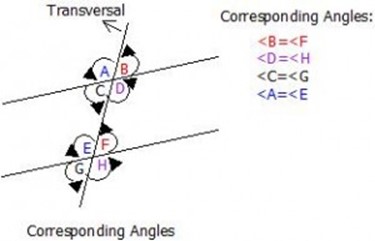
Corresponding Angles
When two parallel lines are crossed by a line called the transversal, the angles formed which are in corresponding positions, are called corresponding angles. Corresponding angles are equal in magnitude.
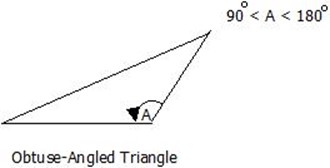
Obtuse-Angled Triangles
Obtuse-angled triangles are triangles with one of their angles greater than 90° but less than 180° (i.e. an obtuse angle).
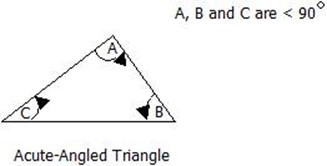
Acute-Angled Triangles
Acute-angled triangles are triangles in which all the angles are acute. That is, all angles are greater than 0° but less than 90°.
Do these
Exercise 21.2 pg 240 No ( 1-10)
Assignment: Exercise 21.3 pg 243 No (1 , 2, 5, 6, 10 & 12)