WEEK 4
TOPIC: APPLICATION OF DIFFERENTIATION ; RATE OF CHANGE, EQUATION OF MOTION , MAXIMUM AND MINIMUM POINTS AND VALUES
Rate of Change
If y = f(x), can sometimes be interpreted as the rate at which y is changing with respect to x. if y increases as x increases, 0, while if y decreases as x increases, 0.
Example
The radius of a circle is increases a t the rate of 0.01cm/s. find the rate at which the area is increasing when the radius of the circle is 5cm.
Solution
Let Abe the area of the circle of radius r.
A = 2
= 2
By the chain rule:
=
= 0.01cm/s
When r = 5cm
= 25 0.01
= 10 0.01
= 0.1 2/s
= 0.3142cm2/s
Example
Water is leaking from a hemisphere bowl of radius 20cm at the rate of 0.5cm3/s. Find the rate at which the surface area of the water is decreasing when the water level is half-way from the top.
Solution

Fig. 10 9
Let Abe the surface area of the water in the hemisphere bowl of radius r, thenA =r2
= = 2r
= =
V = r 3
= 22
= =
=

 = = =
= = =
=
When the water level is half- way from the top r = 10cm.
But = -0.5 cm3/s
= -0.5 cm3/s
= -0.5 cm2/s
Example
Find the rate at which the volume of a spherical balloon is increasing if the surface area is increasing at the rate of 5cm2/s when the radius of the spherical balloon is 4cm.
Solution
V= 3
= 42
s = 42
= 8 =
MAXIMUM AND MINIMUM POINTS The points on a curve at which = 0, are called Stationary Points.
Stationary points fall into three major categories:
- Those in which changes sign from positives through zero to negative. These are called maximum points.
- Those in which changes sign from negative through zero to positive. These are called minimum points.
- Those in which the sign of is not changed in the immediate neighborhood of the stationary points. These are called points of inflexion.
The terms maximum and minimum points are used in the local sense and not in the absolute sense.
Maximum Points
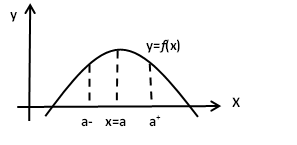
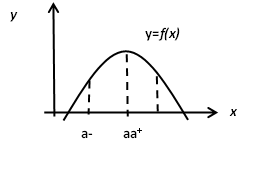
Fig.10. 11 shows part of the curve y = f (x). There is a maximum at the point where x = a
=  f‘(a) = 0
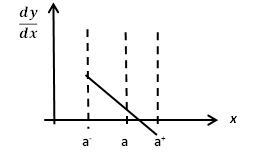
Let us denote a point at the immediate neighborhood of a to the left by a and a pint at the immediate neighborhood of a to the right by a+ then:
At x = a, > 0
 f‘(a–) > 0
At x = a+, < 0
f‘ (a+) < 0
Hence for the existence of a minimum at x = a, three conditions must be satisfied:
- f‘(a) = 0 (ii) f‘ (a) >0
- f‘ (a+)< 0
Minimum Points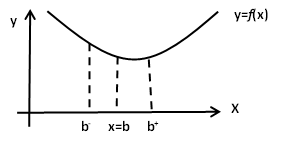
Fig. 10.12 shows a part of the curve y = f (x). There is a minimum at x = b
At x = b, f1 (b) =0
At x = b–, f1 (b–) <0
At x = b+, f1 (b+) <0
So a pint on a curve is a minimum at x = a.
If: (i) f‘ (a) = 0 (ii) f‘ (a–) <0
- f‘(a+)>0
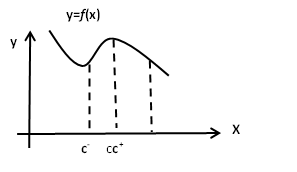 Points of Inflexion
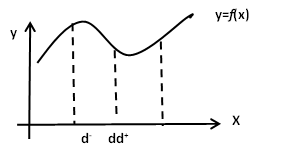
(a)
–
shows part of the curve y= f(x). We observe that
f‘(c) = 0
f‘(c–) < 0
f‘(c+) < 0
The point x = c is a point of inflexion. Similarly, fig. 10.13(b) shows parts of the curve y = f (x)
We observe that
f‘(d) = 0
f‘(d–) >0
f ‘(d+) >0
The point x = d is a point of inflexion.
A maximum point, a minimum point and a point of inflexion are all stationary points. Both maximum and minimum points are called turning points. A point of inflexion however, is not a turning point.
Example
Find the stationary points in each of the following curves whose equations are:
- y = x3+ x2 -3x + 4
3
- y = x4 +4 x3 – 2x2 – 16x + 1
4 3
Solution
- y = x3 + x2-3x + 4
3
= x2+ 2x – 3
= (x – 1) (x + 3)
At the stationary points, = 0
 (x – 1) (x + 3) = 0
x =1 or x = -3
Hence there are stationary points at x = 1 and x = -3
y = x4+ 4 x3 -2x2 – 16x + 1
4 3
= x3 + 4x2 – 4x – 16
= (x -2) (x + 2) (x + 4)
At the stationary points, = 0.
(x – 2) (x + 2) (x + 4) = 0
x =2 or x= -2 or x = -4
Hence there are stationary points at x = 2, x = -2 and x = -4
Example
Find the turning points on the curve y = x4 +
2
5 x3 -2x2 – 3x + 1 and distinguish between them
3
Solution
y =x4+ 5 x3 – 2x2 – 3x + 1
2 3
= 2x3 + 5x2 -4x – 3
= (2x + 1) (x-1) (x+3)
At the stationary points, =0
(2x + 1) (x – 1) (x + 3) = 0
x =, x = 1 and x = -3 are the x-
Coordinates of the stationary points.
Let f(x) = x4+ 5 x3 -2x2 – 3x + 1
2 3
f‘(x)= 2x3 + 5x2 – 4x – 3
= (2x + 1) (x – 1) (x + 3)
Let a = = -0.5, a =-5, a+ = -0.4
Then f‘(a) = 0
f‘ (a) = (-1.2+1) (-0.6 – 1) (-0.6 + 3)
= (-0.2) (-1.6) (2.4)>0
= f1 (a) > 0
f ‘(a+) = (-0.8 + 1) (-0.4 – 1) (-0.4 + 3)
= (0.2) (-1.4) (2.6) <0
f ‘ (a+) < 0Table
f‘(a–) f‘(a) f‘(a+) Sign +ve
/0
—–ve
\Hence, there is a maximum point at x =
At x = 1
Let a = 1, a– = 0.9, a+ = 1.1
 (x – 1) (x + 3) = 0
 x =, x = 1 and x = -3 are the x-
 f ‘(a+) = (-0.8 + 1) (-0.4 – 1) (-0.4 + 3)
 f ‘ (a+) < 0
f'(a–) = 0
f‘ (a–) = (1.8 + 1) (0.9 -1) (0.9 + 3) < 0
f’ (a+) = (2.2 + 1) (1.1 – 1) (1.1 + 4) > 0
Table
| f‘ (a–) | f‘(a) | f ‘(a+) | |
| Sign | -ve / | 0 – | +ve \ |
Hence, there is minimum point at x = 1.
At x = -3
Put a = -3, a– =-3.1; a+= -2.9
f ‘ (a) = 0
f‘ (a–) = (-6.2 + 1) (-3.1 – 1) (-3.1 + 3) < 0
f ‘ (a+) = (-5.8 + 1) (-2.9 – 1) 9-2.9 + 3) > 0
Table
| f’ (a–) | f'(a) | f'(a+) | |
| Sign | –ve / | 0 – | +ve \ |
Hence, x = -3 is a minimum point
Example
Find the stationary points on the curve y = x3 – 6x2 + 12x – 8 and distinguish between them.
Solution
y = x3 – 6x2 + 12x – 8
= 3x2 – 12x = 12
= 3(x2 – 4x + 4)
= 3(x – 2)2
At the stationary points, = 0
Put a = 2, a– = 1.9, a+ = 2.1
and let f‘(x) = x3 – 6x2 + 12x – 8
f ‘(x) =3(x2 – 12x + 12)
= 3(x2 – 4x + 4)
= (3x -2)2
f ‘(a) = 0
f ‘(a–) = 3(1.9 – 2)2 > 0
f ‘ (a+) = 3(2.1 – 2)2 > 0
Table
| f’ (a–) | f'(a) | f'(a+) | |
| Sign | –ve / | 0 – | +ve \ |
Hence, there is a point of inflexion at x, =2
When x = 2
y = 8 – 24 + 24 – 8 = 0
=  The point (2, 0) is a point of inflexion on the curve y = x3 – 6x2 + 12 – 8
The second derivative test for stationary points
We recall that a necessary condition for the existence of stationary points for the curve.
 y = f (x) is that =. This condition is however not sufficient to determine the nature of the stationary points. We shall consider an alternative method which enables us to distinguish between the natures of stationary points.

EVALUATION
1) Find the minimum and maximum points of the curve y= x3 –x-5x and sketch the curve
2) The area of a circle is increasing at the rate of 4cm2/s , find the rate of change of the circumference when the radius is 6cm
GENERAL EVALUATION
1) A curve is defined by f(x) = x3 -6x2-15-1 find (i) the derivative of f(x) (ii) the gradient of the curve at the point where x= 1 (iii) the minimum and maximum points
2) The distance of a particle from a starting point is S = t3 – 15t2 +63t – 40 where t = time taken in seconds, find the (i) distance of the particle from the starting point when the particle is at rest (ii) velocity when the acceleration is zero
Reading Assignment : New FURTHER MATHS PROJECT 2 page 149-167
WEEKEND ASSIGNMENT
1) Find the value of x at which the function y = x2 – 7x2 + 15x has the greatest value a) 5/3 b) 5/4 c) 5/2 d) 5/6
2) Find the values of x at the turning point of y = 2x3 – 3x2 -12x + 8 a) 1 or 2 b) -1 or -2 c) -1 or 2 d) 1 or -2
3) Find the maximum value of the function 3x2 –x3 a) 2 b) 4 c) 0 d) 6
4) Find the minimum value of the function f(x) = x3 + 3x2 – 9x + 1 a) -3 b) -5 c) -4 d) 0
5) At what rate is the area of a circle changing with respect to its radius when the radius is 5cm a) 25 b 15 c) 20 d) 10
THEORY
1) The displacement of a particle is given as S = 12t – 15t2 + 4t3 where t is the time taken . Find the velocity and acceleration of the particle after 3 seconds
2) Find the maximum and minimum points and values of the curve y = x3 – 6x2 + 9x –