CLASS; J S S 2 WEEK 4
TOPIC; BEAD WORKS.
Bead
A bead is a small, decorative object that is formed in a variety of shapes and sizes of a material such as stone, bone, shell, glass, plastic, wood or pearl and that a small hole is drilled for threading or stringing. Beads range in size from under 1 millimeter (0.039 in) to over 1 centimeter (0.39 in) in diameter. A pair of beads made from Nassau’s sea snail shells, approximately 100,000 years old, are thought to be the earliest known examples of jewelry ; jewelry. Beadwork is the art or craft of making things with beads. Beads can be woven together with specialized thread, strung onto thread or soft, flexible wire, or adhered to a surface (e.g. fabric, clay).
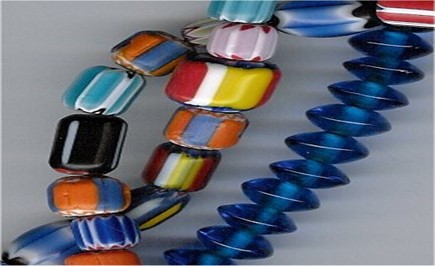
Types of beads
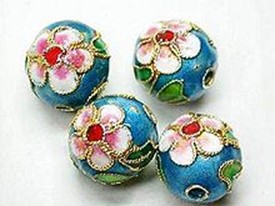
Cloisonné beads
Beads may be divided into several types of overlapping categories based on different criteria such as the materials from which they are made, the process used in their manufacturing, the place or period of origin, the patterns on their surface, or their general shape. In some cases, such as millefiori and cloisonné beads, multiple categories may overlap in an interdependent fashion. They are good for craft making
Components
Beads can be made of many different materials. The earliest beads were made of a variety of natural materials which, after they were gathered, could be readily drilled and shaped. As humans became capable of obtaining and working with more difficult materials, those materials were added to the range of available substances. More recently, synthetic materials were added.
In modern manufacturing, the most common bead materials are wood, plastic, glass, metal, and stone.
Natural materials
Beads are still made from many naturally occurring materials, both organic (i.e., of animal- or plant-based origin) and inorganic (purely mineral origin). However, some of these materials now routinely undergo some extra processing beyond mere shaping and drilling such as color enhancement via dyes or irradiation.
The natural organics include bone, coral, horn, ivory, seeds (such as tagua nuts), animal shell, and wood. For most of human history pearls were the ultimate precious beads of natural origin because of their rarity; the modern pearl-culturing process has made them far more common. Amber and jet are also of natural organic origin although both are the result of partial fossilization.
Beadwork
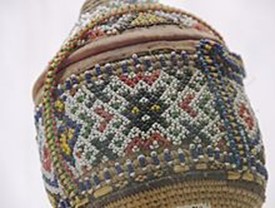
Ethiopian beadwork on basket, from the ethnographic collection of the National Museum, Addis Ababa
Beadwork is the art or craft of attaching beads to one another by stringing them with a sewing needle or beading needle and thread or thin wire, or sewing them to cloth.[1] Beads come in a variety of materials, shapes and sizes. Beads are used to create jewelry or other articles of personal adornment; they are also used in wall hangings and sculpture and many other artworks.
Beadwork techniques are broadly divided into loom and off-loom weaving, stringing, bead embroidery, bead crochet, and bead knitting.
Beads, made of durable materials, survive in the archaeological record appearing with the very advent of modern man, Homo sapiens.
Beads are used for religious purposes, as good luck talismans, for barter, and as curative agents.
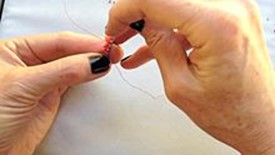
MRAW Bellyband Tri Wing Ring from Contemporary Geometric Beadwork by Kate McKinnon
Modern Beading
Modern beadwork is often used as a creative hobby to create jewelry, handbags, coasters, and dozens of other crafts. Beads are available in many different designs, sizes, colors, shapes, and materials, allowing much variation among bead artisans and projects. Simple projects can be created in less than an hour by novice beaders, while complex beadwork may take weeks of meticulous work with specialized tools and equipment. A lot of free patterns and tutorials can be found in Internet.
Ancient Beading
Faience is a mixture of powdered clays and lime, soda and silica sand. Mix this with a little water to make a paste and molded around a small stick or bit of straw. Now it is ready to be fired into a bead. As the bead heats up the soda sand and lime melt into glass that incorporates and covers the clay. The result is a hard bead covered in bluish glass.
This process was probably discovered first in Mesopotamia and then imported to Egypt. But, it was the Egyptians who made it their own art form. Since before the 1st dynasty of Name (3100 B.C.) to the last dynasty of the Polonies (33 B.C.) and to the present day, faience beads have been made in the same way.
These beads predate glass beads and were probably a forerunner of glass making. If you are a little short of clay and have a little extra lime and the fire is hotter than usual, the mixture will become glass. In fact some early tubular faience beads are clayish at one end and pure glass at the other end. Apparently the beads weren’t fired evenly.
The uneven beads were noticed early on, this led to experimentation, slowly at first. It took a long time for new ideas to be accepted in a conservative, agricultural society. One of the first variations to take hold was to color the faience beads by adding metallic salts. By the beginning of the eighteenth dynasty (1850 B.C.), faience making and glass making had become two separate crafts.
Why were faience beads so common? They were cheaper and less labor-intensive to make than stone beads. Aside from personal use and daily wear they were used to create beaded netting to cover mummies. Most of the archaeological specimens come from
Burials.
As early as the Old Kingdom (circa 2670–2195 B.C.), Egyptian artisans fashioned images of gods, kings, and mortals wearing broad collars made of molded tubular and teardrop beads. These beaded collars may have been derived from floral prototypes. In antiquity the collar was called a wesekh, literally “the broad one.”
In the Americas, the Cherokee used bead work to tell stories. They told them by the patterns in the beads. They used dried berries, gray Indian corn, teeth, bones, claws, or sometimes sea shells when they traded with coastal tribes.
MANUFACTURING
Modern mass-produced beads are generally shaped by carving or casting, depending on the material and desired effect. In some cases, more specialized metalworking or glass working techniques may be employed, or a combination of multiple techniques and materials may be used such as in cloisonné.
Glass working
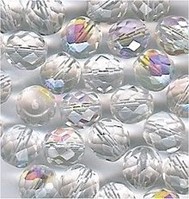
Fire polished beads (10 millimetres (0.39 in)) with AB coating
Most glass beads are pressed glass, mass-produced by preparing a molten batch of glass of the desired color and pouring it into molds to form the desired shape. This is also true of most plastic beads.
A smaller and more expensive subset of glass and lead crystal beads are cut into precise faceted shapes on an individual basis. This was once done by hand but has largely been taken over by precision machinery.
“Fire-polished” faceted beads are a less expensive alternative to hand-cut faceted glass or crystal. They derive their name from the second half of a two-part process: first, the glass batch is poured into round bead molds, then they are faceted with a grinding wheel. The faceted beads are then poured onto a tray and briefly reheated just long enough to melt the surface, “polishing” out any minor surface irregularities from the grinding wheel.
Specialized glass techniques and types
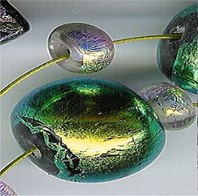
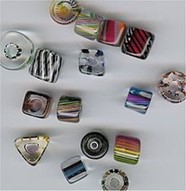
Dichroic beads (10 millimetres (0.39 in) Furnace glass beads
There are several specialized glassworking techniques that create a distinctive appearance throughout the body of the resulting beads, which are then primarily referred to by the glass type.
If the glass batch is used to create a large massive block instead of pre-shaping it as it cools, the result may then be carved into smaller items in the same manner as stone. Conversely, glass artisans may make beads by lampworking the glass on an individual basis; once formed, the beads undergo little or no further shaping after the layers have been properly annealed.
Most of these glass subtypes are some form of fused glass, although goldstone is created by controlling the reductive atmosphere and cooling conditions of the glass batch rather than by fusing separate components together.
Dichroic glass beads incorporate a semitransparent microlayer of metal between two or more layers. Fibre optic glass beads have an eye catching chatoyant effect across the grain.
There are also several ways to fuse many small glass canes together into a multicolored pattern, resulting in millefiori beads or chevron beads (sometimes called “trade beads”). “Furnace glass” beads encase a multicolored core in a transparent exterior layer which is then annealed in a furnace.