Week 4; metal work hand tools
A
- Angle plate
B
- Bore gauge
C
- Calipers
- Center gauge
- Combination square
- Coordinate-measuring machine
D
- Drawbar force gauge
E
- Engineer’s blue
- Engineer’s spirit level
F
- Feeler gauge
G
- Gauge block
- Go/no go gauge
H
- Height gauge
I
- Indicator (distance amplifying instrument)
M
- Machinist square
- Marking blue
- Marking gauge
- Marking out
- Micrometer
O
- Optical comparator
P
- Parallels (engineering)
- Profilometer
R
- Radius gauge
- Ring gauge
- Ruler
S
- Scale ruler
- Sine bar
- Snap gage
- Straightedge
- Surface plate
T
- Tape measure
- Thread pitch gauge
U
- Universal measuring machine
W
- Wiggler (tool)
Marking out tools;
Marking-Out Tools Used on Metal
What allows tools to cut, shape and mark-out pieces of metal?So that all of these tools can scratch and punch into a piece of mild steel, they haveto be HARDER than it. Special Tool-steel Is used to make these tools. They alsoreceive special treatment, to make and keep them hard.ENGINEERS SQUAREThis ‘all-metal” square is similar to the Try Square used on wood. However, the Engineers Square is smaller and more accurate. It’s purpose is the same, to draw lines at 90 to an edge and to check ifwork is a perfect right-angle; as below.

SCRIBERThese are used to draw/scratch lines onto the surface of a piece of metal. They mustnot be used for anything else, as the thin, sharp point us easily mined If misused. Correct use is shown below.

ODD LEG CALiPERSOnce “odd-legs” have been set to a required measurement, they are used to draw a line along a piece of metal. This line will be parallel to the edge it is drawn along: as below. Odd—legs are the ‘metal equivalent” to a marking gauge, used when marking out wood.

MARKING-OUT BLUESpecial sharp and hard tools are needed to mark-out lines on metal. As these lines become very difficult to see, scratched on a thin layer of “marking-out blue” is brushed on first. A pemanent marker-pen can be used in place of the “blue ink-like” liquidDOT PUNCHSharp lines tend to disappear while filing metal, as Burrs are constantly produced On the edge of a piece of metal. In order that lines can be seen more clearly feint dots, called WITNESS MARKS. can be lightly punched around the entire shape (that will be cut-out). A dot punch is used, along with a hammer: to create witness marks. Rest the work on a block of metal to do this, not in a vice. (The point is ground or sharpened to make an angle of 60 degrees)
 CENTRE PUNCHA centre punch is a larger version of a dot punch but it is not as sharp at the point. It is very difficult to start drilling a hole In a piece of metal, at an exact position. The point of the drill needs a large dot, to ‘leadIt in”. A centre punch needs to be hit with greater force, to create a deeper dot. (Point ground to 90 degrees)

DIVIDERS
The sharp points on both ends are used to mark out circles and curves onto a piece of metal.
Also once the dividers have been set at a measurement they can be used to mark off lots of equal distances along a line.

Holding devices; Metal work-holding devices are used for holding objects in position during cutting operations. They include vices and clamps.
1.Vices: Vices are used for holding heavy jobs. The different types of vices are as follows:
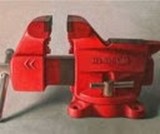
(i). Bench vice: This is a device fastened to the workbench near its edge, used for all types of heavy work, like filing, chipping, sawing, etc. eg
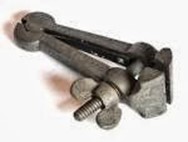
(ii).Hand vice: The hand vice is used where the work piece to be held by the bench vice seems to be too small to be held conveniently .eg.
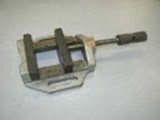
(iii). Machine vice: The machine vice is used for holding work down on the table for the purpose of milling, shaping, drilling, etc. eg.
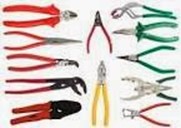
2. Clamps: Clamps are handy tools of various used for smaller articles. They include the following:(i). Pliers: These are very handy tools of various sizes and shapes used for the general purposes of holding small articles and for cutting small wires. They can also be used for pulling, pushing, turning and twisting.eg.
(ii). Toolmaker’s clamp: This is a clamp used for holding parts together during assembling (coupling parts together), riveting, clamping work piece during drilling. Eg.

REVIEW QUESTIONS
(i). name two types of vices used in a metal workshop.(ii). explain the uses of the vices listed above.