WEEK THREE
TOPIC: LOGARITHM- SOLVING PROBLEMS BASED ON LAWS OF LOGARITHM
CONTENT:
- Logarithm of numbers (Index & Logarithmic Form)
- Laws of Logarithm
- Logarithmic Equation
- Change of Base
Logarithm of numbers (Index & Logarithmic Form)
The logarithm to base a of a number P, is the index x to which a must be raised to be equal to P.
Thus if P = ax, then x is the logarithm to the base aof P. We write this as x = log a P. The relationship logaP = x and ax=P are equivalent to each other.
ax=P is called the index form and logaP = x is called the logarithm form
Conversion From Index to Logarithmic Form
Write each of the following index form in their logarithmic form
a) 26 = 64 b) 251/2 = 5 c) 44= 1/256
Solution
a) 26 = 64
Log2 64 = 6
b) 251/2 = 5
Log255=1/2
c) 4-4= 1/256
Log41/256 = -4
Conversion From Logarithmic to Index form.
a) Log2128 = 7 b) log10 (0.01) = -2
c) Log1.5 2.25 = 2
Solution
a) Log2128 = 7
27 = 128
b) Log10(0.01) = -2
10-2= 0.01
c) Log1.5 2.25 = 2
1.52 = 2.25
Laws of Logarithm
a) let P = bx, then logbP = x
Q = by, then logbQ = y
PQ = bx X by = bx+y (laws of indices)
LogbPQ = x + y
:. LogbPQ = logbP + LogbQ
b) P÷Q = bx÷by = bx+y
LogbP/Q = x –y
:. LogbP/Q = logbP – logbQ
c) Pn= (bx)n = bxn
Logbpn = nbx
:. LogPn = logbP
d) b = b1
:. Logbb = 1
e) 1 = b0
Logb1 = 0
EXAMPLE – Solve each of the following:.
a) Log327 + 2log39 – log354
b) Log313.5 – log310.5
c) Log28 + log23
d) given that log102 = 0.3010 log103 = 0.4771 and log105 = 0.699 find the log1064 + log1027
Solution
a) Log327 + 2 log39 – log354
= log3 27 + log3 92 –log354
= log3 (27 X 92/54)
= log3 (271 X 81/54) = log3 (81/2)
= log3 34/log32
= 4log3 3 – log3 2
4 X (1) – log3 2 = 4 – log3 2
= 4 – log3 2
b) log3 13.5 – log3 10.5
= log3 (13.5)- Log310.5 = log3 (135/105)
= log3 (27/21) = log3 27 – log3 21
= log3 3 3 – log3 (3 X 7)
= 3log3 3 – log3 3 -log37
= 2 – Log3 7
c) Log28 + Log33
= log223+ log33
= 2log22 + log33
2+1=3
d) log10 64 + log10 27
log10 26 + log1033
6 log10 2 + 3 log10 3
6 (0.3010) + 3(0.4771)
1.806 + 1.4314 = 3.2373.
EVALUATION
1. Change the following index form into logarithmic form.
(a) 63= 216 (b) 33 = 1/27 (c) 92 = 81
2. Change the following logarithm form into index form.
(a) Log88 = 1 (b) log ½¼ = 2
3. Simplify the following
a) Log512.5 + log52
b) ½ log48 + log432 – log42
c) Log381
4. Given that log 2 = 0.3010, log3 0.477
Log105 = 0.699, find the log10 6.25 + log10
Logarithmic Equation
Solve the following equation
a) Log10 (x2 – 4x + 7) = 2
b) Log8 (r2 – 8r + 18) = 1/3
Solution
a) Log10 (x2 – 4x + 7) = 2
X2 – 4x + 7 = 102 (index form)
X2 – 4x + 7 = 100
X2 – 4x + 7 – 100 = 0
X2 – 4x – 93 = 0
Using quadratic formular
= – b ±√b2– 4ac
2a
a = 1, b = -4, c = – 93

x = – (- 4) ± √(- 4) 2 – 4 X 1 X (- 93)
2 X 1
 = + 4 ± √16 + 372
2
= + 4 ± √388/2
= x = 4 +√ 388/2 or 4 – √388/2
x = 11.84 or x = – 7.85
2) Log8 (x2 – 8x + 18) =81/3
X2 – 8x + 18 = 81/3
X2 – 8x + 18 = (2)3X1/3
X2 – 8x + 18 =2
X2 – 8x 18 – 2 = 0
X2 – 8x + 16 = 0
X2 – 4x – 4x + 16 = 0
X(x – 4) -4 (x – 4) = 0
(x – 4) (x – 4) = 0
(x – 4) twice
X = + 4 twice
Change of Base
Let logbP = x and this means P = bx
LogcP = logcbx = x logcb
If x logcb = logcP
X = logcP
Logc b
:. LogcP = logcP
Logcb
Example : Shows that logab X logba = 1
Logab = logcb
Logca
Logba = logca
Logcb
:. Logab X logba = logcb X logca
Logca + logcb= 1
EVALUATION
Solve the following logarithm equation.
Log3 (x2 + 7x + 21) = 2
Log10 (x2 – 3x + 12) = 1
Reading Assignment : Further Maths Project Book 1(New third edition).Chapter 2 pg. 8- 10
ASSIGNMENT
- If log81/64 = x, find the value of x (a) 2 (b) 1 (c) -3 (d) -4.
2) Solve 9(1 – x) = (1/27) x+1 (a) -5 (b) -1 (c) 1 (d) ½
3) Simplify log7 49 (a) 1/7 (b) 2 (c) 7 (d) log 1/7
4) Solve the equation log216 = x (a) 8 (b) 4 (c) 2 (d) 2
5) Convert 52 = 25 into logarithm form (a) log525 = 2 (b) log 255 = 2 (c) log225 = 5 (d) None of the above
Theory
(1) Find the value of x for which log10 (4x2 + 1) -2 log10 x – log10 2 = 1 is valid.
(2) Solve the logarithmic equation: Log4 (x2 + 6x + 11) = ½
TOPIC: LOGARITHM OF NUMBERS LESS THAN ONE
CONTENTS
- Standard forms
- Logarithm of numbers greater than one
- Multiplication and divisions of numbers greater than one using logarithm
- Using logarithm to solve problems with roots and powers (no > 1)
- Logarithm of numbers less than one.
- Multiplication and division of numbers less than one using logarithm
- Roots and powers of numbers less than one using logarithm
Standard Forms
Numbers such as 1000 can be converted to its power of ten in the form 10n where n can be term as the number of times the decimal point is shifted to the front of the first significant figure i.e. 10000 = 104
Number Power of 10
- 102
- 101
- 100
- 10-3
- 10-1
Note: One tenth; one hundredth, etc are expressed as negative powers of 10 because the decimal point is shifted to the right while that of whole numbers are shifted to the left to be after the first significant figure.
A number in the form A x 10n, where A is a number between 1 and 10 i.e. 1<A<10 and n is an integer is said to be in standard form e.g. 3.835 x 10³ and 8.2 x 10⁻⁵ are numbers in standard form.
Examples : Express the following in standard form
- 7853
- 382
- 0.387
- 0.00104
Solutions
- 7853 = 7.853 x 10³
- 382 = 3.82 x 10²
- 0.387 = 3.87 x 10⁻¹
- 0.00104 = 1.04 x 10⁻³
Logarithm of numbers greater than one
Base ten logarithm of a number is the power to which 10 is raised to give that number e.g.
628000 = 6.28 x10⁵
628000 = 100.7980 x 105
= 100.7980+ 5
= 105.7980

 Log 628000 = 5.7980
IntegerFraction (mantissa)
If a number is in its standard form, its power is its integer i.e. the integer of its logarithm e.g. log 7853 has integer 3 because 7853 = 7.853 x 10³
Examples: Use tables (log) to find the complete logarithm of the following numbers.
(a) 80030 (b) 8 (c) 135.80
(a) 80030 = 4.9033
(b) 8 = 0.9031
(c) 13580 = 2.1329
Multiplication and Division of number greater than one using logarithm
To multiply and divide numbers using logarithms, first express the number as logarithm and then apply the addition and subtraction laws of indices to the logarithms. Add the logarithm when multiplying and subtract when dividing.
Examples: Evaluate using logarithm.
1. 4627 x 29.3
2. 8198 ÷ 3.905
3. 48.63 x 8.53
15.39
Solutions
1. 4627 x 29.3
 No Log
 4627 3.6653
X 29.3 + 1.4669
 Antilog → 1356005.1322
 .
.
\ 4627 x 29.3 = 135600
To find the Antilog of the log 5.1322 use the antilogarithm table:
Check 13 under 2 diff 2 (add the value of the difference) the number is 0.1356. To place the decimal point at the appropriate place, add one to the integer of the log i.e. 5 + 1 = 6 then shift the decimal point of the antilog figure to the right (positive) in 6 places.
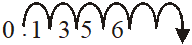
= 135600
2. 819.8 x 3.905
No Log
819.8 2.9137
3.905 0.5916
antilog → 209.9 2.3221
\ 819.8 ÷ 3.905 = 209.9
3. 48.63 X 8.8.53
15.39
 No Log
 48.63 1.6869
8.53 + 0.9309
2.6178
÷ 15.39 – 1.1872
 antilog → 26.95 1.4306

\48.63 ÷ 8.53 = 26.96
15.39
Evaluation:
1. Use table to find the complete logarithm of the following:
(a) 183 (b) 89500 (c) 10.1300 (d) 7
2 Use logarithm to calculate.
3612 x 750.9
113.2 x 9.98
Using logarithm to solve problems with powers and root
(nos. greater than one).
Examples:

 Evaluate
(a) 3.533 (b) 4 40000 (c) 94100 x 38.2
5.683 x 8.14 (2s.f)
 Solution
No. Log_____
3.533 0.5478 x 3
44.00 1.6434
\ 3.533 = 44.00
 (b) 4 40000

 No. Log_____

4 4000 3.6021 ÷ 4

7.952 0.9005
 \ 4 4000 = 7.952

(c) 94100 x 38.2
5.6833 x 8.14
Find the single logarithm representing the numerator and the single logarithm representing the denominator, subtract the logarithm then find the anti log.
(Numerator – Denominator).

 No Log


94100 4.9736 ÷ 2 = 2.4868
38.2 1.5821
Numerator 4.0689 → 4.0689
5.683 0.7543 x 3 = 2.2629
8.14 0.9106
Denominator 3.1735 → 3.1735
 7.859 0.8954


\94100 x 38.2 = 7.859
5.683 x 8.14
~ 7.9 (2.sf)
Logarithm of number less than one.
To find the logarithm of number less than one, use negative power of 10 e.g.
0.037 = 3.7 x 10⁻²
10 0.5682 x 10⁻²
10 0.5682 + (-2)
10-2 5682
Log 0.037 = 2 . 5682
 2 . 5682


Integer decimal fraction (mantissa)
Example: Find the complete log of the following.
(a) 0.004863 (b) 0.853 (c) 0.293
Solution

 Log 0.004863 = 3.6369
 Log 0.0853 = 2.9309
 Log 0.293 = 1.4669
Evaluation
1. Find the logarithm of the following:
(a) 0.064 (b) 0.002 (c) 0.802
2. Evaluate using logarithm.

95.3 x 318.4
1.295 x 2.03
Using logarithm to evaluate problems of Multiplication, Division, Powers and roots with numbers less than one.
Examples:
1. 0.6735 x 0.928
2. 0.005692 ¸ 0.0943
3. 0.61043
 4. 4 0.000
 5. 3 0.06642
Solution
1. 0.6735 x 0.928
 No. Log.___
0.6735 1.8283
0.928 1.9675

 0.6248 1.7958
\ 0.6735 x 0.928 = 0.6248
2. 0.005692 ¸ 0.0943

No Log
0.005692 3.7553
¸ 0.0943 2.9745
0.06037 2.7808
 3. 0.61043
 No Log_____
0.61043 1.7856 x 3
0.2274 1.3568
\ 0.61043 = 0.2274
\ 0.005692 ¸ 0.943 = 0.6037
 4. 4 0.00083
 No. Log._____

 4 0.00083 4.9191 ¸ 4
 0.1697 1.2298

\ 4 0.06642 = 0.1697
 5. 3 0.6642

No. Log.____________


3 0.6642 2.8223 ¸ 3
 2.1 + 1 + 0.8223 ¸ 3
 3 + 1 .8223 ¸ 3
 1 + 0.6074
 0.405 1.6074

3 0.6642 = 0.405
Note: 3 cannot divide 2 therefore subtract 1 from the negative integer and
add 1 to the positive decimal fraction so as to have 3 which is divisible
by 3 without remainder.
Evaluation:
 1. Evaluate
5 (0.1684)3

2. 6.28 x 304
981
Reading Assignment :Further Maths Project Book 1(New third edition).Chapter 2 pg.10- 16
ASSIGNMENT
Use table to find the log of the following:
1. 900 (a) 3.9542 (b) 1.9542 (c) 2.9542 (d) 0.9542
2. 12.34 (a) 3.0899 (b) 1.089 (c) 2.0913 (d) 1.0913
3. 0.000197 (a) 4.2945 (b) 4.2945 (c) 3.2945 (d) 3.2945
4. 0.8 (a) 1.9031 (b) 1.9031 (c) 0.9031 (d) 2.9031
5. Use antilog table to write down the number whose logarithms is 3.8226.
(a) 0.6646 (b) 0.06646 (c) 0.006646 (d) 66.46
Theory
Evaluate using logarithm.

1. 23.97 x 0.7124
 3.877 x 52.18
2. 3 69.52 – 30.52
WEEK TWO (2) DATE: 26th-30th September, 2016
TOPIC: SURDS
COTENT:
- Rules of surds
- Basic Form of Surds
- Similar Surds
- Conjugate Surds
- Simplification of Surds
- Additional & Subtraction of Surds
- Multiplication and Division of Surds
- Rationalization of Surds
- Equality of Surds
Rules of Surds
Surds are irrational numbers. They are the root of rational numbers whose value can not be expressed as exact fractions. Examples of surds are: √2, √7, √12, √18, etc.
- √(a X b ) = √a X √ b
- √(a / b ) = √a / √b
- √(a + b ) ≠ √a + √b
- √(a – b ) ≠ √a – √b
Basic Forms of Surds
√a is said to be in its basic form if A does not have a factor that is a perfect square. E.g. √6, √5, √3, √2 etc. √18 is not in its basic form because it can be broken into √ (9×2) = 3√2. Hence 3√2 is now in its basic form.
Similar Surds
Surds are similar if their irrational part contains the same numerals e.g.
- 3√n and 5√ n
- 6√2 and 7√2
Conjugate Surds
Conjugate surds are two surds whose product result is a rational number.
(i)The conjugate of √3 – √5 is √3 + √5
The conjugate of -2√7 + √3 is -2√7 – √3
In general, the conjugate of √x + √y is √x – √y
The conjugate of √x – √y = √x + √y
Simplification of Surds
Surds can be simplified either in the basic form or as a single surd.
Examples 1. Simplify the following in its basic form (a) √45 (b) √98
Solution
(a) √45 = √ (9 x 5) = √9 x √5 = 3√5
(b) √98 = √ (49 x 2) = √49 x √2 = 7√2
Example 2. Simplify the following as a single surd (a) 2√5 (b) 17√2
Solution
(a) 2√5 = √4 x √5 = √ (4 x 5) = √20
(b) 17√2 = √289 x √2 = √ (289 x 2) = √578
Addition and Subtraction of Surds
Surds in their basic forms which are similar can be added or subtracted.
Example: Evaluate the following
(a)√32 + 3√8 (b) 7√3 – √75 (c) 3√48 – √75 + 2√12
Solution
- (√32 + 3√8
=√ (16 x 2) + 3√ (4 x 2)
=4√2 + 6√2
= 10√2
(b) 7√3 – √75
= 7√3 – √ (25 x 3)
=7√3 – 5√3
=2√2
(c) 3√48 – √75 + 2√12
= 3√ (16 x 3) – √ (25 x 3) + 2√ (4 x 3)
= 12√3 – 5√3 + 4√3
= 11√3
EVALUATION
1. Simplify the following (a)5 √ 12 – 3 √ 18 + 4 √72 + 2 √75 (b) 3√2 – √32 + √50 + √98
2. Multiply the following by their conjugate (a) √3 -2√5 (b) 3√2 + 2√3
Multiplication and Division of Surds
Example: Evaluate the following (a) √45 x √28 (b) √24 / √50
Solution
√45 x √28
= √ (9 x 5) x √ (4 x 7)
= 3√5 x 2√7
= 3 x 2 x √ (5 x 7)
= 6√35
(b)√24 / √50
= √ (24 / 50)
= √ (12 / 25)
= √12 / √25
= √ (4 x 3) / 5
= 2√3 / 5
Surds Rationalisation
Rationalisation of surds means multiplying the numerator and denominator by the denominator or by the conjugate of the denominator.
Example: Evaluate the following (a) 6 / √3 (b) 3
√3 + √2
Solution
- 6 / √3 (b) 3

 = 6 x √3 √3 + √2

 = 6 x √3 √3 + √2
√3 x √3 = 3 (√3 – √2)

 = 6√3 (√3 + √2) (√3 – √2)
3 = 3√3 – 3√2
 = 2√3 (√3)2 – (√2)2
= 3√3 – 3√2
3 – 1
= 3√3 – 3√2
1
= 3( √3 -√2)


 Equality of Surds
Given two surds i.e P + m and q + n if P + m = q + n, then

 P – q = n – m the L.H.S
Of the equation is a rational number while the L.H.S and R.H.S can only be equal of they are both equal to zero (0)
P – q = 0
:. P = q and n – m = 0 i.e.

 N = m
N = m
Examples – 
 Find the square root of the following?
a) 7 + 2 10 b) 14 – 4 6
Solution


 (a) Let the square root of 7 + 2 10 be m + n
 ( m + n) 2 = 7 + 2 10

 M +2 m n+ n = 7 + 2 10
M + n = 7 _____ (1)

 2 m n = 2 10


M n = 10
Squarely both surds we have
M n = 10 _______(ii)
M + n = 7 ______ (i)
M n = 10 _______ (ii)
From equation (1) m = 7 – n
Put m in (ii) we have
(7 – n) n = 10
7n – n2 = 10
In sum; n2 – 7n + 10 = 0
n2 – 2n – 5n + 10 =0
n (n – 2) – 5 (n – 2) = 0
(n -5) (n – 2) = 0
n = 5 or 2
m = 7 – 2, where n = 2
m = 5,
m = 7 – 5 , when n = 5
m = 2
m= 5 or 2
 The square root of 7 + 10 are 5 + 2 twice.


 (b) Let the square root of 14 – 4 6 be p – Q

 The ( p – Q)2 = 14 – 4 6

 P – 2 pQ + Q = 14 – 4 6
P +Q = 14 ……………………………(1)


 -2 pQ = 4 6
 -2 – 2
 PQ = 2 6 (squaring both sides)

PQ = = (2 6 )2
PQ = 4 x 6 ……………………………….. (11)
P +Q = 14 ………………………………… (1)
PQ = 24 ……………………………………… (11)
From equation……………… (1) p = 14 – Q
Sub for p in equation ………………… (11)
(14 –Q ) Q = 24
14 Q – Q 2 = 24
In turn we have :
Q2 – 14 Q + 24 = 0
Q2 – 12Q– 2Q + 24 = 0
Q (Q -12) – 2 (Q – 12) = 0
Q = 2 or 12
if p = 14 – Q ,when Q= 12
p = 14 – 12
p = 2
if p = 14 – Q, when q = 2
p = 14- 2
= 12


 12 – 2 = 2 3 – 2 and

 2 – 12 = 2 – 2 3
EVALUATION
1.Express 3√2 – √3in the form √mwhere m and n are whole number.
2√3 – √2 √n
2.Express 1 in the form p√5 + q√3, where p and q are rational numbers.
√5 +√3
Reading Assignment :Further Maths Project Book 1(New third edition).Chapter 3 pg.19-27
ASSIGNMENT
1.Expand (3√2 – 1)(3√2 + 1) (a) 16 (b) 20 (c) 17 (d) 24
2.Simplify √200 in its basic form (a) 10√2 (b) 5√4 (c) 2√10 (d) 2√50
3.Simplify 9/√3 (a) 3√2 (b) 3√3 (c) 1/3 (d) 2√2
4.Express 3√5 as a single surd (a) √40 (b) √55 (c) √45 (d) √35implify
5.Simplify √`128 – 4√8 (a) 0 (b) 1 (c) 2 (d) 3
Theory
1.Express 3√2 – √3in the form √mwhere m and n are whole number.
2√3 – √2 √n
2.Express 1 in the form p√5 + q√3, where p and q are rational numbers.
√5 +√3
1 . Evaluate the following (a) 323/5 (b) 251.5 (c) (0.000001)2 (d) 3432/3 (e) 190
2 . Solve the following exponential equations (a) 2x = 0.125 (b) 3-x = 243 (c) 25x = 625 (d) 10x = 1/0.001 (e) 4/2x =64x
3 . Solve the following exponential equations (a) 22x -6(2x) + 8 = 0 (b) 22x+1 -5(2x) + 2 = 0
(c) 32x – 4(3x+1) +27 = 0 (d) 32x – 9 = 0 (e) 72x – 2 X 7x + 1 = 0
4 . Change each of the following index form to their logarithmic form (a) 26 = 64 (b) 3-3 =1/27 (c) 251/2 =5 (d) 35 = 243 (e) (0.01)2 = 0.0001
5 . Change the following logarithmic form into index form (a) log2128 = 7 (b) log1/2(1/4) = 2 (c) log749 = 2 (d) log51/125 = -3 (e) log51 = 0
6 . Simplify each of the following (a) log327 + 2log39 –log354 (b) 1/2log48 + log432 – log42 (c) log2√8 + log3√3 (d) logxx9 (e) log512.5 + log52
7 . Solve the following logarithmic equations (a) log10(x2 – 4x + 7) = 2 (b) log8(x2 – 8x + 18) = 1/3 (c) log5(x2 – 9) = 0 (d) log4(x2 + 6x + 11) = ½
8 . Use logarithm table to evaluate the following (a) (3.68)2 x 6.705 (b)√0.897 x 3.536
√0.3581 0.00249
9 . Simplify each of the following (a) 2√12 + 3√48 + √75 (b) 4√8 – 2√98 + √128 (c) (3√2 – 1) (3√2 + 1 )
10 . Express 1 in the formm√5 + n√3where m and n are rational numbers
3√5 + 5√3