WEEK 3
Topic: Gradients of straight lines and curves
Sub-topic:
Gradients of straight lines
Duration: 40 minutes
Learning Objectives: By the end of the lesson, students should be able to calculate the gradient of a straight line.
Reference Materials: i. New General Mathematics for SSS 2, by M.F Macrae et al. Pages 184 – 192.
Previous Knowledge: Students can draw the graph of a linear equation (straight-line graph).
Instructional Materials: Graph board and graph book.
Content: GRADIENT OF A STRAIGHT LINE
The gradient of a straight line is the rate of change of y compared with x.
For example, if the gradient is 2, then for any increase in x, y increases two times as much.
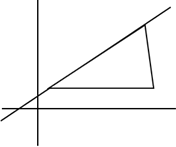
Gradient of AB = Increase in y from A to B = MB
Increase in x from A to B AM
Example
Find the gradient of the line joining P(7, -2) and Q(-1, 2)


Gradient of PQ = increase in y = – AQ
Increase in x PA
=
Example 2
Find the gradient of the line 7x + 4y – 8 = 0
Re-arrange the equation: 4y = – 7x + 8
y = + 2
Therefore, gradient (m) = , y – intercept (c) = 2
SKETCHING GRAPHS OF STRAIGHT LINES
Given the equation
y = 3x – 2 , gradient = 3, y – intercept(c) = -2
2x + 3y = 6, gradient = , y – intercept(c) = 2
Example
Sketch the graph of the line whose equation is 4x – 3y = 12
Solution
When x = 0 ,- 3y = 12
y = – 4
The line crosses the y – axis at (0, – 4).
When y = 0 , 4x = 12
x = 3
The line crosses the x – axis at (3, 0).
 From the graph:
Gradient m =
= =
y – intercept = – 4
Lines parallel to axes
Any line parallel to the x – axis has a gradient of zero. The equation of such lines is always in the form
y = c, where c may be any number.
The figure below shows the graph of y = 5 and y = – 3.
Notice that the equation of the x – axis is y = 0

————————————
————————————-
The gradient of a line that is parallel to the y – axis is undefined. The equations of such a lines are always in the form x = a , where a may be any number.
The figure below shows the graph of line x = 2 and x = – 4.
Notice that the equation of the y – axis is x = 0

EQUATION OF A STRAIGHT LINE
Equation of a straight line is of the form y = mx + c, where m is the gradient and c is the y – intercept.
Example 1
Determine the equation of a straight line whose gradient is and passes through the point (- 3, 2).
Solution
Using the formula y – y1 = m(x – x1)
Where (x1, y1) = (- 3, 2) and m =
y – 2 = (x + 3)
3y – 6 = – x – 3
x + 3y = 3
Example 2
Find the equation of the straight line passing through the points (1, 4) and (- 2, 6).
Using the formula
=
Where = (x1, y1) = ( 1, 4) and (x2, y2) = (- 2, 6), the equation is
=
cross multiply
– 3y + 12 = 2x – 2
2x + 3y = 14
GRADIENT OF A CURVE
Example
Draw the graph of y = for values of x from –2 to 3. Find the gradient of the curve at the point where x has the value (a) (b) – 2
Solution
| x | -2 | -1 | 0 | 1 | 2 | 3 |
| y | 1 | ¼ | 0 | ¼ | 1 | 2¼ |
(a) Gradient of the curve where x = 3
= gradient of tangent PT
= = 2.25 = 2¼ = 9 = 11/2
1.5 1.5 6
(b) Gradient of curve where x = – 2
= gradient of tangent QR
= – = – 1 = – 1
1