WEEK 3
Balancing Chemical Equations
Atoms are neither created nor destroyed during any chemical reaction. Chemical changes merely rearrange the atoms.
The statement above is supported by:
- Law of conservation of mass/matter
- Law of definite proportions
- Law of multiple proportions
Chemical reactions are represented in a concise way by chemical equations.
2 H2 + O2 → 2 H2O
- The reacting substances, called reactants, are located on the left side of the arrow.
- The substances formed, called products, are located on the right side of the arrow.
- In a chemical equation, the + sign is read as “reacts with” and the arrow is read as “produces”.
- Numbers in front of the formulas are coefficients, indicating the relative number molecules or ions of each kind involved in the reaction.
Coefficients of 1 are never written – they are understood.
- Numbers to the lower right of chemical symbols in a formula are subscripts, indicating the specific number of atoms of the element found in the substance.
- Subscripts of 1 are never written – they are understood.
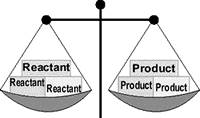 A chemical equation must have the same number of atoms of each element on both sides of the arrow. When this condition is met, the equation is said to be balanced.
To count atoms, multiply the formula’s coefficient by each symbol’s subscript.
For example: 2Al2(SO4)3
- For Al – coefficient of 2, times subscript of 2 = 4 aluminum atoms
- For S – coefficient of 2, times subscript inside parenthesis of 1, times subscript outside parenthesis of 3 = 6 sulfur atoms
- For O – coefficient of 2, times subscript inside parenthesis of 4, times subscript outside parenthesis of 3 = 24 oxygen atoms
The order in which the following steps are performed is important. While shortcuts are possible, (and you will learn about one), following these steps in order is the best way to be sure you are correct.
Balance equations “by inspection” with these steps:
- Check for diatomic molecules.
- Balance the metals (not Hydrogen).
- Balance the nonmetals (not Oxygen).
- Balance oxygen.
- Balance hydrogen.
- The equation should now be balanced, butrecount all atoms to be sure.
- Reduce coefficients (if needed). ALL coefficients must be reducable before you can reduce. An equation is not properly balanced if the coefficients are not written in their lowest whole-number ratio.
HINT: NEVER change subscripts to balance equations.
The physical state of each substance in a reaction may be shown in an equation by placing the
following symbols to the right of the formula:
- (g) for gas
- (l) for liquid
- (s) for solid
- (aq) for aqueous (water) solution
Stoichiometry is the quantitative study of chemical changes.
The most common type of stoichiometry calculation is a mass-mass problem. Generally, a mass-mass problem looks like this: “given this amount of reactant, how much product will form?”
Steps in solving a mass-mass problem:
- Write a balanced equation for the reaction.
- Write the given mass on a factor-label form.
- Convert mass of reactant to moles of reactant.
- Convert moles of reactant to moles of product.
- Convert moles of product to grams of product.
- Pick up the calculator and do the math.
Mass-Mass Sample Problem:
If iron pyrite, FeS2, is not removed from coal, oxygen from the air will combine with both the iron and the sulfur as coal burns. If a furnace burns an amount of coal containing 125 g of FeS2,
how much SO2 (an air pollutant) is produced?
1. Write a balanced equation showing the formation of iron (III) oxide and sulfur dioxide.
4 FeS2 + 11 O2 → 2 Fe2O3 + 8 SO2
2. Write the mass information given in the problem.
3. Convert grams of FeS2 to moles of FeS2.
4. Changes moles of FeS2 (reactant) to moles of SO2 (product).
This ratio comes from the coefficients in the balanced equation. Notice that the ratio was reduced from 8 : 4 to 2 : 1 when placed in the dimensional analysis form. While reducing is not
absolutely necessary (the ratio will cancel properly even if not reduced), a good chemistry student notices such things and will do it.
5. Convert moles of SO2 to grams of SO2 .
6. All units have been canceled except for grams of SO2 (product). The problem has been solved. Pick up the calculator and do the math.
Stoichiometry
The limiting reactant is the reactant that is completely consumed in the reaction.
- The limiting reactant is not present in sufficient quantity to react with all other reactants.
- The reaction stops when the limiting reactant is completely consumed.
- Any remaining reactants are considered “excess reactants”.
- The amount of product formed is determined by the “limiting reactant”.
Steps in solving a limiting reactant problem:
- Write a balanced equation for the reaction.
- Convert both reactant quantities to moles.
- Determine the moles of product that could be formed by each reactant.
- The least amount in step #3 identifies the limiting reactant.
- Use that number of moles of product to determine the mass produced.
A limiting reactant problem example: What mass of water can be produced by 4 grams of hydrogen gas reacting with 16 grams of oxygen gas?
The problem solution:
1. Write a balanced equation for the reaction.
2 H2 + O2 → 2 H2O
2. Convert both reactant quantities to moles.
Using the mole ratio from the equation, determine the moles of water that could be formed by each reactant.
4. Oxygen produces the least amount of water.
- 16 grams of oxygen cannot produce as much water as 4 grams of hydrogen. In other words, 16 grams of oxygen will be used up in the reaction before 4 grams of hydrogen.
- Oxygen is the “limiting” reactant.
- Use oxygen for the calculation of product amount.
5. Complete the problem by converting moles of H2O to mass of H2O.
The theoretical yield for this problem is 18 grams. If you performed this reaction in the lab, your actual yield might be less. Can you think of reasons why?
Limiting Reactant Problems
Percent Yield
- The quantity of product that is calculated to form when all the limiting reactant is used up is called the theoretical yield.
- The amount of product actually obtained in a reaction is called the actual yield.
- The actual yield is almost always less than (and never greater than) the theoretical yield.

Sample problem:
Given the reaction:
Fe2O3(s) + 3CO(g) → 2Fe(s) + 3CO2(aq)
A. If you start with 155 g of Fe2O3 as the limiting reactant, what is the theoretical yield of Fe?
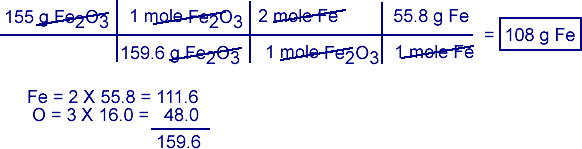
B. If the actual yield of Fe was 87.9 g, what was the percent yield?

EVALUATION
- S8 + O2 → SO3
- HgO → Hg + O
- Zn + HCl → H2 + ZnCl2
- Na + H2O → NaOH + H2
- C10H16 + Cl → C + HCl
- 5.Si2H3 + O2 → SiO2 + H2O
- Fe + O → Fe2O3
- FeS2 + O2 → Fe2O3 + SO2
- Fe2O3 + H2 → Fe + H2O
- K + Br →
- C2H2 + O2 →
- H2O2 → H2O + O2
- C7H16 + O2 → CO2 + H2O
- SiO2 + HF →
- KClO3 → KCl + O2
- KClO3 → KClO4 + KCl
- P4O10 + H2O → H3PO4
- Sb + O → Sb4O6
- Fe2O3 + CO → Fe + CO2
- PCl5 + H2O → HCl + H3PO4
- H2S + Cl → S8 + HCl
- Fe + H2O → Fe3O4 + H2
- N + H → NH3
- N2 + O2 → N2O
- CO2 + H2O → C6H12O6 + O
- SiCl4 + H2O → H4SiO4 + HCl
- H3PO4 → H4P2O7 + H2O
- Al(OH)3 + H2SO4 → Al2(SO4)3 + H2O
- Fe2(SO4)3 + KOH → K2SO4 + Fe(OH)3
- H2SO4 + HI → H2S + I + H2O
- Al + FeO →
- P4 + O2 → P2O5
K2O + H2O → KOH
- Na2O2 + H2O → NaOH + O
- C + H2O → CO + H
- H3AsO4 → As2O5 + H2O
- Al2(SO4)3 + Ca(OH)2 →
- FeCl3 + NH4OH →
- Ca3(PO4)2 + SiO2 → P4O10 + CaSiO3
- N2O5 + H2O → HNO3
- Al + HCl

- H3BO3 → H4B6O11 + H2O
- Mg + N →
- NaOH + Cl → NaCl + NaClO + H2O
- Li2O + H2O → LiOH
- CaC2 + H2O → C2H2 + Ca(OH)2
- Fe(OH)3 → Fe2O3 + H2O
- Pb(NO3)2 → PbO + NO2 + O
- Ca + AlCl3 → CaCl2 + Al
- NH3 + NO → N + H2O
- H3PO3 → H3PO4 + PH3
- Fe2O3 + C → CO + Fe

- FeS + O2 → Fe2O3 + SO2
- NH3 + O → NO + H2O
- Hg2CO3 → Hg + HgO + CO2
- SiC + Cl → SiCl4 + C
- Al4C3 + H2O → CH4 + Al(OH)3
- Ag2S + KCN → KAg(CN)2 + K2S
- Au2S3 + H → Au + H2S
- ClO2 + H2O → HClO2 + HClO3
- MnO2 + HCl → MnCl2 + H2O + Cl
1.From XNH3(g)+YO2-ZNO(g)+QH2O(g)
The value of Z is
(A) .4 (B) .7 (C).6 (D).5
2.One molecule of oxygen atoms
(A).has a molar mass of 32g (B).has 6.02x 10²³
(C).can be represented as O2 (D) .has a formula mass of 16
(E) Contains Avogadro’s number of atom
3.The numerical coefficients in a balanced equation give
(A).the number of moles of reactants and products
(B).the molar mass of the reactants and products
(C).the number of moles of reactants only
(D).the number of molecules and atoms of products
(E).the mass ratio of the reactants