SCHEME OF WORK FOR ENGLISH LANGUAGE
OMEGA TERM JSS THREE
| WEEKS TOPIC |
|
|
|
|
|
|
|
|
|
|
|
|
|
|
| 11 EXAMINATION. |
WEEK TWO
REVISION
SPEECH WORK
TOPIC: THE VOWEL SOUNDS
In a phonetic definition, vowels are distinguished from consonants in term of how they are articulated in the vocal tract and the associated patterns of acoustic energy.
When vowel sounds are produced, air escapes in a relatively unimpeded way through the mouth or nose. Such articulation involves only slight moments of the tongue and lips.
Vowels can, therefore, be defined as the sounds produced with neither a complete nor a narrowing of the vocal tract. Vowel sounds are produced when there is a free flow of air.
Vowel sounds can also be define as the sound in which there is no obstruction to the flow of air as it passes from the larynx to the lips. Vowels are normally described with reference to four criteria:
- The part of the tongue that is raised front, back, centre or lip.
- The extent to which the tongue raises in the direction of the palate-high, mid or low. Alternatively, tongue height can be described as close, mid-close, mid-open and open.
- The position of the soft palate-raised for oral vowels and lowered for nasalized vowels.
- The kind of opening made at the lips-various degrees of rounding or spreading.
TYPES OF VOWEL SOUNDS
The vowels sounds of English can be classified into three
- Monothongs or pure vowels
- Diphthongs or impure vowels
- Triphthongs
THE MONOTHONGS
A vowel is monothongs or pure when only one sounds is involved. The monothongs are twelve. However, they are further divided into two groups thus: the short and long vowels.
- The Short Vowels: They are so called due to the brevity of the sounds the denote during speech process. They are as follows: /i/, /e/, /u/, /əe/, /ə/, /ɔ/, and /ʌ/. The seven short vowel sound can also be called lax vowels.
- The Fine Long Vowel: Which can also be called the tense vowels are fine. They include /i:, a:, ɔ:, u:, ɛ:/
THE TWELVE MONTHONGS
- /I:/ – This is a long sound, produced by raising the front of the tongue towards the hard palate; the lips are spread to a neutral position, and the air is forced through. Examples are found in words like read, see, chief, key be etc.
- /i/ – This is a short form of vowel one. it is produced by raising the front of the tongue towards the hand palate. Especially the central position of the palate, and the middle part of the tongue is raised slightly higher than half closed position and the lips are somewhat spread. Examples; fit, little, hill, ship etc.
- /e/ – The vowel is produced by raising the front of the tongue and the middle of the tongue to about half the distance between close and open, and the lips between being spread and neutral. Examples are in words like bet, egg, spread, pen, get, pet etc.
- /əe/ – This is produced by raising the blade of the tongue and the middle of the tongue raised to about one-sixth of the distance between open and close, and the lips between neutral and spread. Examples are in words like: – bad, mat, man, match, back, bag, etc.
- /a:/ – This vowel involves the back of the tongue unlike the previous ones, the middle of the tongue is quite low down in the mouth, and the lips are in the neutral position. Examples – father, calm, clerk, laugh, dark, saga, class, pass etc.
- /ɔ/ – This is articulated with the back of the tongue. While the lips are slightly rounded, the jam is usually open during pronunciation. The vowel is not quite fully back, and between open – mid and open in tongue height. Examples not, box, long, spot, bought, because, cop, cough, what, want etc.
- /ɔ:/ – This is the long variant of vowel 6. It is produced by raising the back of the tongue, slightly raising the middle of the tongue and rounding the lips very considerably. Examples – saw, law, caught, fought, cord, sword etc.
- /u/ – This sound is produced by raising the back of the tongue toward the soft palate (root of the mouth), raising the middle of the tongue in a little above half close position, and closely rounding the lips. It is short vowel with examples – put, foot, book, push, would, could, bought, woman, bosom, circular, bullet etc.
- /u:/ – This sound is mad right at the top and back of the mouth and the lips are moderately rounded. During production, the tongue is raised to a certain height towards the soft palate, the middle of the tongue is produced by raising the back of the tongue almost to close position and closely rounding the lips. Examples – two, food, moot, canoe, shoe, do, to, move, mute, rule, fruit, juice, suit etc.
- /ʌ/- This is a short sharp vowel, produced by raising the back of the tongue, though not fully, raising the middle of the tongue somewhat half way, and leaving the lips difficult sound for most Nigerians. Examples: cut, but mother, cup, stuck, done, some, sum, does, worry come, love, couple etc.
- /
ɛ:/ – This is a long weak vowel, which is produced by raising the central part of the tongue and the lips in a central position. Is a central vowel that is often spelt “er”. It is pronounced “air” – – (r) – – (r). examples: fern, bird, girl, earth, journey, tournament, scourge, thirst, thirty, circuit, skirt etc.
- /ə/ – This is a short, weak vowel, which is produced by raising the central part of the tongue and the lips kept in a neutral position. It occurs mostly in unaccented syllables. It is called the schwa sound. It is generally not articulated with much energy. Examples: Mature, formula, curable, matter, doctor, neighbour, famous, confuse, today etc.
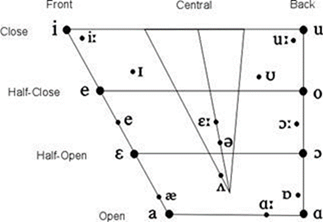
It is the most frequently occurring vowel for monothongs, it is usual to represent the position where each is articulated in the mouth.
CARDINAL VOWELS CHART

REVISION
GRAMMAR
TOPIC: MEANING AND TYPES OF NOUN
The word noun is derived from a Latin word “nomeri” (a name). a noun can therefore, simply be defined as the name of anything. It may be concrete, real or tangible such as Ayo, Lagos, Book, Teacher, Pupil, Water etc. It may be abstract, intangible or imaginary such as Hope, Fear, Belief, Wish, Idea, Thought, Love etc.
ROLES OF NOUN
A noun can play the role of either the subject or object of a verb. It could also be the object of a preposition or even a complement in a sentence. The role also indicates it position in a sentence.
EXAMPLES
Subject of a verb: Lagos is a busy city
Object of a verb: The girl loves the boy
Object of a preposition: John put the car in the garage
Complement of the verb “is” or its varieties as am, are, was, were: Stella is a teacher
TYPES OF NOUN
There are basically two types of noun: proper and improper or common nouns.
Proper nouns are names given to specific people, places, things, days and months.
Examples;
Ayo, Audu, Emmanuel, Ibadan, Ghana, Europe, The Guardian, Mr. Biggs, UBA Plc, Friday Wednesday, January, December etc.
Improper or common nouns do not refer to anything specific, they can refer to one in a group, count or mass concrete or abstract. Thus we can have varieties of common nouns such as: –
- Collective:– The name of a group of people or things considered as a unit e.g flock, team, crew, crowd, army, furniture.
- Concrete: – The name of what can be touched or felt e.g book, teacher, biro, cloth, table radio etc
- Abstract: – The name of what cannot be touched or felt e.g hope, love, poverty, honesty, fear etc
- Countable: – The name of a thing that may be counted e.g house, student, three, car clock etc.
- Uncountable: – The name of a thing that may not be counted e.g water, salt, oil ink etc
REVISION
COMPOSITION
TOPIC: ESSAY WRITING
Writing is a form of persuasive communication. There is always a point of view to project and which the writer wants the reader to understand. In order words, we write for a reader. The success of writing is therefore best judged by how well the reader understands the message we are trying to send by writing.
Writing is one of the most significant features of a literate society. It is the use of language in its writing form. The writer’s opinion is the thesis, which indeed an essay should contain. This thesis should be supported with a range of organized materials properly synthesized constitute good writing.
THE QUALITIES OF A GOOD WRITING
The qualities of a good writing have been discussed in varied forms. However, we find these noted in Ebele Eko (1987) more encompassing and exhaustive than others. They are;
- Economy
- Simplicity
- Clarity
- Economy: – Economy in this sense means conciseness. To be concise is to utilize the mini-mum number of words to express an idea in a sentence without loosing any detail. Also, a good writing should be concise in the number of sentences in a piece of writing. A good writing should not emphasize economy at the expense of clarity and accuracy. Redundancy of words sentences and paragraphs should be avoided.
- Simplicity: –
The language of a good writing should be simple. It should not be too difficult to understand. To achieve this, the writing should avoid the use of rare and complex vocabulary; and long complex sentences which could be broken down into several well arranged simple sentences. What should engage the writer’s mind is how well his message is delivered and understood. Anyway writing is done for someone else to read. In all, a good writing should be straight forward and easily understood.
- Clarity: – Clarity is another important quality of a good writing. A writer should express his subject of discussion as clearly as possible. He should have the ordinary readers in mind. He should be eager to invite more people into his field. This can be best done by demystifying the subject with the use of language which does not convey obscurity and vagueness of ideas. No matter how technical and abstract a subject might be, a writer should be able to give the reader information and instruction that are simple, clear, direct and therefore effective, useful and educative. This goes a long way to show that the writer has adequate knowledge of his subject.
THE ESSAY OUTLINE
Longer essays require elaborate outlines. These outlines can occur in any of the two forms – topic and sentence outlines. The topic outline is shorter. It sets down points or ideas in stages without explaining. The sentence outline is more restricted and more specific in its directions.
THE FORM OF THE OUTLINE.
Stage 1: – Formulate the thesis and establish the purpose of the essay.
Stage 2: – Write down the major ideas or topic sentences each directly connected to the thesis as major paragraph.
State 3: – Sub-divide each topic sentence into sub-paragraphs, each dealing with just a point
Stage 4: – (a) Complete the sub-division and write complete sentences (b) Revise the essay, ensuring the topic of the presentation
ADHERE TO THE OUTLINE
TYPES OF ESSAY
- Narrative Essay
- Descriptive Essay
- Argumentative Essay
- Expository Essay
NARATIVE ESSAY
A narrative essay is not only a story one has made up. Any account of one’s previous experience is a narrative. Most novels and shorts stories are forms of the narrative weather one is writing an imaginary story or a real life experience, there is the need for preparation. The following steps should be taken:
- Established just what you want to relate.
- Know that every narrative tells what took place in a definite period of time. Then remember to break up the period into units you can manage; treat each unit separately.
- Identify the points of emphasis and ensure that each point constitute a unit of expression, just like what you have in a paragraph when writing.
- Remember to include only those details that will be useful to your narratives.
- If you have any important lesson to be drawn from your narrative, remember to emphasis it at the conclusion of your decision. Above all, the past tense is predominant in the narrative.