CLASS; J S S 2 WEEK 2
TOPIC;
KEY – SIGNATURE.
Key signature is the several combinations of sharps or flats after the clef at the beginning of each stave, indicating the key of a composition.
In musical notation, a key signature is a set of sharp or flat symbols placed together on the staff. Key signature are generally written immediately after the clef at the beginning of a line of musical notation, although they can appear in other parts of a score, notably after a double bar line.
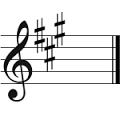 In musical notation, a key signature is a set of sharp or flat symbols placed together on the staff. Key signatures are generally written immediately after the clef at the beginning of a line of musical notation, although they can appear in other parts of a score, notably after a double bar line.
A key signature designates notes that are to be played higher or lower than the corresponding natural notes and applies through to the end of the piece or up to the next key signature. A sharp symbol on a line or space in the key signature raises the notes on that line or space one semitone above the natural, and a flat lowers such notes one semitone. Further, a symbol in the key signature affects all the notes of one letter: for instance, a sharp on the top line of the treble staff applies to Fs not only on that line, but also to Fs in the bottom space of the staff, and to any other Fs. This convention was not universal until the late Baroque/early Classical period, however; music published in the 1720s and 1730s, for example, uses key signatures showing sharps or flats on both octaves for notes which fall within the staff.
An accidental is an exception to the key signature, applying only in the measure in which it appears.
Although a key signature may be written using any combination of sharp and flat symbols, about a dozen diatonic key signatures are by far the most common, and their use is assumed in much of this article. A piece scored using a single diatonic key signature and no accidentals contains notes of at most seven of the twelve pitch classes, which seven being determined by the particular key signature.
Each major and minor key has an associated key signature that sharpens or flattens the notes which are used in its scale. However, it is not uncommon for a piece to be written with a key signature that does not match its key, for example, in some Baroque pieces, or in transcriptions of traditional modal folk tunes.
Later on, this use of a key signature that is theoretically incorrect for a piece as a whole or a self-contained section of a piece became less common (in contrast to brief passages within a piece, which, as they modulate from key to key often temporarily disagree with the key signature); but it can be found at least as late as one of Beethoven’s very late piano sonatas. For example, in his Sonata no. 31 in A♭ major, Op. 110, the first appearance of the Arioso section in the final movement is notated throughout in 6 flats; but it both begins and ends in A♭ minor and has a significant modulation to C♭ major, and both these keys theoretically require 7 flats in their key signature. (The second appearance later in the movement of this same section, a semitone lower, in G minor, uses the correct key signature of two flats.)
CLEF SIGNATURE.
Clef signature is related to stave and pitch notes accurately, a sign called a clef is used to fix the position of a certain letter names on it. Tow clefs are commonly used, one of the high notes, which is G or treble clef while the other if F or Bass clef. These clefs are signs written on the staff at the beginning of a piece of music to show the types of stave or staff.
SCALE.
Scale is an alphabetical arrangement of sounds ascending and descending order. It consist of eight notes.
Examples; from C to C = 8 notes.
Major scale structure
Except for C major, key signatures appear in two varieties, “sharp key signatures” (“sharp keys”) and “flat key signatures” (“flat keys”), so called because they contain only one or other.
Scales with sharp key signatures
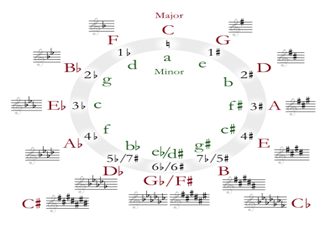
Sharp key signatures consist of a number of sharps between one and seven, applied in this order: F C G D A E B. A mnemonic device often used to remember this is “Father Charles Goes down and Ends Battle. The key note or tonic of a piece in a major key is immediately above the last sharp in the signature.[7] For example, one sharp (F♯) in the key signature of a piece in a major key indicates the key of G major, the next note above F♯. (Six sharps, the last one being E♯ (an enharmonic spelling of F♮) indicate the key of F♯ major, since F has already been sharped in the key signature.)
| Major key | Numberof sharps | Sharp notes | minor key | EnharmonicEquivalent |
| C major | 0 | A minor | None | |
| G major | 1 | F♯ | E minor | None |
| D major | 2 | F♯, C♯ | B minor | None |
| A major | 3 | F♯, C♯, G♯ | F♯ minor | None |
| E major | 4 | F♯, C♯, G♯, D♯ | C♯ minor | None |
| B major | 5 | F♯, C♯, G♯, D♯, A♯ | G♯ minor | C♭ major/A♭ minor |
| F♯ major | 6 | F♯, C♯, G♯, D♯, A♯, E♯ | D♯ minor | G♭ major/E♭ minor |
| C♯ major | 7 | F♯, C♯, G♯, D♯, A♯, E♯, B♯ | A♯ minor | D♭ major/B♭ minor |
This table shows that each scale starting on the fifth scale degree of the previous scale has one new sharp, added in the order given above.
Scales with flat key signatures
“Flat key signatures” consist of one to seven flats, applied as: B E A D G C F (same as the order of sharps, but reversed.) The mnemonic device is then reversed for use in the flat keys: “Battle Ends and down Goes Charles’ Father”. The major scale with one flat is F major. In all other “flat major scales”, the tonic or key note of a piece in a major key is four notes below the last flat, which is the same as the second-to-last flat in the signature. In the major key with four flats (B♭ E♭ A♭ D♭), for example, the penultimate flat is A♭, indicating a key of A♭ major.
| Major key | Numberof flats | Flat notes | minor key | EnharmonicEquivalent |
| C major | 0 | A minor | None | |
| F major | 1 | B♭ | D minor | None |
| B♭ major | 2 | B♭, E♭ | G minor | None |
| E♭ major | 3 | B♭, E♭, A♭ | C minor | None |
| A♭ major | 4 | B♭, E♭, A♭, D♭ | F minor | None |
| D♭ major | 5 | B♭, E♭, A♭, D♭, G♭ | B♭ minor | C♯ major/A♯ minor |
| G♭ major | 6 | B♭, E♭, A♭, D♭, G♭, C♭ | E♭ minor | F♯ major/D♯ minor |
| C♭ major | 7 | B♭, E♭, A♭, D♭, G♭, C♭, F♭ | A♭ minor | B major/G♯ minor |
In this case each new scale starts a fifth below (or a fourth above) the previous one.
Major scale
Major scales
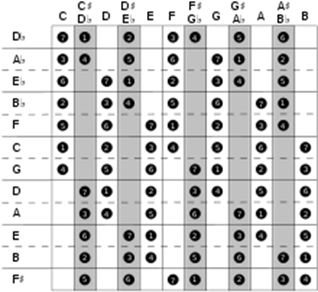
The major scale or Ionian scale is one of the most commonly used musical scales, especially in Western music. It is one of the diatonic scales. Like many musical scales it is made up of seven notes: the eighth duplicates the first at double its frequency so that it is called a higher octave of the same note (from Latin “octavos”, the eighth).
The simplest major scale to write is C major, the only major scale not to require sharps or flats:
C-D-E-F-G-A-B-C ( C major scale (help info)
The major scale had a central importance in European music, particularly in the common practice period and in popular music, owing to the large number of chords that can be formed from it.[citation needed] In Hindustani classical music it is known as Bilaval.
There are 15 major scales in music, these major scales have their own relative minor scales.
- The sixth degree of the major scales is the first degree of the minor.
- The sub-mediate of the major of the major is the tonic off the minor.
- The minor scales uses the same key signature with its major scale.
Structure

The pattern of whole and half steps characteristic of a major scale
A major scale is a diatonic scale. The sequence of intervals between the notes of a major scale is:
- whole, whole, half, whole, whole, whole, half
where “whole” stands for a whole tone (a red u-shaped curve in the figure), and “half” stands for a semitone (a red broken line in the figure).
A major scale may be seen as two identical tetra chords separated by a whole tone. Each tetra chord consists of two whole tones followed by a semitone:
- Whole, whole, half.
Scale degrees

| MAJOR SCALE RELATIVE MINOR SCALES |
| C major A minor. |
| G major – 1 shape E minor – 1 shape. |
| D major – 2 shapes B minor – 2 shapes. |
| A major – 3 shapes F# minor – 3 shapes. |
| E major – 4 shapes C# minor – 4 shapes. |
| B major – 5 shapes G# minor – 5 shapes. |
| F# major – 6 shapes D# minor – 6 shapes. |
| C# major – 7 shapes A# minor – 7 shapes. |
FLAT KEYS
| MAJOR SCALE | RELATIVE MINOR SCALES |
| F major- 1 flat | D minor – 1 flat. |
| Bb major – 2 flat | G minor – 2 flat |
| Eb major – 3flat | C minor – 3 flat. |
| Ab major – 4 flat | F minor – 4 flat. |
| Db major – 5 flat | B minor – 5 flat. |
| Gb major – 6 flat. | E minor – 6 flat. |
| Cb major – 7 flat. | Ab minor – 7 flat. |