WEEK TWO
HUMAN REPRODUCTION (II)
- Pregnancy
- Signs and symptoms of pregnancy
- Stages of growth of the fetus
Pregnancy (conception)
Conception is also known as pregnancy.it is the period between fertilization and the birth of the young one .In human, the period of pregnancy is about 9 months.
Signs and symptoms of pregnancy
- Food aversions: If a woman is newly pregnant she may feel repelled by the smell of some food. She may also find that certain food she used to enjoy as suddenly completely repulsive to her.
- Mood swings: It is common to have mood swings during pregnancy due to the changes in the hormone in the body every woman respond differently to these changes.
- Abnormal bloating: Hormonal changes in early pregnancy may lead to the feeling of bloating that is similar to the feeling some women have just before their period
- Frequent urination: Shortly after a woman becomes pregnant, hormonal changes makes a chain of events that raises the rate of blood flow through the kidneys this cause your bladder to fill more quickly so you need to pee more often
- Fatigue: Pregnant women tend to always feel tired and exhausted during pregnancy and this leads to sleepiness and sluggishness
- Sore breast: The breast becomes swollen and sensitive during pregnancy due to its rising levels of hormones in their body
- Missed period: If a woman missed her period, it is an indication that she is pregnant. Although it is possible to still experience the monthly menstrual period even when a woman is pregnant
- High basal body temperature: If you have been charting your basal body temperature and you see that your body temperature has stayed elevated for 18days in a roll it is an indication that you are probably pregnant.
CARE NEEDED DURING PREGNANCY
- Get pregnancy test as soon as you miss your period
- Talk with your partner and someone else you trust
- Begin antenatal care check-ups with a medical doctor
- Follow proper antenatal care instructions which include avoiding all drugs and medicine not prescribed by a medical doctor
- Eat nourishing foods rich in protein, calcium folic acid, iodine and iron and drink plenty of water and fruit juices
- Get adequate rest and relaxation
- Do not smoke cigarettes or take alcohol
MYTHS AND FACTS ABOUT PREGNANCY
A myth refers to something that many people believe but that does not exist in the reality. It is false. On the other hand, a fact is something that is known to be true, especially that can be proved. There are myths and facts about pregnancy especially in the African traditional set up.
MYTHS ABOUT PREGNANCY
- Only pregnancy can make a woman miss her monthly period
- All pregnant women vomit
- Pregnancy makes you unclean before God
- All pregnant women have morning sickness
- Pregnant women should not dye their hair
- Pregnant women shouldn’t eat fish
- I can’t get pregnant if I have my period
- I can’t get pregnant the first time I have sex
- If I wash out my vagina after sex I won’t get pregnant
- Pregnant women should not take baths
FACTS ABOUT PREGNANCY
- Pregnant women should not carry heavy objects
- Some women may experience some bleeding and yet be pregnant
- Pregnant women should not change cat litter
- Pregnant women should not drink alcohol
- You can be pregnant for over a year
Stages of growth of the fetus
Each month a group of eggs (called oocytes) is recruited from the ovary for ovulation (release of the egg). The eggs develop in small fluid-filled cysts called follicles. Normally, one follicle in the group is selected to complete maturation. This dominant follicle suppresses all the other follicles in the group, which stop growing and degenerate.
The mature follicle opens and releases the egg from the ovary (ovulation). Ovulation generally occurs about two weeks before a woman’s next menstrual period begins. After ovulation, the ruptured follicle develops into a structure called the corpus lustrum, which secretes progesterone and estrogen. The progesterone helps prepare the endometrium (lining of the uterus) for the embryo to implant.
On average, fertilization occurs about two weeks after your last menstrual period. When the sperm penetrates the egg, changes occur in the protein coating around it to prevent other sperm from entering. At the moment of fertilization, a baby’s genetic make-up is complete, including its sex.
If a Y sperm fertilizes the egg, the baby will be a boy; if an X sperm fertilizes the egg, and the baby will be a girl.
Human chorionic gonadotropin is a hormone present in your blood from the time of conception. It is produced by cells that form the placenta and is the hormone detected in a pregnancy test. However, it usually takes three to four weeks from the first day of your last period to increase enough to be detected by pregnancy tests.
Within 24 hours after fertilization, the egg begins dividing rapidly into many cells. It remains in the fallopian tube for about three days. The fertilized egg (called a blastocyst) continues to divide as it passes slowly through the fallopian tube to the uterus where its next job is to attach to the endometrium (a process called implantation). Before this happens, the blastocyst breaks out of its protective covering. When the blastocyst establishes contact with the endometrium, an exchange of hormones helps the blastocyst attach. The endometrium becomes thicker and the cervix is sealed by a plug of mucus.
Within three weeks, the blastocyst cells ultimately form a little ball, or an embryo, and the baby’s first nerve cells have already formed. Your developing baby is called an embryo from the moment of conception to the eighth week of pregnancy. After the eighth week and until the moment of birth, the developing baby is called a fetus.
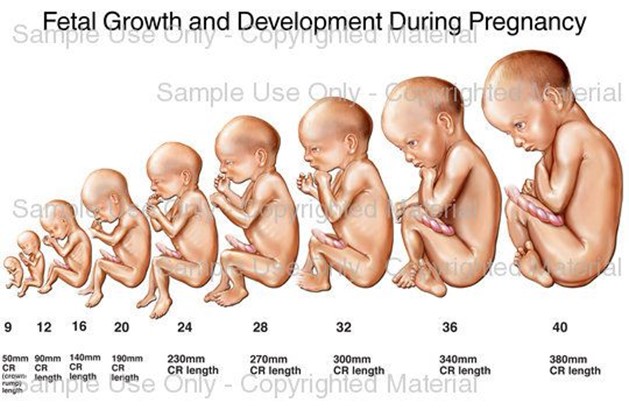
The development stages of pregnancy are called trimesters or three-month periods, because of the distinct changes that occur in each stage.
STAGES OF GROWTH: MONTH BY MONTH
Month 1
As the fertilized egg grows, a water-tight sac forms around it gradually; filling it with fluid. This is called the amniotic sac, and it helps cushion the growing embryo.
The placenta also develops. The placenta is a round, flat organ that transfers nutrients from the mother to the baby, and transfers wastes from the baby.
A primitive face will take form with large dark circles for eyes. The mouth, lower jaw, and throat are developing. Blood cells are taking shape, and circulation will begin. The tiny “heart” tube will be at 65 times a minute by the end of the fourth week. By the end of the first month, the baby is about 1/4 inch long – smaller than a grain of rice!
Month 2
The baby’s facial features continue to develop. Each ear begins as a little fold of skin at the side of the head. Tiny buds that eventually grow into arms and legs are forming. Fingers, toes and eyes are also forming. The neural tube (brain, spinal cord and other neural tissue of the central nervous system) is well formed. The digestive tract and sensory organs begin to develop. Bone starts to replace cartilage.
The head is large in proportion to the rest of the baby’s body. By the end of the second month, your baby is about 1 inch long and weighs about 1/30 of an ounce. At about 6 weeks, your baby’s heart beat can usually be detected. After the 8th week, your baby is called a fetus instead of an embryo.
Month 3
The baby’s arms, hands, fingers, feet, and toes are fully formed. The baby can open and close its fists and mouth. Fingernails and toenails are beginning to develop and the external ears are formed. The beginnings of teeth are forming. The baby’s reproductive organs also develop, but the baby’s gender is difficult to distinguish on ultrasound.
By the end of the third month, your baby is fully formed. All the organs and extremities are present and will continue to mature in order to become functional. The circulatory and urinary systems are working and the liver produces bile. At the end of the third month, your baby is about 4 inches long and weighs about 1 ounce. Since the baby’s most critical development has taken place, the chance of miscarriage drops considerably after three months.
Month 4
The baby’s heartbeat may now be audible through an instrument called a Doppler. The fingers and toes are well-defined. Eyelids, eyebrows, eyelashes, nails, and hair are formed. Teeth and bones become denser. The baby can even suck his or her thumb, yawn, stretch, and make faces.
The nervous system is starting to function. The reproductive organs and genitalia are now fully developed, and the doctor can see on ultrasound if the baby is a boy or a girl. By the end of the fourth month, the baby is about 6 inches long and weighs about 4 ounces.
Month 5
One may begin to feel the baby move, since he or she is developing muscles and exercising them. This first movement is called quickening.
Hair begins to grow on the baby’s head. The baby’s shoulders, back, and temples are covered by a soft fine hair called lanugo. This hair protects the baby and is usually shed at the end of the baby’s first week of life. The baby’s skin is covered with a whitish coating called vernix caseosa. This “cheesy” substance is thought to protect baby’s skin from the long exposure to the amniotic fluid. This coating is shed just before birth. By the end of the fifth month, the baby is about 10 inches long and weighs from 1/2 to 1 pound.
Month 6
The baby’s skin is reddish in color, wrinkled, and veins are visible through the baby’s translucent skin. Baby’s finger and toe prints are visible. The eyelids begin to part and the eyes open.
Baby responds to sounds by moving or increasing the pulse. One may notice jerking motions if baby hiccups. If born prematurely, the baby may survive after the 23rd week with intensive care. By the end of the sixth month, the baby is about 12 inches long and weighs about 2 pounds.
Month 7
The baby will continue to mature and develop reserves of body fat. The baby’s hearing is fully developed. He or she changes position frequently and responds to stimuli, including sound, pain, and light. The amniotic fluid begins to diminish.
At the end of the seventh month, the baby is about 14 inches long and weighs from 2 to 4 pounds. If born prematurely, the baby would be likely to survive after the seventh month.
Month 8
The baby will continue to mature and develop reserves of body fat. One may notice that the baby is kicking more. Baby’s brain is developing rapidly at this time, and the baby can see and hear.
Most internal systems are well developed, but the lungs may still be immature. The baby is about 18 inches long and weighs as much as 5 pounds.
Month 9
The baby continues to grow and mature: the lungs are nearly fully developed.
The baby’s reflexes are coordinated so he or she can blink, close the eyes, turn the head, grasp firmly, and respond to sounds, light, and touch. Baby is definitely ready to enter the world!
One may notice that the baby moves less due to tight space. The baby’s position changes to prepare itself for labor and delivery. The baby drops down in the pelvis. Usually, the baby’s head is down toward the birth canal. The baby is about 18 to 20 inches long and weighs about 7 pounds.
 CLASSWORK 2
- What is pregnancy?
- Give four facts about pregnancy
ASSIGNMENT 2
SECTION A
- The following are not symptoms of pregnancy in human except (a) fighting (b) fatigue (c) crying (d) walking
- The ideal pregnancy duration in human is (a) 6 months (b) 7 months (c) 8 months (d) 9 months
- The fusion of the male and female gamete to form a zygote is known as (a) conception (b) fertilization (c) menopause (d) menstruation
- The fluid that cushions the growing embryo is called (a) water (b) mineral (c) amniotic fluid (d) baby fluid
- Pregnancy can be detected with any of these symptoms except (a) nausea (b) fatigue (c) food aversion (d) menstruation
SECTION B
- Carefully state the difference between fertilization and conception
- Mention any four signs and symptoms of pregnancy
- Mention three ways of detecting pregnancy