WEEK ELEVEN
REFRACTION OF LIGHT
- Refraction of light
- Refractive index
- Determination of Refractive index
- Total internal reflection
- Critical angle
Refraction of light
Refraction is the bending away of light from the normal as it passes from one medium to the other.
There is a change in the direction and speed of a ray of light when it passes from medium to another medium of different density. This change in the direction of the light of the light ray which is due to difference in the speed of light in different media is called refraction.
When a ray of light travels from optically less dense medium (air) to an optically dense medium (water, glass), it bends towards the normal.
A ray passing from glass or water to air is bent away from the normal
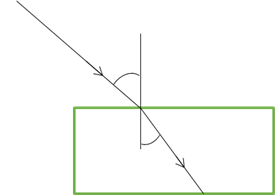 Incident ray normal
Medium 1- air
i
Medium 2 – glass
Refracted ray
LAWS OF REFRACTION
1. The incident ray, refracted ray and the normal at the point of incidence; all lie on the same plane.
2. The ratio of the sine of the angle of incidence to the sine of the angle of refraction is a constant for a given pair of media.
The second law is known as Snell’s law
The constant, n, is known as the refractive index of the second medium with respect to the first medium. It is a number which gives a measure of refraction or bending of light as it travels from one medium to another.
As the ray of light travels from air to glass, the refractive index can be written as:
From the principle of reversibility of light
Furthermore,
Determination of Refractive index
EFFECTS OF REFRACTION
The phenomenon of refraction is responsible for the following
1 The bottom of a clear river or pond appears shallower than it really is
2 A rod or spoon appears bent or broken when it is partially immersed in water or any liquid
3 Letters in print seem to be nearer when we place a thick block of glass over them
REFRACTION THROUGH RECTANGULAR PRISM
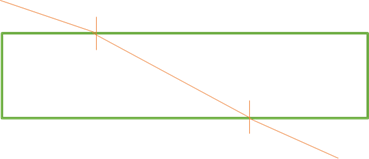
The refractive index, n=sin(A/2+D/2)/sinA/2
Total internal reflection & Critical angle
When light passes at a small angle of incidence from a denser to a less dense medium e.g. from glass to air, there is a strong refracted ray. There is also a weak ray reflected back into the denser medium.
When the angle of incidence increases, the angle of refraction also increases. At a certain increase of the angle of incidence, the angle of refraction is 900. This angle of incidence in the denser medium for which the angle of refraction in the less dense medium is 900, is referred to as the critical angle ( c). For angle of incidence greater than C, the refracted ray disappears and all the incident light is reflected back into the denser medium. At this point, the ray is said to experience total internal reflection. Example of total internal reflection is the mirage on the road, where the refractive density of warm air is less than that of cool air and light meets a layer at a critical angle, it suffers total internal reflection.
REAL AND APPARENT DEPTH
A thick slab of glass appears to be only two –third of its real thickness when viewed vertically from above. Similarly, water in a pond appears to be only three quarters of its real depth. Rays from a coin at the bottom of a bucket of water are refracted away when they leave water and enter the eyes. They appear as if coming from a virtual image, which is apparent depth while the actual depth of the bottom remains and is referred to as real depth
Refractive index=real depth/apparent depth
CLASSWORK 11
- State the laws of refraction
- The velocities of light in air and glass are 3.0 x10⁸ m/s and 1.8 x10⁸ m/s respectively. Calculate the sine of the angle of incidence that will produce an angle of refraction of 300 for a ray of light incident on glass
ASSIGNMENT 11
SECTION A
- The direction of light ray changes as it passes from one medium to the other. The phenomenon is called (a) diffraction (b) reflection (c) dispersion (d) deviation (e) refraction
- The horizontal floor of a reservoir appears to be 1.0m deep when viewed vertically from above. If the refractive index of water is 1.35, calculate the real depth of the reservoir (a) 2.35m (b) 1.35m (c) 1.00m (d) 0.50m (e) 0.35m
- Which of the following is an application of refraction (a) eye glasses (b) car headlamp (c) touch light (d) shaving mirror (e) none of the above
- A ray of light is incident normally on an air-glass interface. What is its angle of refraction (a) 900 (b) 600 (c) 450 (d) 300 (e) 00
- A transparent block 5.0cm thick is placed on a dot. The dot when viewed is seen 3.0cm from the top of the block. Calculate the refractive index of the material of the block (a) (b) (c) (d) (e)
SECTION B
- (a) What is:
(i) refraction of a wave? (ii) Critical angle?
(b) A water poured into a jar to a depth of 21cm. the bottom of the jar appears to be raised by 3cm when viewed vertically. Calculate the refractive index of the water
A ray of light incident at an angle of 300 at an air-glass interface (i) draw a ray diagram to show deviation of the ray in glass (ii) determine the angle of deviation.