WEEK 10
AIR AND FLAMES
Air is a mixture of gases – nitrogen, oxygen, carbon(IV) oxide, water vapor and noble gases. The following observations confirm air to be a mixture:
– The composition of air is not quite constant. Variations in composition have been found when samples of air are taken from different parts of the earth. This implies that if air were a compound, its composition would be definite or constant.
– If air is dissolved in water and boiled out again, it will be observed that the percentage of oxygen in the air is increased from 21% to about 30%. The increase in percentage of oxygen only shows that water usually contain dissolved oxygen, even more than nitrogen (oxygen is about twice more soluble in water than nitrogen). The dissolution and release of air from water is a physical process which implies that air is a mixture.
– When liquid air is heated, nitrogen evaporates earlier, leaving almost pure oxygen. This implies that components of air are easily separable by physical methods.
– A mixture of carbon(IV) oxide, nitrogen, oxygen, water vapor and noble gases in appropriate ratio does not produce any observable change identifiable with chemical reactions (such as evolution of heat, explosion and volume change), but the mixture is similar to ordinary air in everyway.
– The composition of air is not represented by any simple chemical formula, unlike if it were a compound. Composition of Air The constituents of air and their percentage composition are given below: Nitrogen – 78.1% – 4/5 of volume of air Oxygen – 20.9% -1/5 of volume of air. Carbon dioxide – 0.03%. Water vapor – variable. Noble gases – about 1%
Impurities (example, H2S, SO2, e.t.c.) – variable.
The above statistics shows that nitrogen and oxygen are the two main gases of the air, occupying about 4/5 and 1/5 by volume respectively
To Determine the Presence and Proportion of The Constituents of Air
Air is a mixture of gases – 78% nitrogen and 21% oxygen – with traces of water vapor, carbon dioxide, argon, and various other components.
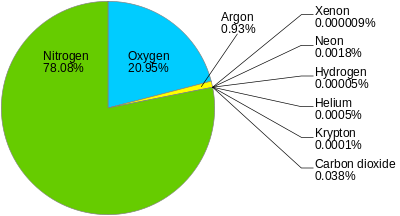
Oxygen
The presence and proportion of oxygen in air can be determined by burning certain metals, example, copper, lead and magnesium in air. The oxygen of the air combines with these metals to form oxides, which are greater in masses than the pure metals.
The difference in mass is the oxygen present in the volume of air used – this procedure can be employed to estimate the volume of oxygen in the air. The equations for the chemical reactions are:
2Cu(s) + O2(g) → 2CuO(s) Copper(II) oxide
2Pb(s) + O2(g) → 2PbO(s) Lead(II) oxide
2Mg(s) + O2(g) → 2MgO(s) Magnesium oxide
Phosphorus can also be burnt in a measured volume of air to obtain by volume the proportion of oxygen in air. The equation of the reaction is:
P4(s) + 5O2(g) → P4O10(s) Phosphorus(V) oxide
For convenience, white phosphorus is used. White phosphorus catches fire very easily (for this reason, it is stored under water). Note: only the oxygen component of air supports combustion, others, i.e., CO2, N2, and water do not.
To obtain a more accurate determination of the proportion of oxygen by volume in air, we can use the smoldering of phosphorus in air, or by passing air into alkaline pyrogallol, or into benzene-1,2,3 – triol, which absorbs its oxygen.
When white phosphorus is exposed to a measured volume of air, it smolders as it absorbs oxygen from the air. The volume of the absorbed oxygen is measured, and the percentage composition is calculated to be about 20.8%. The chemical change that occurs is same with that of the combustion of phosphorus in air:
P4(s) + 5O2(g) → P4O10(s)
When a measured volume of air is passed into alkaline pyrogallol or benzene-1,2,3-triol, only the oxygen component is absorbed. The volume of the absorbed oxygen is measured and its percentage composition can also be determined.
Carbon(IV) Oxide
The occurrence of carbon(IV) oxide in air is traceable to the combustion of fuels, e.g. coal, wood, petrol and paraffin – these materials are composed mainly of carbon.
C(s) + O2(g) → CO2(g)
It is also present in the air through the process of respiration – all animals and plants produce CO2 as a by-product of respiration, which is released into the atmosphere. The decay of organic material also releases CO2 into the atmosphere. For the fact that plants require CO2 to synthesis carbohydrates, and also for the fact that CO2 dissolves in the water of the oceans, the percentage of CO2 in air remains constant at 0.03% by volume, in spite of the enormous amount produced into the atmosphere.
The presence and proportion of CO2 in the air can be determined by passing a measured volume of air into a solution of calcium hydroxide (also called lime water). Calcium hydroxide solution absorbs CO2 in limited amount to give white precipitate of CaCO3, and in excess amount to give a milky appearance.
Ca(OH)2(aq) + CO2(g) → CaCO3(s) + H2O(l)
CaCO3(s) + H2O(l) + CO2(g) → Ca(HCO3)2(aq) Calcium hydrogen trioxocarbonate(IV).
The milky appearance is due to calcium hydrogen trioxocarbonate(IV), Ca(HCO3)2 produced. The volume of CO2 absorbed is measured, and its percentage composition calculated. Other substances that can be used to absorb CO2 are concentrated solutions of KOH and NaOH (these will produce soluble carbonates with limited CO2 ; and hydrogentrioxocarbonate(IV) with excess
CO2.
Solid NaOH can also be used. Solid NaOH absorbs water from the air to form a solution, which then absorbs CO2 to form sodium trioxocarbonate(IV) decahydrate. The decahydrate loses 9 of its water of crystallization, absorbs more CO2 and forms sodium hydrogen trioxocarbonate(IV).
2NaOH(s) + 9H2O(l) + CO2(g) → Na2CO3.10H2O(s)
Na2CO3 .H2O(s) + CO2(g) → 2NaHCO3(s)
Water Vapor
The evaporation of water from oceans, rivers, lakes etc, produces the water vapor of air. Its presence and proportion in the air can be found by passing a measured volume of air through some substances which absorb water, such as anhydrous calcium chloride and conc. tetraoxosulphate(VI) acid.
In a day or two, a solution of the compound will be obtained, while the volume of air decreases. The volume of water vapor thereby absorbed is measured, and its percentage composition calculated – the results vary from place to place. Nitrogen Nitrogen is almost inert; therefore, there is no suitable chemical procedure to test it in the presence of the other components.
Hence, the other components are usually removed from the air, leaving behind nitrogen for complex test procedures. The following is a procedure to separate nitrogen from air: A given volume of air is passed through a deliquescent substance to remove water vapor, after which, it is passed into a solution of slaked lime, i.e. calcium hydroxide, where the CO2 component is absorbed.
It is moved onto a furnace where the oxygen component burns copper to give copper(II) oxide. The gas left after this process is mainly nitrogen, which is not removed by any known chemical method.
Note: * The presence of the noble gases in atmospheric nitrogen makes it denser than pure nitrogen obtained from its compounds. In the industry, either nitrogen or oxygen is obtained from liquid air (containing mainly oxygen and nitrogen) by fractional distillation. Nitrogen boils at 77 K, argon which is the major noble gas in the air boils at 87 K, while oxygen boils at 90 K.
* By fractional distillation, pure nitrogen is obtained.
Air Impurities or Pollutants
Air, especially in the industrial areas contains certain particles, which pollute it. These include hydrogen sulphide (H2S), sulphur(IV) oxide (SO2), the oxides of nitrogen, carbon monoxide (CO), dust and other solid particles such as lead. An evidence of these pollutants in the air is the tarnishing of silver- this is due to the presence of H2S, which forms a black layer of silver sulphide on the sliver.
FLAMES
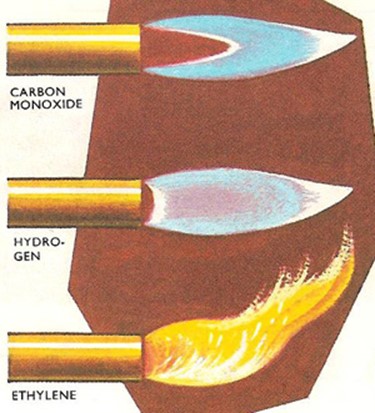
Flames occasionally flicker and dance over the surface of a burning coal fire, but most of the time the fire is flameless, illuminated only by the glow of burning solids. The flames leaping from it are areas in which gases are burning. When they burn, these gases combine with the oxygen in the air and in doing so, heat and light are given out making the flame hot and often visible. If a gas will burn, then it always burns with a flame. For example, the gases carbon monoxide and hydrogen always burn with flames, carbon monoxide with a bright blue flame and hydrogen with a paler blue flame. But there is no hard and fast rule for solids. Some burn with flames; others do not. When hot iron filings are lowered into a jar of oxygen, they burn with a dull glow, but not with a flame. In contrast under similar conditions, warm yellow phosphorus will burst into flame and cannot be made to burn flamelessly. If the temperature is raised sufficiently for the solid to vaporize, it burns with a flame as the vapor catches fire. If no vapor is given off then there can be no flame. Volatile substances burn more often with flames than non-volatile substances. To get a piece of paraffin wax to burn with a flame it must be heated quite strongly. But if a wick is inserted to make it a candle, no such strong heating is necessary. When a match is applied, some of the wax melts, and it is drawn up the wick by capillary action. The tip of the lighted wick becomes incandescent and the heat generated causes some wax to vaporize and catch fire. More wax rises up the wick to take its place. Before any gas or vapor can burst into flame a certain temperature must be reached. The lowest temperature at which the substance will take fire is known as the ignition temperature. The ignition temperature is not a fixed value for a particular gas for it varies with the conditions. Gas pressure and the presence of catalysts can affect it. At very low pressures, gases are more difficult to set alight because the ignition temperature is much higher. For flammable liquids this temperature is known as flash pointest temperature at which the liquid gives off a vapor that will burst into flame
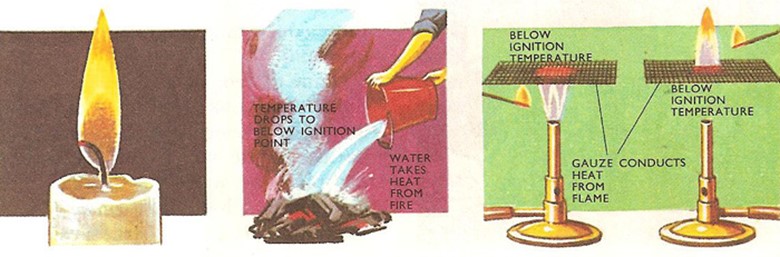
When a piece of metal gauze is held above a Bunsen burner and a lighted taper is applied below, the flame is stopped by the gauze because the metal conducts the heat away, preventing the gas above from reaching the ignition point and so it cannot catch fire. When the experiment is repeated this time by applying the flame above the gauze, for the same reason, only the gas above the gauze catches fire. There is no flame, only unburned gas beneath it.
Flames differ in appearance. There are several reasons for this. The flames may have different structures. Apart from at the center, a candle flame appears uniformly yellow throughout; so does a luminous Bunsen flame, whereas a roaring Bunsen flame has an inner blue cone surrounded by an outer transparent cone. All flames also have a central zone of unburned gas at the base. This is quite easily demonstrated by holding a piece of asbestos paper so that it cuts across the lower part of the flame. A hollow ring of soot is deposited by the burning gas or vapor but none by the unburned gases. Holding another piece of asbestos paper vertically in the flame shows the zone of unburned gases to be cone-shaped. The candle flame and the outer cone of the Bunsen flame are both examples of diffusion flames (see diffusion). When the candle is lit, the vaporized paraffin was diffuses out from the wick and mingles with the air needed for its combustion. The gases which have bee only partly burnt in the inner cone of the Bunsen flame behave similarly, diffusing out to mix with the inward diffusing air. The inner Bunsen cone is an explosion of traveling flame. If a match is applied to one end of a tube of coal gas, the gas catches fire at that end and the flame travels along the tube, as each successive layer of gas is burnt. The blue cone is a flame of this type, only the gas issuing from the Bunsen is not stationary. The rate at which the flame travels down through the gas is balanced by the rate at which more gas issues from the burner to take its place. As the two balance, the flame appears to be stationary. The traveling nature of the flame can be further demonstrated by turning down the gas supply. Then the flame travels down into the burner faster than the gas can come out and the Bunsen lights at the bottom. This is known as striking back. The Bunsen should never be left to burn with this sort of flame as the bottom of the burner becomes overheated. Also the gas is only partially burned and the poisonous gases escape into the atmosphere.
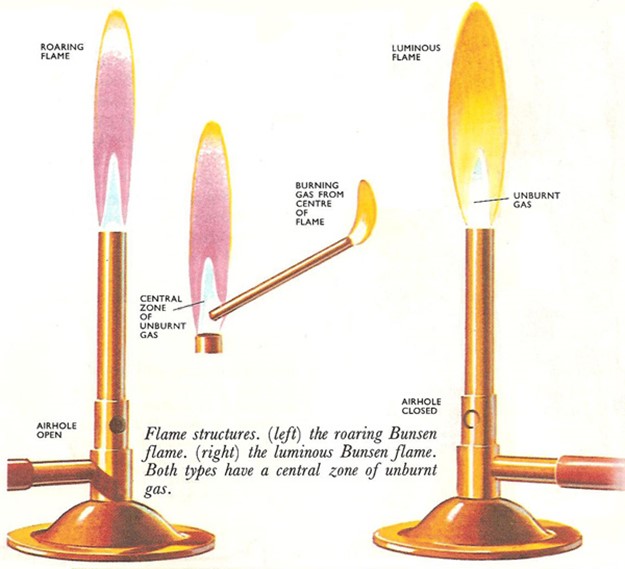
As for the Bunsen flame, flames of other burning substances can have various cones or mantles. The flame of burning ammonia consists of three different colored mantles or cones, an inner cone of unburned gas, a yellow middle cone, and an outer mantle of yellowish-green flame. The flame of burning carbon monoxide is bright blue, and a candle flame, bright yellow. The different colors of flames are caused by the different chemical reactions taking place within them. If a flame has three mantles, then there are three different chemical reactions taking place, one in each mantle. Certain substances in the flame give out light colors. If the reaction produces fragments consisting of a carbon atom bonded with a hydrogen atom, violet light is given out. The presence of two bonded carbon atoms tinges a flame green. Carbon particles give out red or white light. No completely satisfactory theory has yet been put forward to explain the luminosity exhibited by some flames. At one time it was thought that the luminous flames had solid particles suspended in them. But it has been proved that although many luminous flames do contain particles of solid, this is not always so. It has also been suggested that with hydrocarbon flames the luminosity is caused by dense hydrocarbons rather than solid particles.
Cool flames
The mind automatically associates flames with heat, but some are actually quite cool. Over a pressure range, particular mixtures of vapor and air give flames which are comparatively cool, with temperatures around 300°C, compared with normal flame temperatures of over 1,000°C. Variation of composition or pressure may give rise to a normal flame or to an explosion. Naturally explosive mixtures must be avoided in car cylinders.
Bunsen Burner and Types of Flames
| Bunsen Burner is still used today as it safely burns a continuous stream of a flammable gas like natural gas, etc. The amount oxygen mixed with the gas stream determines whether the combustion is complete. Less air makes an incomplete and thus cooler reaction, resulting in a luminous flame. While a gas stream is well mixed with air creates a more complete and hotter reaction the non-luminous flame due to more oxygen available.
Bunsen burner parts 🙂 The air flow can be controlled by opening or closing the slot openings at the base of the barrel, the collar. |

QUESTIONS
1.What happens when air is passed over alkaline pyrogallol.
2.State the constituents of Air and their percentage composition.
3.Describe the types of flames you know.
4.Describe an experiment to determine the composition of Air.