SCHEME OF WORK MATHEMATICS
SS 2 MATHEMATICS
- Revision
- Straight line – Gradient of straight line, Gradient of a curve., drawing of tangents to a curve
- Inequalities
(a) Revision of linear inequalities in one variable
(b) Solutions of inequalities in 2 variables
(c) Range of values combined inequalities - Graphs of linear inequalities in two variables
Max and minimum values of simultaneous linear inequalities
- App of linear inequalities in real life
Introduction to linear programming
- Algebraic fractions
- Simplification of fractions
- Operations in algebraic fractions
- Equation involving fractions
- Undefined fraction: if Then y is undefined when ax + c = 0
7. Review of the first half term’s work and periodic test
8. Fractions (continued)
- Substitution in fraction
- Simultaneous equation involving fractions
9. Logic
- Simple and compound statement
- Logical operation and the truth tables
- Conditional statements and indirect proofs
10. Chord properties of circles
Perpendicular bisector of chord
Distance of equal chords from the centre of the circle
Angles subtended by 2 equal chords.
11. Circle Theorems: angle properties of circle
Angle subtended by an arc at the centre is twice the one subtended at the circumference.
Angles in the same segment
Angles in a semi circle
Opposite angles of cyclic quadrilateral
12&13 Revision and Second term Examinations
WEEK 1
REVISION/STRAIGHT LINE
GRADIENTS OF A STRAIGHT LINE AND GRADIENT OF A CURVE
In coordinate geometry, we make use of points in a plane. A point consists of the x-coordinate called abscissa and the y-coordinate known as ordinate. In locating a point on the x – y plane x – coordinate is first written and then the y-coordinate. For example, in a given point (a, b), the value of x is a and that of y is b. Similarly, in a point (3, 5), the value of x is 3 and that of y is 5. A linear graph gives a straight line graph from any given straight line equation which is in the general form y = mx + c or ax + by + c = 0
Example: Draw the graph of equation 4x + 2y = 5
- Point of intersection of two linear equations
Two lines y = ax +b and y2 = cx + d
Intercept when ax + b = cx + d
That is you solve the two equations simultaneously - Intersection of a line with the x or y axis
The point of intersection of a line with the x –axis can be obtained by putting y = o to find the corresponding value of x = a, say the required point of intersection gives (a, o). Similarly, for the point of intersection of a line with the y-axis, put x = o to find the corresponding value of y. If the corresponding value of y is b, the required point of intersection is (o, b)
Example: Find the point of intersection of the line 2x + 3y + 2 = 0 with the
i. x – axis (ii) y – axis
Example 3: Find the point of intersection of the lines y = 3x + 2 and y = 2x + 5
Solution
y = 3x + 2 (1)
y = 2x + 5 (2)
At the point of intersection
3x + 2 = 2x + 5
3x – 2x = 5 -2
X = 3
Substitute 3 for x in equation (1), we obtain y = 3(3) + 2 = 11.
Hence, the point of intersection is (3, 11)
GRADIENT OF A STRAIGHT LINE
The Gradient of a straight line is defined as the ratio
Change in y in moving from one
 Change in x point to another on the line. The Gradient of a straight line is always constant.

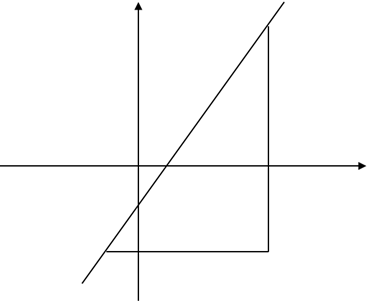
Gradient from A to B =
Gradient of a line that passes through points (x1, y1)
And (x2, y2) is given as gradient m =


Meaning that the gradient of the line is the ratio of increase in y to increase in x
TANGENT OF ANGLE OF SLOPE
In the above diagram, tan = .
Since = y2 – y1 tan = = m
And = x2 – x1
tan = m. it then follows that the gradient of a line can be defined as tangent of angle of slope.
Example:
Calculate the gradient and the angle of slope of the line passing through (1, 3) and (-4, 2)
EQUATION OF A STRAIGHT LINE AND TANGENT TO A CURVE
EQUATION OF A STRAIGHT LINE
Equation of a line with gradients in m and y intercept c. Equation of a line with gradient m and y intercept c is given as y = mx + c.
ii. Equation of a line passing through the point (x1, y1) with gradient.
The general equation of a line with known gradient m and which passes through the point (x1,y1) is given as m = –
Example 2
The equation of the line with gradient 2 and which passé through the point (-3, 2).
The solution (equation) of a line with known gradient and passing through the point (x1, y1) is given by –
Here, m = 2, (x1, y1) = (-3, 2)
The required equation of the line is
y – 2 = 2(x + 3)
y = 2x + 6 + 2
y = 2x + 8
y = 2x + 8
Equation of a line passing through two given points
The equation of a line passing through two given points (x1, y1) and (x2, y2)
Is =
iv. Double Intercept form of the equation of a line. The equation of a line which has an intercept “a” on the x – axis and intercept “b” on the y-axis is given by + = 1
Double intercept form of the equation of a line
The Equation of a line which has an intercept ‘a’ on the axis and intercept ‘b’ on the y-axis is given by + = 1
v. Equation of a line passing through a point and making an angle with the horizontal axis.
The equation of a line passing through the point (x1, y1) and making an angle with the horizontal axis is = tan or y – y1 = (x – x1) tan .
Drawing Tangents to a cure
The gradient at any particular point on a curve is defined as being the gradient of the tangent to the curve at that point the gradient of the curve at point A is the gradient of the tangent BA, that is, tan . The tangent is drawn by placing a ruler against the curve at A and drawing a line considering that the angels between the line and the curve are equal. (Note: Gradient to the horizontal line of a curve is zero because the tangent is horizontal known as a turning points (maximum/minimum)
WRAP UP AND ASSESSMENT
The gradients of a straight line is given as gradient = change in y / change in x.
The gradient of a curve at a point is given by the gradient of the tangent at that point.
The gradient at a turning point of any quadratic equation equals zero.
Exercise 14.5 no 1; the figure below (the text recommended) represents the graph of the function y = x2 + 4x – 5, (a) use the given tangents to find the gradient of the curve at (i) A (ii) B.
(b) Use the Graph to find the roots of the function.
(c) State the equation of the line of symmetry of the curve.
TICKET OUT:
Ex 14.5 Pg 194, No 2. And 4 copy and complete the table below for the function y = use a scale of 2cm for 1 unit on both axes, draw the graph of the function.