SUBJECT: FURTHER MATHEMATICS CLASS: SS2
FIRST TERM SCHEME OF WORK
| WEEK | TOPIC |
| 1 | Finding quadratic equation with given sum and product of roots, conditions for equal roots, real roots and no root |
| 2 | Tangents and Normals to Curves |
| 3 | Polynomials ;definition, basic operations + , x , – , ;– |
| 4 | Polynomials ( Continued) factorization |
| 5 | Cubic Equation , roots of cubic equations |
| 6 | Review and Test |
| 7 | Logical Reasoning ; fundamental issues and definitions and theorem proving |
| 8 | Trigonometric Function , six trig functions of angles of any magnitude ( sine, cosine,tangent,secant, cosecant, cotangent) |
| 9 | Relationship between graph of trigonometric ratios such as sin x and sin 2x, graphs of y= a sin (bx) + c , y = a cos (bx) + c , y = a tan (bx) + c |
| 10 | Graphs of inverse by ratio and equation of simpletrgonometric identities |
| 11 | Revision |
REFERENCES
- Further Mathematics Project 1 by TuttuhAdegun
- Further Mathematics Project 2 by TuttuhAdegun
- Additional Mathematics by Godman
WEEK 1
TOPIC: SOLUTION TO QUADRATIC EQUATION
FINDING QUADRATIC EQUATION GIVEN SUM AND PRODUCT OF ROOTS CONDITION FOR EQUAL ROOTS, REAL ROOTS AND NO ROOT
We recall that if ax2 + bx + c = 0, where a, a and c are constants such that a ≠ 0, then,
x = or x =
Suppose we represent these distinct roots by α and β; thus:
α =
and
β
We may also put D = b2 – 4ac, so that
α=
β =
Sum of roots
α + β = +
=
=
Products of roots
αβ =
˸αβ = b2 – D
 4a2
4a2
= b2 – (b2 – 4ac)
 4a2
4a2
= 4ac
 4a2
4a2
=
Hence, if ax2 + bx + c = 0, where a, b and c are constants andα≠ 0 then α + β= ,
αβ =
x2 + x– 42 = 0
then (x – 6) (x – 7) = 0
Hence the roots of the equation are 6 and -7. In general, if a quadratic equation factorizes into
(x – α) (x – β) = 0
then α and β must be the roots of that equation.
The general quadratic equation ax2 + bx + c = 0 can also be written as:
x2 + …(1)
If the roots of the equation are α and β then the above equation can be written as:
(x –α) (x – β) = 0
x2 – (α – β) x + αβ = 0 —(2
By comparing coefficients in equations (1) and (2)
-(α + β) =
: α + β =
andαβ =
The above consideration gives rise to two problems:
(a) Given a quadratic equation, we can find the sum and product of the roots.
(b) Given the roots, we can formulate the corresponding quadratic equation.
The quadratic equation whose roots are α and β is
x2 – (α + β) x + α β = 0
Find the sum and product of the roots of each of the following quadratic equations:
(a) 2x2 + 3x – 1 = 0
(b) 3x2 – 5x – 2 = 0
(c) x2 – 4x – 3 = 0
(d) ½ x2 – 3x – 1 = 0
Solution
(a) 2x2 + 3x – 1 = 0
a = 2; b = 3; c = -1
Let α and β be the roots of the equation, then
α + β=
α β =
(b) 3x2 – 5x – 2 = 0
a = 3; b = -5; c = -2
Let α and β be the root of the equation, then
α + β =
α β =
(c) x2 – 4x – 3 = 0
a = 1; b = 4; c = -3
Let α and β be the root of the equation, then
α + β =
α β =
(d) ½ x2 – 3x – 1 = 0
a = ½, b = -3, c = -1
Let α and β be the root of the equation, then
α + β =
α β = = -2
Find the quadratic equation whose roots are:
(a) 3 and -2 (b) ½ and 5
(c) -1 and 8 (d)¾ and ½
Solution
The quadratic equation whose roots are α and β is x2 – (α + β) x +α β = 0.
(a) α + β = 3 – 2 = 1, α β = 3 (-2) = -6
: The quadratic equation whose roots are 3 and -2 is x2 – x – 6 = 0.
(b) α β = α β =
:The quadratic equation whose roots are
x2–
or 2x2 – 11x + 5 = 0
(c) α+ β = 7, α β = -8
:α β = 7,α β = -8
:The quadratic equation whose roots are -1 and 8 is x2 – 7x – 8 = 0.
(b) α+ β = α β =
:The quadratic equation whose roots are ¾ and ½ is
x2–
or 8x2 – 10x + 3 = 0
Symmetric Properties of Roots
of ax2 + bx + c = 0, then
α + β = α β =
Certain relations involving α and β can also be determined from α + β and α β even when we do not knowα and β distinctively. Such relations are usually said to be symmetric.
They are symmetric in the sense that if α and β are interchanged, either the relation remains the same or is multiplied by -1.
If α≠ β, determine whether or not each of the following is symmetric:
(a) α + β (b) αβ
(c) α2 β2 (d) α2– β2
(e) 3α +2β (f) α2 β2
Solution
(a) α+ β =β + α
: α + β is symmetric
(b)αβ = βα
: αβ is symmetric
(c) α2 β2= α2 β2
: α2 β2 is symmetric
(d) α2 – β2= -(α2 – β2)
: α2 – β2is symmetric
(e) 3α + 2β≠ 3β + 2αsince α ≠ β
:3α + 2β is not symmetric
(f) α2+ β2 = β2+α2
:α2 + β2is symmetric
If α and β are the roots of 3x2 – 4x – 1 = 0, find the value of:
(a) α+ β (b) αβ
(c) α2 β2 (d)
(e) (f) α3β3
(g) α–β (h)
Solution
a = 3; b = -4; c = -1
(a) α + β =
(b) αβ =
(c) α2 β2 = (α + β)2 – 2αβ
=
 (d) ==
 (e) = α2β2 =
 αβ
αβ
(f) α3β3 = (α+β) (α2+β2 – αβ)
= (α+β) (α2+β)2-3αβ)]

 =
=
=
(g) We know that
(α – β)2 = α2+β2 – 2αβ
= (αβ)2 – 4αβ
 (α-β) = (αβ)2 – 4αβ

=

=
=
(h) =
=
=

=
 2
2
=
 The Graph of y = ax2 + bx + c (a ≠ 0) is called a parabola and has two shapes depending on whether a > 0 or a < 0.
Q
 (a) a> 0 (b)
a< 0
P
When a > 0, the lowest point on the graph is called the minimum point, and it occurs when
x =
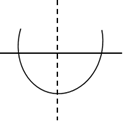
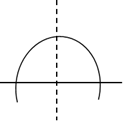 Also, the line when
a> 0
(a) x (b) a < 0
x
x = x =
Nature of Roots
We recall that the solution of
ax2 + bc + c = 0
is x = , where D = b2 – 4ac
Three restrictions can be placed on the value of D.
(a) D > 0
(b) D < 0
(c) D = 0
When D > 0

 The roots of the equation are real and distinct. The graph of y = ax2 + bx + c crosses the x – axis at two points.
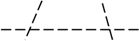 (a) a> 0 (b) a < 0
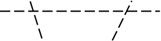 D > 0 D > 0
x = α1 x = β1 x = α2 x = β2
If in addition D is a perfect square, the roots are rational, but if D is not a perfect square, the roots are irrational and are always in conjugate pairs.
When D < 0
The roots are not real. They are said to be imaginary as is not a real number. The graph of
y = ax2 + bx + c does not cross the x – axis in this case.


 (a) a> 0 a – axis
D < 0 (b) a < 0
D < 0
 x – axis
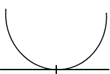
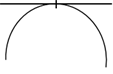
When D = 0
The roots are real and equal. They are said to be coincidental. The graph touches the x – axis at
x =
 x =
x =
(a) a> 0 a < 0
D < 0 D = 0
x =
Since D enables us to determine the position of the graph of y = ax2 + bx + c relative to the x – axis, it is called a discriminant.
Determine the nature of roots of the following quadratic equations:
(i) x2 – 3x – 2 = 0
(ii) x2 – 6x + 9 = 0
(iii) 2x2 – 2x + 5 = 0
Solution
(i) a = 1; b = -3; c = -2
D = b2 – 4ac
= 9 + 8
= 17<0
Hence the roots of the equation are real and distinct.
(ii) x2 – 2x + 9 = 0
a = 1; b = -6; c = 9
D = b2 – 4ac
= 36 – 36
= 0
Hence the roots are real and equal.
(iii) 2x2 – 2x + 5 = 0
a = 2; b = -2; c = 5
D = b2 – 4ac
= 4 – 40
= -36
Hence the roots are imaginary.
Evaluation
1. Find the quadratic equation where roots are
(a) 3 and -2 (b) ¾ and ½
General Evaluation
(1) If α and β are the roots of 3x2 – 4x – 1 = 10, find the value of:
(a) α2 + β2 (b) (c)
(d) α3 + β3 (e) α – β
(2) Find the sum and product of roots of these equation
(a) 2x2 + 3x – 1 = 0 (b) 3x2 – 5x – 2 = 0
Reading assignment
New Further Maths Project 2 page 8, 9, 10, 11
Weekend Assignment
(1) Determine the nature of roots of x2 – 3x – 2 = 0
(a) Real (b) Imaginary (c) Equal (d) Coincidental
(2) If α ≠ β which of the following is not symmetric
(a) αβ = βα (b) α + β = β + α (c) 3α + 2β = 3β + 2α
(d) α2 + β2 = β2 + α2
If α and β are the roots of 2x2 – 7x – 3 = 0, find:
(3)αβ2 + α2
(a)
(4)
(a)
(5)
(a)
Theory
(1) Find the constants p, q and r such that 3x2 – 12x + 16 = p (x + q)2 + r
(2) If α and β are the roots of x2 – 10x + 2 = 0, find α3 – β3.