THIRD TERM E-LEARNING NOTE
SUBJECT: MATHEMATICS CLASS: SSS 1
SCHEME OF WORK
WEEK TOPIC
- Mensuration: The Concept of B – D a Shape Cube, Cuboids, Cylinder, Triangular Prism, Cone, Rectangular Based Pyramid, Total Surface Area of Cone, Cylinder and their Volumes.
- (a) Volumes of Frustums of Cone, Rectangular Based Pyramid and other Pyramids
(b) Proofs of Angles Sum of a Triangle = 180o
(c) The Exterior Angle - Geometrical Construction
- Revision of Construction of Triangle
- Drawing and Bisection of Line Segment
- Construction and Bisection of Angles 90o, 45o, 135o, 221/2o, 571/2o
- Construction and Bisection of Angles: 30o, 60o, 90o, 120o, 150o, etc.
- Construction:
- Construction of Quadrilateral Polygon i.e. four sided figure with given certain conditions parallelogram
- Construction of Equilateral Triangle
- Locus of Moving Points Including Equidistance from Two Lines of Two Points and Constant Distance from the Point.
- Deductive Proof:
- Sum of Angles of a Triangle.
- Relationship of Triangles on a Straight Line.
- Revision of Angles on Parallel Line Cuts by a Transversal Line.
- Congruent Triangles.
- Properties of Parallelogram and Intercept Theorem.
- Statistics
- Collection and Tabulation and Presentation of data e.g. data from height, ages, weight, test and examination scores of students, population of students from different schools, classes etc.
- Different Species of Animals and Types of Vehicles etc.
Calculation of Range, median and mode of ungrouped data
- Data Already Collected by the Students
- Data Collected from Other Statistical Records
- Revision
- Collection, Tabulation and Presentation of Grouped Data
- Data from height, ages, weights, test and examination scores of students
- Population of students from different classes.
- Calculation of Range, Median and Mode of Grouped Data
- Data already collected by the students
- Other statistical records
- Statistical Graphs:
- Drawing of bar chart, pie-chart and histogram
- Cumulative frequency curve
- Reading and drawing inferences from the graph
- (a) Mean deviation, Variance and standard deviation of grouped data use in solving practical problems related to real life situations
- Revision/Examination
REFERENCE BOOKS
- New General Mathematics SSS 1 by M.F. Macrae et al
- Essential Mathematics SS 1
WEEK ONE
TOPIC:
Mensuration: The concept of B – D a shape cube, cuboids, cylinder, triangular prism, cone, rectangular based pyramid, total surface area of cone, cylinder and their volumes.
MENSURATION OF SOLID SHAPES
Properties of solid shapes
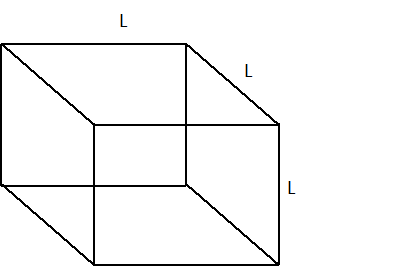 a) A Cube
A cube has the following properties.
- It has 12 straight edges
- It has 8 vertices
- It also has 6 square faces
- Its net consists of 6 square faces joined together
b) A Cuboid
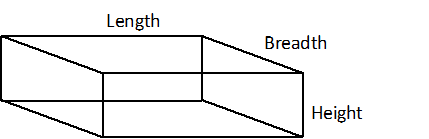
A cuboid has the following properties.
- It has 12 straight edges
- It has 8 vertices
- It also has 6 rectangular faces
- Its net consist of 6 rectangular faces
c) A Triangular Prism
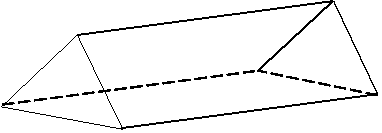
A triangular prism has the following properties:
- It has 6 vertices
- It has 9 straight edges
- It also has 3 rectangular faces and two triangular faces which are the end faces
- Its net consist of 3 rectangles and 2 triangles joined together
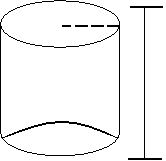 d) A Cylinder

Properties:
- A cylinder has 2 circular faces
- It has 1 curved surface
- It has 2 curved edges
- Its net consist of two circular faces and 1 rectangular face i.e its net consist of 2 circles and 1 rectangle.
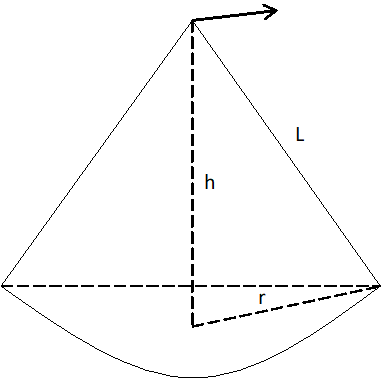 e) A Cone
 A cone has the following properties:
- It has one vertex
- It has 2 curved edges
- It has 1 curved surface
- It also has 1 circular face
- Its net consist of a sector of a circle and a circle
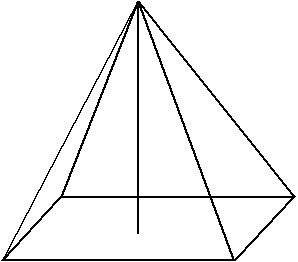
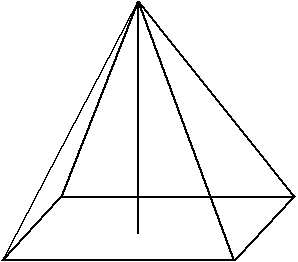
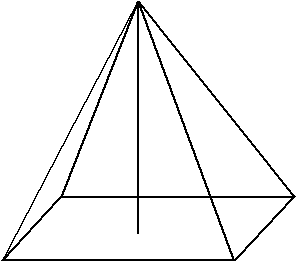
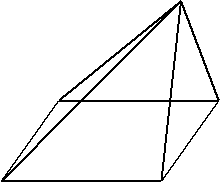 f) Rectangular based pyramids


A rectangular based pyramid has the following properties:
- It has 8 straight edges
- It has 5 vertices
- It has 4 triangular faces
- It has 1 rectangular face
- Its net consists of 4 triangles and 1 rectangle
EVALUATION
- (a) Mention and draw 3 solid shapes that you know
(b) Write down the properties of each of the solid shapes you mentioned in 1a above
(c) List one real object for each of the solid shape mentioned in (1a) above
Surface Area and Volume of Common Solid shapes
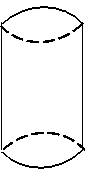
A prism is a solid which has uniform cross section. Cubes, cuboids, and cylinders are examples of prisms. In general,
 Volume of prism = area of uniform cross section X perpendicular height
=area of base x height
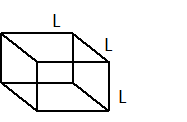
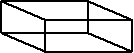
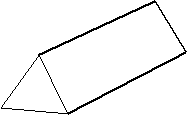 Cube Cuboids
Cylinder
Triangular prism
Cube
Volume = l3
Surface area = 6l2
Cuboid
Volume =lbh
Surface area = 2 (lb + lh + bh)
Cylinder
Volume = πr2 h
Curved surface area = 2πrh
Total surface area = 2πrh + 2π r2
= 2πr ( h + r)
Examples
1. Calculate the volumes of the following solids. All lengths are in cm.
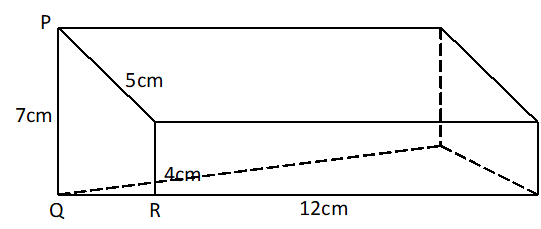 a)
a)
s

In the figure above, PQRS is a trapezium
b)
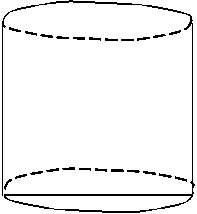


2. Calculate the total surface area of the solids in 1 (b) above
Solutions
1a.) Volume of prisms = area of uniform cross section X perpendicular height
= area of base X length of the prism
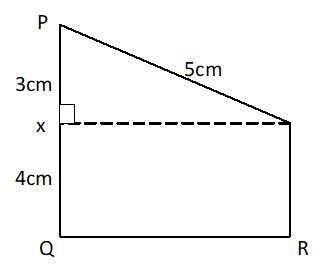 Area of PQRS = ½ ( 7 + 4) X /QR/ cm2

4cm
Since /QR/ = / X S/
Consider triangle P X S
/ PX /2 + /XS/2= 52
3 2+ /XS/2 = 25
9 + / XS/2 = 25
/XS/2 = 25 – 9
/XS/2 = 16
/XS/ = √16cm = 4cm
Thus /XS/ = /QR/ = 4cm
Area of PQRS = ½ x ( 7 + 4) x /QR/ cm2
= ½ x 11 x 4 cm2
= 22cm2
Hence,
Volume of Prism = area of uniform cross section X length of prism
= 22cm2 x 12cm
= 264cm3
(b) volume of given cylinder = πr2h
from the given cylinder,
r = d/2 = 14/2 cm = 7cm
h = 4cm
volume of given cylinder = π x (7) 2 x 4cm3
22/7 x 49 x 4cm
= 22 x 28cm3
= 616cm3
2a) To calculate the total surface area of the solid shapes in 1a and b above.
2b) Total surface area of the given cylinder = 2πrh + 2πr2
= 2πr ( h + r)
= 2 x 22/7 x 7 ( 4+ 7 ) cm2
= 44 x 11cm2
= 484 cm2
EVALUATION
1a. A rectangular tank is 76cm long, 50cm wide and 40 cm high. How many litres of water can it hold?
b. Calculate the total surface area of the rectangular tank in question 1a above
Surface area of a Cone
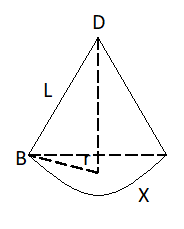
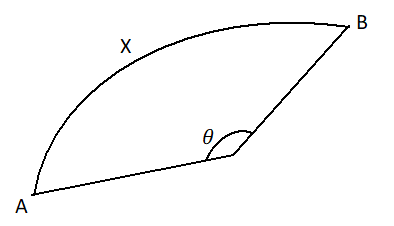 A sector of a circle can be bent to form the curved surface of an open cone. In the figure below, the sector OA x B is of radius l and arc A X B subtends angle θ at O. This sector is bent to form a cone of base radius r and slant height
o
The following points should be noted
- The area of the sector is equal to the area of the curved surface of the cone .
- The length of arc A x B in the 1st part of the figure above is the same as the circumference of the circular base of the cone in the 2nd part of the figure above
Curved surface area of cone =θ x πl2 …………..0
360
Also,
θ x 2πl = 2 πr
360
Divide both sides by 2π
θ x 2πl = 2 πr
360 2π 2π
θ x l =r
360
divide both sides by l
θ = r
360 l
substitute r/l for θ in equation i) above:
360
Curve surface area of cone =r x πl2
l
= Πrl
Hence,
Total surface area = curved surface area of a cone + area of circular base
= πr l +π r2
= πr ( l + r)
Examples
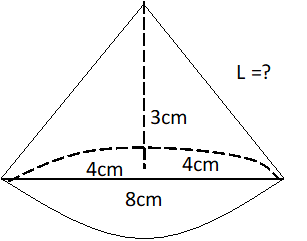
A paper cone has a diameter of 8cm and a height of 3cm
a). Make a sketch of the cone and hence use Pythagoras theorem to calculate its slant height.
b). Calculate the curved surface area of the cone in terms of π
c ) If the cone is cut and opened out into the sector of a circle. What is the angle of
the sector?
d) Assuming that the paper cone is closed at its base, what will be the total surface area of the closed paper cone?
Solutions.
From the given information about the paper cone,
Diameter = 8cm
:. Radius = diameter
2
= 8cm = 4cm
2
using Pythagoras theorem in the right angled triangle OBC
l2 = /OB/2 + /BC/ 2
l2 = 32 + 42
l2 = 9 + 16
l2 = 25
Take square root of both sides

√ l2 =√ 25
l = 5cm
:.the slant height of the paper cone is 5cm
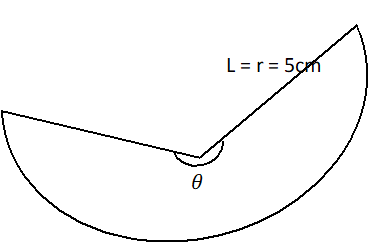 b) Curve surface area of the cone = πrl
= π x 4 x 5 cm
= 20 πcm2
c)
If the paper cone is cut and opened out into the sector of a circle as shown in the figure above, then
area of sector of circle = curved surface area of the cone
i.eθx π x (5) 2 = 20 x π
360
5
 θx π x 25 = 20 x π
 360
360
12
5 θ = 72 x 20
Divide both sides by 5
5 θ =72 x 20
5
5 θ = 72 x 4
θ = 288o
EVALUATION
- A 216 sector of a circle of radius 5cm is bent to form a cone. Find the radius of the base of the cone and its vertical angle
- Calculate (a) the curved surface area (b) the total surface area of the cone formed in question (1) above. Leave your anser in terms of П
Volume of Pyramids and Volume of cone
In general,
Volume = 1/3 x base area x height
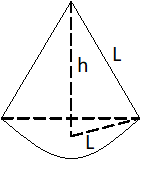
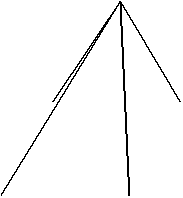
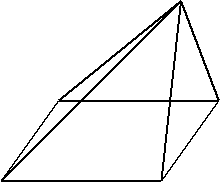
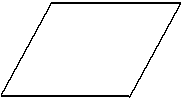
Square based pyramid rectangular based pyramid Cone
:. Volume of square based pyramid = 1/3 x b2 x h
volume of rectangular based pyramid = 1/3 x l x b x h
volume of cone = 1/3 x Πr2 x h
Examples
1.A pyramid 8cm high stands on a rectangular base 6cm by 4cm.Calculate the volume of the pyramid.
2. A right pyramid on a base 4cm square has a slant edge of 6cm.Calculate the volume of the pyramid.
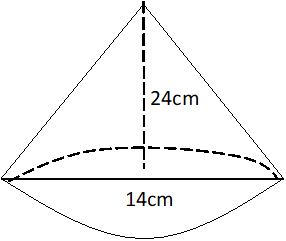
3. Calculate the volume of a cone 14cm in base diameter and 24cm high.
Solutions
1) Volume of a rectangular based pyramid = 1/3 x l x b x h
= 1/3 x 6 x 4 x 8 cm3
= 8 x8 cm3
= 64cm3
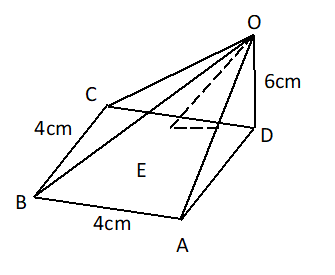 2) Considering the square base ABCD
/DB/ 2= /DC/ 2 + /CB/2
Pythagoras rule:
/DB/2 = 42 + 42
/B/2 = 16 + 16.

 :. √/DB/ = √ 32
/DB/ = 4 √2 cm
but
/ EB/ = ½ /DB/
Since t is the midpoint of / DB/
 Then /EB/ = ½ X 4 X √ 2

= 2 √2 cm.
Now
Consider right angle OEB
OE 2 + EB 2 = ( OB)2
OE 2+ ( 2√2) 2 = ( 6) 2
OE 2 + 4 x 2 = 36
OE 2 + 8 = 36
OE 2 = 36 – 8
OE2 = 28
 OE = √28

 OE = √4 x 7

OE = 2 x √ 7 cm
OE = 2 √7cm
 But OE =height of the pyramid = 2√7
:.volume of square of based pyramid = 1/3 x b2 x h

1/3 x 42 x 2 x √7 cm3
 1/3 x 16 x 2 x √7 cm3

= 32 x √7 cm3
3
32 x 2.646cmm3
3
 = 32 x.0.882cm3
= 28. 224cm3
= 28.2cm3 to 1 d.p.
3)
Since
Diameter = 14cm
Radius = diameter
2
= 14 cm.=7cm
2
:. Volume of cone = 1/3 πr2 h
= 1/3 x 22/7 x ( 7 ) 2 x 24
= 1/3 x 22/7 x 49 x 24 cm3
= 22 x 56cm3
= 1232 cm3
EVALUATION
1. A cone of height 9cm has a volume of n cm3 and a curved surface area of n cm3. Find the vertical angle of the cone
2. A right pyramid on a base 8cm square has a slant edge of 6cm. Calculate the volume of the pyramid
GENERAL EVALUATION
- A solid cone has a circular base of radius 7cm. the vertical height of the cone is 15cm. the cone is melted and recast into a metal cube of side xcm. Calculate correct to 3.s.f. the value of x.
- A cylindrical container with a diameter 80cm and height 50cm is full of liquid. The liquid is then poured into another cylinder with a diameter 90cm. calculate the depth of the water.
READING ASSIGNMENT
NGM SS Bk 1 pg 166- 170 Ex 15a Nos 1 (d), 1(f), 2(b) and 29c) pages 168 -169.
WEEKEND ASSIGNMENT
- Calculate the volume of a cylinder which has a radius of 21cm and height 6cm. A. 8500cm3 B. 8316cm3 C. 7632cm3 D 7500cm3 E. 8000cm3
- Calculate the total surface of the cylinder in question 1. A, 5346cm2 B, 4653cm3 C. 3000cm2 D. 3564 cm2 E 3800cm2
- Calculate the volume of a cone which has a base diameter of 7cm and a height of 6cm A. 77cm3 B. 70cm3 C. 88cm3 D. 90cm3 E. 65cm3
- Calculate the curved surface area of the cone in question 3 above. A, 152cm2 B. 150cm2 C. 132cm2 D 142cm2 E. 160cm2
- Calculate the total surface area of a cuboids which is 8cm by 5cm by 3cm. A.198cm2 B. 178cm2 C 188cm2 D 168cm2 E. 158cm2.
THEORY
- A water tank is 1.2m square and 1.35m deep. It is half full of water . How many times can a 9 litre bucket be filled from the tank?
- A measuring cylinder of radius 3cm contains water to a height of 49cm. If this water is poured into a similar cylinder of radius 7cm, what will be the height of the water column?.