BST – BASIC TECHNOLOGY JSS 2
SCHEME OF WORK
- First – Aid
- Rescue operation
- materials and their uses
- wood
- metal
- materials and their uses
-ceramics / glass
– Rubber
– Plastics
5. Geometric construction
6. Angles
7. Angles [continue]
8. Triangles
9. Triangle [continue]
10. Circle
11. Revision
Week 1; first aid
First aid
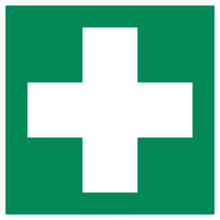
The universal first aid symbol (or the background may be red with a white cross)
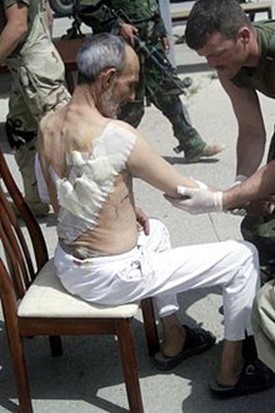
A US Navy corpsman gives first aid to an injured Iraqi citizen.
 Medical portal
 Medical portal
First aid is the assistance given to any person suffering a sudden illness or injury,[1] with care provided to preserve life, prevent the condition from worsening, and/or promote recovery. It includes initial intervention in a serious condition prior to professional medical help being available, such as performing CPR while awaiting an ambulance, as well as the complete treatment of minor conditions, such as applying a plaster to a cut. First aid is generally performed by the layperson, with many people trained in providing basic levels of first aid, and others willing to do so from acquired knowledge. Mental health first aid is an extension of the concept of first aid to cover mental health.
There are many situations which may require first aid, and many countries have legislation, regulation, or guidance which specifies a minimum level of first aid provision in certain circumstances. This can include specific training or equipment to be available in the workplace (such as an Automated External Defibrillator), the provision of specialist first aid cover at public gatherings, or mandatory first aid training within schools. First aid, however, does not necessarily require any particular equipment or prior knowledge, and can involve improvisation with materials available at the time, often by untrained persons.[2]
First aid can be performed on all mammals, although this article relates to the care of human patients.
Contents
[hide]
- 1History
- 1.1Early history and warfare
- 1.2Formalization of life saving treatments
- 2Aims
- 3Key skills
- 3.1Preserving life
- 3.2Promoting recovery
- 4Training
- 4.1Specific disciplines
- 5First aid services
- 6Symbols
- 7Conditions that often require first aid
- 8First Aid Kit
- 8.1Making of the First Aid Kit
- 8.2Contents
- 9References
- 10External links
History[edit]

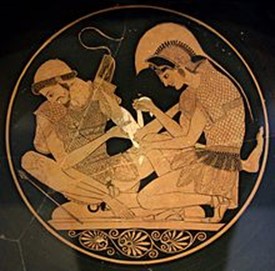
The binding of a battlefield wound depicted on ancient Greek pottery
Early history and warfare[edit]
Skills of what is now known as first aid have been recorded throughout history, especially in relation to warfare, where the care of both traumatic and medical cases is required in particularly large numbers. The Ancient Egyptians (aka people of KMT) are the first known to use bandages including the high genius doctor Imhotep. They not only used them to create mummies but also as part of the treatments for surgical patients. Most ancient Greek doctors, philosophers, etc. studied in ancient Egypt and then returned to Greece. The bandaging of battle wounds is shown on Classical Greek pottery from circa 500 BCE, whilst the parable of the Good Samaritan includes references to binding or dressing wounds.[3] There are numerous references to first aid performed within the Roman army, with a system of first aid supported by surgeons, field ambulances, and hospitals.[4] Roman legions had the specific role of capsarii, who were responsible for first aid such as bandaging, and are the forerunners of the modern combat medic.[5]
Further examples occur through history, still mostly related to battle, with examples such as the Knights Hospitaller in the 11th century CE, providing care to pilgrims and knights in the Holy Land.[6]
Formalization of life saving treatments[edit]
During the late 18th century, drowning as a cause of death was a major concern amongst the population. In 1767, a society for the preservation of life from accidents in water was started in Amsterdam, and in 1773, physician William Hawes began publicizing the power of artificial respiration as means of resuscitation of those who appeared drowned. This led to the formation, in 1774, of the Society for the Recovery of Persons Apparently Drowned, later the Royal Humane Society, who did much to promote resuscitation.[7][8]
Napoleon’s surgeon, Baron Dominique-Jean Larrey, is credited with creating an ambulance corps (the ambulance volantes), which included medical assistants, tasked to administer first aid in battle.
In 1859 Jean-Henri Dunant witnessed the aftermath of the Battle of Solferino, and his work led to the formation of the Red Cross, with a key stated aim of “aid to sick and wounded soldiers in the field”.[6] The Red Cross and Red Crescent are still the largest provider of first aid worldwide.[9]

Esmarch bandage showing soldiers how to perform first aid
In 1870, Prussian military surgeon Friedrich von Esmarch introduced formalized first aid to the military, and first coined the term “erste hilfe” (translating to ‘first aid’), including training for soldiers in the Franco-Prussian War on care for wounded comrades using pre-learnt bandaging and splinting skills, and making use of the Esmarch bandage which he designed.[3] The bandage was issued as standard to the Prussian combatants, and also included aide-memoire pictures showing common uses.
In 1872, the Order of Saint John of Jerusalem in England changed its focus from hospice care, and set out to start a system of practical medical help, starting with making a grant towards the establishment of the UK’s first ambulance service. This was followed by creating its own wheeled transport litter in 1875 (the St John Ambulance), and in 1877 established the St John Ambulance Association (the forerunner of modern-day St John Ambulance) “to train men and women for the benefit of the sick and wounded”.[10]
Also in the UK, Surgeon-Major Peter Shepherd had seen the advantages of von Esmarch’s new teaching of first aid, and introduced an equivalent programme for the British Army, and so being the first user of “first aid for the injured” in English, disseminating information through a series of lectures. Following this, in 1878, Shepherd and Colonel Francis Duncan took advantage of the newly charitable focus of St John,[3] and established the concept of teaching first aid skills to civilians. The first classes were conducted in the hall of the Presbyterian school in Woolwich (near Woolwich barracks where Shepherd was based) using a comprehensive first aid curriculum.
First aid training began to spread through the British Empire through organisations such as St John, often starting, as in the UK, with high risk activities such as ports and railways.[11]
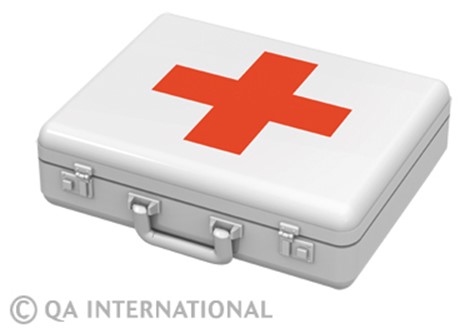
first aid materials ;
First aid kit
It is crucial to have a proper first aid kit at home, in your car, and in your backpack while hiking, and to know where to find one at work. Care should be taken to ensure that it is complete and kept in good condition. This first aid kit contains the materials required to treat most benign problems. It also helps to stabilize a more serious situation while waiting for professional medical assistance. The basic kit, of which the elements are numbered below, may be completed at home with a thermometer and acetaminophen or ibuprofen based analgesics and, for hiking, with sunscreen, insect repellent, and calming lotion for sunburn and insect bites (calamine). Metallic instruments must be disinfected with alcohol before and after use. Materials that are outdated or partially used, or whose packaging has been damaged by humidity, must be thrown out and replaced. forms of medications
first aid kitA basic first aid kit includes:
- Metal scissors with rounded ends
accessories- Splinter tweezers
nail care- Disposable gloves and masks to protect against infection
half-mask respirator- Different sized safety pins to fasten a bandage
- Different sized adhesive bandages, sterile and individually wrapped, to protect a wound
- Gauze compresses, sterile and individually wrapped, to cover an extended wound or stop bleeding
- Different sized gauze bandages in rolls, sterile and individually wrapped
- Thick compress dressings, sterile and individually wrapped, to stop bleeding
- Elastic cloth bands
- Triangular bandages, to make a sling or to keep a splint or compress dressing in place
- Roll of adhesive tape, to secure dressings
- Swabs soaked in antiseptic, individually wrapped, to clean an injury
- Antiseptic cleanser
Risk of infection
All wounds are a means of entry for pathogenic agents and present a risk of infection. Superficial wounds must therefore be cleaned gently with soap and water and treated with gloved or clean hands, an antiseptic product and sterile dressing.Signs of wound infection are increase in pain, swelling and redness around the wound, increase in skin heat, and appearance of pus.

question- define first aid
- list 5 materials in first aid box

 forms of medications
 first aid kit
 accessories
 nail care
 half-mask respirator