Scheme of work for jss2
Week 1; revision of last term work
Week 2; quadrilaterals
Week 3; plane figures[polygon]
Week 4&5; area of plane figures
Week 6; wood work machine
Week 7; metal work machine
Week 8; care and maintenance of metal work machine
Week 9; friction
Week 10; reduction of friction
Week 11; revision
Week 12; examination
Week 1; revision
Rescue comprises responsive operations that usually involve the saving of life, or prevention of injury during an incident or dangerous situation.
Tools used might include search and rescue dogs, mounted search and rescue horses, helicopters, the “jaws of life”, and other hydraulic cutting and spreading tools used to extricate individuals from wrecked vehicles. Rescue operations are sometimes supported by special vehicles such as fire department’s or EMS heavy rescue vehicle.
OverviewRopes and special devices can reach and remove individuals and animals from difficult locations including:
Air-sea rescueCave rescueCombat search and rescueConfined space rescueMine rescueRope rescueSearch and rescueSki patrolSurface water rescueSwiftwater rescueUrban search and rescueVehicle extricationWildernessRescue operations require a high degree of training and are performed by rescue squads, either independent or part of larger organizations such as fire, police, military, first aid, or ambulance service.
Week 2; quadrilaterals
In this tutorial on basic geometry concepts, we cover the types and properties of quadrilaterals: Parallelogram, rectangle, square, rhombus, trapezium.
Definition:
A quadrilateral is a simple closed figure with four sides.
Types of quadrilaterals
There are five types of quadrilaterals.
- Parallelogram
- Rectangle
- Square
- Rhombus
- Trapezium
One common property of all quadrilaterals is that the sum of all their angles equals 360°.
Let us look into the properties of different quadrilaterals.

Parallelogram

Properties of a parallelogram
- Opposite sides are parallel and congruent.
- Opposite angles are congruent.
- Adjacent angles are supplementary.
- Diagonals bisect each other and each diagonal divides the parallelogram into two congruent triangles.
- If one of the angles of a parallelogram is a right angle then all other angles are right and it becomes a rectangle.
Important formulas of parallelograms
- Area = L * H
- Perimeter = 2(L+B)

Rectangles
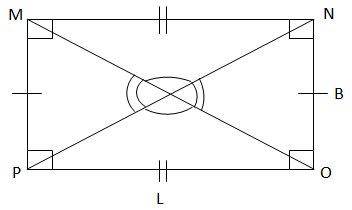
Properties of a Rectangle
- Opposite sides are parallel and congruent.
- All angles are right.
- The diagonals are congruent and bisect each other (divide each other equally).
- Opposite angles formed at the point where diagonals meet are congruent.
- A rectangle is a special type of parallelogram whose angles are right.
Important formulas for rectangles
- If the length is L and breadth is B, then
Length of the diagonal of a rectangle = √(L2 + B2)
- Area = L * B
- Perimeter = 2(L+B)

Squares

Properties of a square
- All sides and angles are congruent.
- Opposite sides are parallel to each other.
- The diagonals are congruent.
- The diagonals are perpendicular to and bisect each other.
- A square is a special type of parallelogram whose all angles and sides are equal.
- Also, a parallelogram becomes a square when the diagonals are equal and right bisectors of each other.
Important formulas for Squares
- If ‘L’ is the length of the side of a square then length of the diagonal = L √2.
- Area = L2.
- Perimeter = 4L

Rhombus
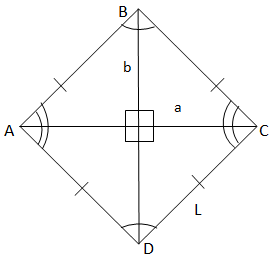
Properties of a Rhombus
- All sides are congruent.
- Opposite angles are congruent.
- The diagonals are perpendicular to and bisect each other.
- Adjacent angles are supplementary (For eg., ∠A + ∠B = 180°).
- A rhombus is a parallelogram whose diagonals are perpendicular to each other.
Important formulas for a Rhombus
If a and b are the lengths of the diagonals of a rhombus,
- Area = (a* b) / 2
- Perimeter = 4L

Trapezium
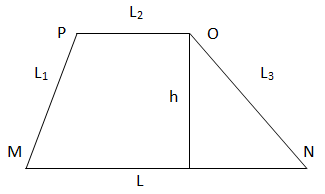
Properties of a Trapezium
- The bases of the trapezium are parallel to each other (MN ⫽ OP).
- No sides, angles and diagonals are congruent.
Important Formulas for a Trapezium
- Area = (1/2) h (L+L2)
- Perimeter = L + L1 + L2 + L3
Summary of properties
Summarizing what we have learnt so far for easy reference and remembrance:
| S.No. | Property | Parallelogram | Rectangle | Rhombus | Square |
| 1 | All sides are congruent | ✕ | ✕ | ✓ | ✓ |
| 2 | Opposite sides are parallel and congruent | ✓ | ✓ | ✓ | ✓ |
| 3 | All angles are congruent | ✕ | ✓ | ✕ | ✓ |
| 4 | Opposite angles are congruent | ✓ | ✓ | ✓ | ✓ |
| 5 | Diagonals are congruent | ✕ | ✓ | ✕ | ✓ |
| 6 | Diagonals are perpendicular | ✕ | ✕ | ✓ | ✓ |
| 7 | Diagonals bisect each other | ✓ | ✓ | ✓ | ✓ |
| 8 | Adjacent angles are supplementary | ✓ | ✓ | ✓ | ✓ |
Assignment
- Define quadrilaterals
- Define polygon