CLASS; J S S 1 WEEK 4
TOPIC;
INTRODUCTION TO CHOREOGRAPHY
Choreography
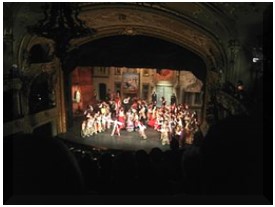
Choreography is the art or practice of designing sequences of movements of physical bodies (or their depictions) in which motion, form, or both are specified. Choreography may also refer to the design itself.
A choreographer is one who creates choreographies by practicing the art of choreography, a process known as choreographing. Choreography is used in a variety of fields, including cheerleading, cinematography, gymnastics, fashion shows, ice skating, marching band, show choir, theatre, synchronized swimming, cardistry, video game production and animated art. In the performing arts, choreography applies to human movement and form. In dance, choreography is also known as dance choreography or dance composition.
The word choreography literally means “dance-writing” from the Greek words (circular dance, see chorea) and (writing). It first appeared in the American English dictionary in the 1950s, and “choreographer” was first used as a credit for George Balanchine in the Broadway show On Your Toes in 1936. Prior to this, stage credits and movie credits used phrases such as “ensembles staged by”, “dances staged by”, or simply “dances by” to denote the choreographer.
Choreography (dance)
In dance, choreography is the act of designing dance. Choreography may also refer to the design itself, which is sometimes expressed by means of dance notation. A choreographer is one who designs dances. Dance choreography is sometimes called dance composition.
Aspects of dance choreography include the compositional use of organic unity, rhythmic or non-rhythmic articulation, theme and variation, and repetition. The choreographic process may employ improvisation for the purpose of developing innovative movement ideas. In general, choreography is used to design dances that are intended to be performed as concert dance.
The art of choreography involves the specification of human movement and form in terms of space, shape, time and energy, typically within an emotional or non-literal context. Movement language is taken from the dance techniques of ballet, contemporary dance, jazz dance, hip hop dance, folk dance, techno, k pop, religious dance, pedestrian movement, or combinations of these.
Techniques
Dances are designed by applying one or both of these fundamental choreographic methods:
Principles of Choreograph a Dance
Choreographing a dance requires creativity, patience, and hard work! Before you piece together the perfect routine, let the music and genre inspire you. Be confident in your steps and the skills of your performers. Most importantly, have fun! Rehearse and perform your piece with confidence.
1
Spend some time thinking about your routine. Is there a specific message you wish to get across or a mood you hope to convey. Keep track of your thoughts and ideas in a journal, on your computer, or in a notes app on your phone. As you begin choreographing, refer to these early brainstorming sessions for inspiration and direction.
- Get inspired by other performances. Devote sometime to watching street performers, YouTube videos, and classical recitals. Watch old musicals and modern music videos.
2
Take your audience, venue, and event into consideration. When choreographing a dance, it is important to know your audience. Who are you performing for? What kind of dance are they expecting? As a choreographer, it is also essential that you take the venue and event into consideration. Will the dancers be on a stage, on a gym floor, or outdoors? Will your piece be performed at a recital or at the halftime of your high school’s basketball game? The answers to these questions will influence the content of your dance number.
3
Select a style. There are hundreds of styles to choose between. You could choreograph a hip-hop routine or a fiery flamenco. Pick a style that suits your skills and the talents of your dancers. If you’re feeling daring, try creating a mash-up. Combine and mesh multiple styles into one stellar routine.
- Choose a style that is fun and that you and your dancers are comfortable with.
4
Choose a song. Selecting a song that complements the dance style is essential. While classical songs work well for ballet, hip-hop routines generally require more modern tunes. The song should inspire your creativity, motivate you to move, and intrigue your audience.
- Don’t be afraid to select an out-of-the-box song. Sometimes taking a risk can be very rewarding. Listen to new artists or artists from different countries.
5
Determine how many dancers will perform your piece. Are you creating a beautiful solo or a daring duet? Do you feel inspired to create a complex group number or a dance simple enough for a flash mob? Decide how many dancers you will need in order to convey your message to the audience. - Be flexible! If your dancers are volunteers, you may not get as many willing participants as you had originally hoped.
- Improvisation in choreography is the process in which a choreographer provides dancers with a score (i.e., generalized directives) that serves as guidelines for improvised movement and form. For example, a score might direct one dancer to withdraw from another dancer, who in turn is directed to avoid the withdrawal, or it might specify a sequence of movements that are to be executed in an improvised manner over the course of a musical phrase, as in contra dance choreography. Improvisational scores typically offer wide latitude for personal interpretation by the dancer.
- Planned choreography, in which a choreographer dictates motion and form in detail, leaving little or no opportunity for the dancer to exercise personal interpretation.