week 9; triangles
inscribing circle in a triangle
“Incircle” redirects here. For incircles of non-triangle polygons, see Tangential quadrilateral and Tangential polygon.
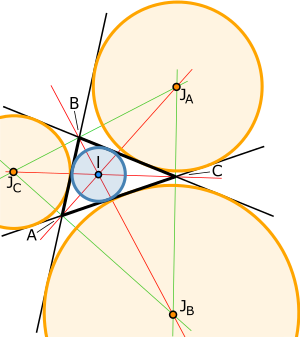
A triangle (black) with incircle (blue), incenter (I), excircles (orange), excenters (JA,JB,JC), internal angle bisectors (red) and external angle bisectors (green). The green triangle is the excentral triangle.
In geometry, the incircle or inscribed circle of a triangle is the largest circle contained in the triangle; it touches (is tangent to) the three sides. The center of the incircle is a triangle center called the triangle’s incenter.[1]
An excircle or escribed circle[2] of the triangle is a circle lying outside the triangle, tangent to one of its sides and tangent to the extensions of the other two. Every triangle has three distinct excircles, each tangent to one of the triangle’s sides.[3]
The center of the incircle, called the incenter, can be found as the intersection of the three internal angle bisectors.[3][4] The center of an excircle is the intersection of the internal bisector of one angle (at vertex A, for example) and the external bisectors of the other two. The center of this excircle is called the excenter relative to the vertex A, or the excenter of A.[3] Because the internal bisector of an angle is perpendicular to its external bisector, it follows that the center of the incircle together with the three excircle centers form an orthocentric system.[5]:p. 182
Polygons with more than three sides do not all have an incircle tangent to all sides; those that do are called tangential polygons. See also Tangent lines to circles.
Circumscribed circle
From Wikipedia, the free encyclopedia
This article is about circumscribed circles in Geometry. For the use of circumscribed in Biological classification, see Circumscription (taxonomy).
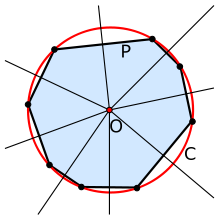
Circumscribed circle, C, and circumcenter, O, of a cyclic polygon, P
In geometry, the circumscribed circle or circumcircle of a polygon is a circle which passes through all the vertices of the polygon. The center of this circle is called the circumcenter and its radius is called the circumradius.
A polygon which has a circumscribed circle is called a cyclic polygon (sometimes a concyclic polygon, because the vertices are concyclic). All regular simple polygons, all isosceles trapezoids, all triangles and all rectangles are cyclic.
A related notion is the one of a minimum bounding circle, which is the smallest circle that completely contains the polygon within it. Not every polygon has a circumscribed circle, as the vertices of a polygon do not need to all lie on a circle, but every polygon has a unique minimum bounding circle, which may be constructed by a linear timealgorithm.[2] Even if a polygon has a circumscribed circle, it may not coincide with its minimum bounding circle; for example, for an obtuse triangle, the minimum bounding circle has the longest side as diameter and does not pass through the opposite vertex.
Question;
- Construct triangle [AB] = 60mm
- [AB] 70mm