CLASS;JSS1 WEEK 3 TOPIC;
THEORY OF MUSIC
Sight Singing: A Beginner’s Guide
Have you always wanted to learn to sight sing/read music? If you learn how to sight sing, you’ll be able to pick up a piece of music you’ve never seen or heard before and sing it on the spot.
I’ve put together a beginner’s tutorial on sight singing to get you started. All of these concepts have much deeper levels that we will explore in future posts. For now, I’m going to teach you the basics of what you need to know to start sight singing some simple melodies TODAY!
Sight Singing Step #1
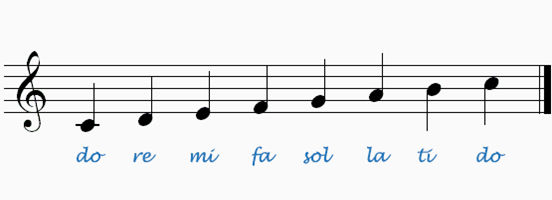
The first step to becoming a good sight singer is to know your way around the major scale. You should be able to sing it a capella and in tune on solfege syllables.
Sight Singing Step #2
The second step is learning the names of the notes on the staff (treble clef most importantly). Most vocal music (other than baritone and bass parts in choral music) is written in treble clef.
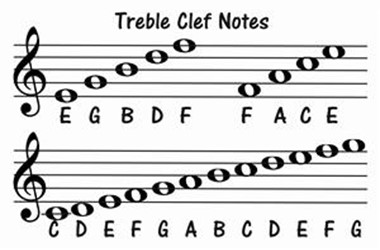
Lines- Every Good Boy Deserves Fudge
Spaces- FACE
Sight Singing Step #3
The third step is learning basic rhythmic values. When you read music, the notes on the page represent pitch as well as rhythm.

Audio Player
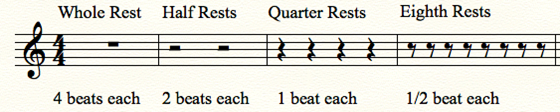
Rests are periods of silence in music. They work the same way that notes do, except they represent silence instead of sound. For example, a quarter note is a pitch that lasts for 1 beat. A quarter rest is silence that lasts for 1 beat.
Sight Singing Step #4
Time signatures and Key signatures. For now, we are going to keep it simple and focus only on 4/4 time and the key of C Major.
(I will be posting full tutorials on time signatures and key signature in the near future.)
What is a time signature?

You can find the time signature at the beginning of a piece of music. It looks like a fraction- two number stacked on top of each other. The top number in the time signature tell you how many beats are in each measure of music. A song with a time signature of 4/4 has four quarter note beats per measure.
Example-

What is a key signature?

A key signature is a set of sharp or flat symbols placed together on the music staff. You can find the key signature at the beginning of a piece of music- right between the clef sign and the time signature. The key signature tells you what key the piece of music is in and what notes are sharp or flat in that particular key.
Examples of other key signatures-

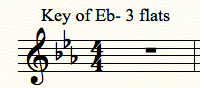
Key signatures might seem complicated, but really it’s just memorization. The goal is to be able to look at a key signature and think “Ah yes- I see three flats in that key signature. This song is in the key of Eb Major
Sight Singing Step #5
Practice! Here are some sight singing exercises to get you started.
Your first note is C-
Audio Player.
Basic Music Theory
Ever wondered why music theory didn’t make sense? The key to learning basic music theory is to learn and use the same systems that all musicians use.
Music is a language. It has parts that make up the whole, and those parts are made of even smaller parts. This sentence is made of words, and these words are made of letters. To learn how to make the sentence as a whole, you have to learn the letters of the alphabet, and learn how to put them into words. Then you have to learn certain words, and learn how to put them into sentences.
Music works the same way. You learn the alphabet then put those pieces together to make musical phrases, then put those together to make a song.
Alphabet The music alphabet is like the English alphabet. It is a system of letters that are assigned to represent sounds in music that we call notes. This is the simplest part to learn, and everything else will be based on this, so start here!
Scales Scales are just a linear arrangement of notes. If notes are actual pitches, then scales are those pitches in a certain order. (ex. A B C D E F G) because scales or pieces of scales are used in just about every song ever written, they are a huge piece of basic music theory.
Intervals An Interval is the distance from one note to another. Whether it’s B to C (a Second) or G# to Eb (a Sixth), every interval has its own name. This stuff is really useful in figuring out harmonies. Chords Chords are certain members of a scale combined into one sound. (For instance “C + E + G = CMaj” or “D + F + A = DMin”.) Chords give structure, organization, and shape to a song. They make the song “sound” a certain way. Even if you are strictly a lead player, you NEED to know this. Even as a violinist, I use chords all the time to talk about the songs. I’ll play that fill after the G7 chord.
Key Signatures Key signatures tell us the tonality or “key” of a song. It also tells us which notes the song will be using. The more you work with these, the more familiar you get with the range and scale of particular keys. Unless you want all of your songs to sound the same, PLEASE study these.