WEEK ELEVEN:
Topic:
Introduction to building drawing.


Content:
(i) Meaning of working drawing.
(ii) Examples of working drawing.
Meaning of working drawing.
Working drawing is a type of architectural or mechanical drawing from which construction work is actually carried out. Therefore, they must give all the graphical information necessary for constructional purposes and must be accurately drawn in orthographic projection showing the plan, elevations and essential sections. There are working drawings for mechanical components, site plan, foundation plan, floor plan and elevations. They must have detailed dimensioning, appropriate titles and the scale used.
Evaluation
1. Define a working drawing.
2. Mention some of the features of a working drawing.
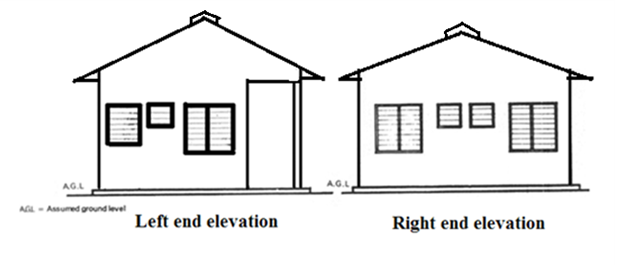
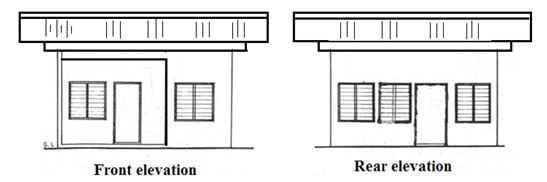
 Example of the working drawing of a bungalow.
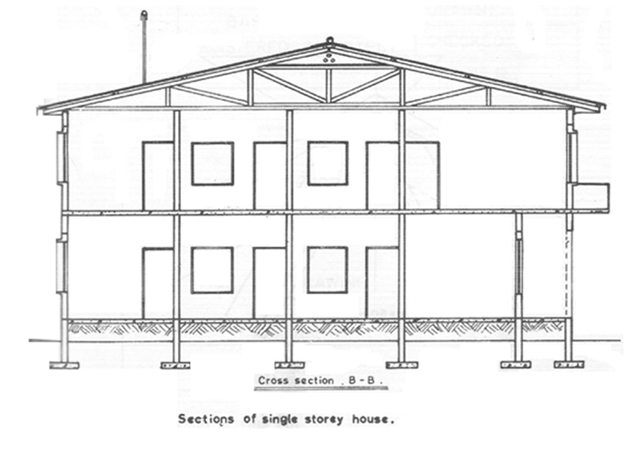
 Example of the working drawing of a storey building.

Evaluations
1. Draw a floor plan of your dream bungalow building.
2. Sketch the front, end and rear elevations of your school building.
Reading assignment
Visit www.google.com for types of working drawings.
Drafting technology by Spence pages 687 – 704.
Weekend Assignment
Objective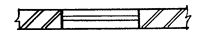
1. On a building floor plan, the symbol above represents A. window. B. lintel. C. door. D. column.
 2. In a building floor plan. the part shown below can be identified as a A. lintel B. door. C. window.
D. Arch
3. Which of the following can be found in a door opening? A. Sill. B. Jamb. C. Eaves D. Tread.
4. A function of an internal wall is to A. carry loads. B. divide the space. C. enhance wall stability.
D. reinforce the foundation.
5. Which of the following is not a roof member? A. Muntin. B. Ridge. C. Purlin. D. Rafter.
Theory
1. Mention 5 characteristics of a working drawing.
 2. The figure below shows the sketch plan of a three bedroom bungalow. Study the given specifications and answer the following questions.
SPECIFICTIONS
Foundation: 800 X 225 strip laid 1000 below ground level.
Wall: All walls are 225 thick sandcrete, hollow blocks, with 13 mortar rendering on both sides.
Floor: 300 hardcore; 150 thick concrete slab; 25 mortar screed.
Finished floor to ceiling, 3000.
Doors: Main entrance – 2100 X 1800 flush wooden in 120 X 80 timber frame.
Inside – 900 X 210 X 40 flush wooden in 100 X 50 timber frame.
Kitchen (outside) – 900 X 2100 fabricated metal in 100 X 50 metal frame’
Windows: All glass louvred with aluminum carriers in 100 X 50 timber frames.
Toilets (W1) – 800 X 500.
Others – 1400 X 1200.
Lintel: 225 X 255 reinforced concrete.
Roof: Pitch angle 120 (gable roof) with corrugated aluminum sheets; 300 eaves projection;
timber rafter 200 X 50 at 1000 centres; purlins 75 X 50 at 900 centres;
ceiling joist 50 X 50 at 1200 centres.
Note: (Assume suitable dimensions where necessary)
Draw the:
(a) floor plan of the building to a scale of 1 : 100;
(b) front elevation of the building to a scale of 1 : 100;
(c) sectional elevation P – P of the building to a scale of 1 : 50.