SUBJECT: MATHEMATICS CLASS: SS2
SCHEME OF WORK
| WEEK | TOPIC |
| 1 | Revision of Logarithm of Numbers Greater than One and Logarithm of Numbers Less than one; Reciprocal and Accuracy of Results Using Straight Calculation. |
| 2 |
|
| 3 |
|
| 4 |
|
| 5 |
|
| 6 |
|
| 7 | Simultaneous Equations: Solving Simultaneous Equations Using Elimination and Substitution Method; Word Problem Leading to Simultaneous Equations. |
| 8 | Simultaneous Equations: Solving Equations Involving One Linear and One Quadratic; Using Graphical Method to Solve Quadratic Equations. |
| 9 | Straight Line Graphs: Gradient of a Straight Line; Gradient of a Curve; Drawing of Tangents to a Curve. |
| 10 | Revision. |
REFERENCE BOOKS
- New General Mathematics SSS2 by M.F. Macrae etal.
- Essential Mathematics SSS2 by A.J.S. Oluwasanmi.
WEEK ONE
TOPIC: REVISION OF LOGARITHM OF NUMBERS GREATER THAN ONE AND LOGARITHM OF NUMBERS LESS THAN ONE.
CONTENT
- Standard forms
- Logarithm of numbers greater than one
- Multiplication and divisions of numbers greater than one using logarithm
- Using logarithm to solve problems with roots and powers (no > 1)
- Logarithm of numbers less than one.
- Multiplication and division of numbers less than one using logarithm
- Roots and powers of numbers less than one using logarithm
STANDARD FORMS
A way of expressing numbers in the form A x 10x where 1< A < 10 and x is an integer, is said to be a standard form. Numbers are grouped into two. Large and small numbers. Numbers greater than or equal to 1 are called large numbers. In this case the x, which is the power of 10 is positive. On the other hand, numbers less than 1 are called small numbers. Here, the integer is negative.
Numbers such as 1000 can be converted to its power of ten in the form 10x where x can be termed as the number of times the decimal point is shifted to the front of the first significant figure i.e. 10000 = 104
Number Power of 10
- 102
- 101
- 100
- 10-3
- 10-1
Note: One tenth; one hundredth, etc are expressed as negative powers of 10 because the decimal point is shifted to the right while that of whole numbers are shifted to the left to be after the first significant figure.
Examples
1. Express in standard form (i) 0.08356 (ii) 832.8 in standard form
Solution
i 0. 08356 = 8.356 x 10⁻²
ii 832.8 = 8.328 x 10²
2. Express the following in standard form
(a) 39.32 = 3.932 x 101
(b) 4.83 = 4.83 x 100
(c) 0.005321 = 5.321 x 10⁻³
WORKING IN STANDARD FORM
Example
Evaluate the following leaving your answer in standard form
- 4.72 x 10³ + 3.648 x 10³
(ii)6.142 x 10⁵ + 7.32 x 10⁴
(iii) 7.113 x 10⁻⁵– 8.13 x 10⁻⁶
solution
i. 4.72 x 10³ + 3.648 x 103
= [ 4.72 + 3.648 ] x 103
= 8.368 x 10 3
ii. = 6.142 x 10⁵+ 7.32 x 104
= 6.142 x 10⁵+ 0.732 x 105
= [6.142 + 0.732 ] x 105
= 6.874 x 10⁵
iii. = 7.113 x 10⁻⁵ – 8.13 x 10-6
= 7.113 x 10⁻⁵ – 0.813 x 10-5
= [ 7.113 – 0.813 ] x 10-5
= 6.3 x 10⁻⁵
Example:Simplify : √[P/Q], leaving your answer in standard form given that P = 3.6 x 10⁻³ and
Q = 4 x 10⁻⁸.
Solution
= √[P/Q]
3.6 x 10-3
= 4 x 10-8
= / 36 x 10-4
√ 4 x 10-8
= √ 9 x 10⁻⁴ –(-8)
= 3 x (104) ½
= 3 x 10²
EVALUATION
1. Evaluate 2.5 x 10⁻³ + 3.2 x 10⁻²
2. Without using table, evaluate the following leaving your answer in standard form,
i. 4ab given that a= 3.5 x 10⁻³ and b = 2.3 x 10⁶ ii. 0.08 x 0.000025
0.0005
LOGARITHM OF NUMBERS GREATER THAN ONE
Base ten logarithm of a number is the power to which 10 is raised to give that number e.g.
628000 = 6.28 x10⁵
628000 = 100.7980 x 105
= 100.7980+ 5
= 105.7980

 Log 628000 = 5.7980
IntegerFraction (mantissa)
If a number is in its standard form, its power is its integer i.e. the integer of its logarithm e.g. log 7853 has integer 3 because 7853 = 7.853 x 10³
Examples:
Use tables (log) to find the complete logarithm of the following numbers.
(a) 80030 (b) 8 (c) 135.80
Solution
(a) 80030 = 4.9033
(b) 8 = 0.9031
(c) 13580 = 2.1329
Evaluation
Use table to find the complete logarithm of the following:
(a) 183 (b) 89500 (c) 10.1300 (d) 7
Multiplication and Division of numbers greater than one using logarithm
To multiply and divide numbers using logarithms, first express the number as logarithm and then apply the addition and subtraction laws of indices to the logarithms. Add the logarithm when multiplying and subtract when dividing.
Examples
Evaluate using logarithm.
1. 4627 x 29.3
2. 8198 ÷ 3.905
3. 48.63 x 8.53
15.39
Solutions
1. 4627 x 29.3
 No Log
 4627 3.6653
X 29.3 + 1.4669
 antilog → 135600 5.1322
 \ 4627 x 29.3 = 135600
To find the Antilog of the log 5.1322 use the antilogarithm table:
Check 13 under 2 diff 2 (add the value of the difference) the number is 0.1356. To place the decimal point at the appropriate place, add one to the integer of the log i.e. 5 + 1 = 6 then shift the decimal point of the antilog figure to the right (positive) in 6 places.
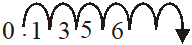
= 135600
2. 819.8 x 3.905
 No Log
819.8 2.9137
3.905 0.5916
antilog → 209.9 2.3221
\ 819.8 ÷ 3.905 = 209. 9

3. 48.63 X 8.8.53
15.39
 No Log
 48.63 1.6869
8.53 + 0.9309
2.6178
÷ 15.39 – 1.1872
 antilog → 26.95 1.4306
 \48.63 ÷ 8.53 = 26.96
15.39
Evaluation: Use logarithm to calculate. 3612 x 750.9
113.2 x 9.98
USING LOGARITHM TO SOLVE PROBLEMS WITH POWERS AND ROOT (NO. GREATER THAN ONE)
Examples:


 Evaluate:
 (a) 3.533 (b) 4 40000 (c) 94100 x 38.2 to 2 s.f
5.6833 x 8.14
Solution
- 3.533
 No. Log_____
3.533 0.5478 x 3
44.00 1.6434
\ 3.533 = 44.00


 (b) 4 4000
 No. Log_____


 4 4000 3.6021 ÷ 4

7.952 0.9005


 \4 4000 = 7.952


 (c) 94100 x 38.2
5.6833x 8.14
Find the single logarithm representing the numerator and the single logarithm representing the denominator, subtract the logarithm then find the antilog.

 No Log



 94100 4.9736 ÷ 2 = 2.4868
38.2 1.5821
Numerator 4.0689→ 4.0689
5.683 0.7543 x 3 = 2.2629
8.14 0.9106
Denominator 3.1735→
3.1735
 7.859 0.8954



\94100 x 38.2 = 7.859 ~ 7.9 (2.sf)
5.683 x 8.14
LOGARITHM OF NUMBERS LESS THAN ONE
To find the logarithm of number less than one, use negative power of 10 e. g.
0.037 = 3.7 x 10-2
= 10 0.5682 x 10-2
= 10 0.5682 + (-2)
= 10-2 5682
Log 0.037 = 2 . 5682
 2 . 5682


Integer decimal fraction (mantissa)
Example: Find the complete log of the following.
(a) 0.004863 (b) 0. 853 (c) 0.293
Solution
 Log 0.004863 = 3.6369
 Log 0.0853 = 2.9309
 Log 0.293 = 1.4669
Evaluation
1. Find the logarithm of the following:
(a) 0.064 (b) 0.002 (c) 0.802
2. Evaluate using logarithm.


 95.3 x 318.4
1.295 x 2.03
USING LOGARITHM TO EVALUATE PROBLEMS OF MULTIPLICATION, DIVISION, POWERS AND ROOTS WITH NUMBERS LESS THAN ONE
OPERATION WITH BAR NOTATION
Note the following when carrying out operations on logarithm of numbers which are negative.
i.The mantissa (fractional part) is positive, so it has to be added in the usual manner.
ii. The characteristic (integral part) is either positive or negative and should therefore be added or operated as directed numbers.
iii. For operations like multiplication and division, separate the integer from the characteristic before performing the operation.
Examples:
Simplify the following, leaving the answers in bar notation, where necessary
 .7675 + 2.4536
- 6.8053 – 4.1124
- 2.4423 x 3
- 2.2337 ÷ 7
 .7675 + 2.4536
Solution
i.  .7675 + 2.4536 ii. 6.8053 – 4.1124
 .7675 6.8053
+ 2. 4536 – 4. 1124
6. 22112.6929
iii. 2.4423 x 3 iv. 2. 2337 ÷ 7
= 3( 2 + 0.4423) = 7 + 5.2337÷ 7
= 6 + 1.3269 = 1+ 0.7477
= 5.3269 = 1 + 0.7477
= 1.7477
Examples: Evaluate the following using the logarithm tables;
1. 0.6735 x 0.928
2. 0.005692 ¸ 0.0943
3. 0.61043


 4. 4 0.00083


 5. 3 0. 06642
Solution
1. 0.6735 x 0.928
 No. Log.__
 0.6735 1.8283
 0.928 1.9675


 0.6248 1.7958
\ 0.6735 x 0.928 = 0.6248
2. 0.005692 ¸ 0.0943
No Log
0.005692 3.7553
¸ 0.0943 2.9745
0.06037 2.7808
 3. 0.61043
No Log_____
0.61043 1.7856 x 3
0.2274 1.3568
\ 0.61043 = 0.2274
\ 0.005692 ¸ 0.943 = 0.6037
 4. 4 0.00083
 No. Log._____

 4 0.00083 4.9191 ¸ 4
 0.1697 1.2298

\ 4 0.06642 =0.1697


 5. 3 0.06642
No. Log.____________


 3 0.06642 2.8223 ¸ 3
 3 ) 2 + 0.8223
 3 ) 3 + 1.8223
 1 + 0.6074
 0.405 1.6074


 30.6642 = 0.405
Note: 3 cannot divide 2 therefore subtract 1 from the negative integer and
add 1 to the positive decimal fraction so as to have 3 which is divisible
by 3 without remainder.
Evaluation:Use the logarithms table to evaluate

 5 (0.1684)3
GENERAL EVALUATION / REVISION QUESTION
Use tables to evaluate the following, giving your answers correct to 3 s.f.


 1. (0.897)3 2.(0.896 × 0.791)3 3. (800.9 × 87. 25)2
4. 8750000 × 8900 5. 80.42 × 78000


 300.5 100.5 × 35.7
WEEKEND ASSIGNMENT
Use table to find the log of the following:
1. 900 (a) 3.9542 (b) 1.9542 (c) 2.9542 (d) 0.9542
2. 12.34 (a) 3.0899 (b) 1.089 (c) 2.0913 (d) 1.0913
3. 0.000197 (a) 4.2945 (b) 4.2945 (c) 3.2945 (d) 3.2945
4. 0.8 (a) 1.9031 (b) 1.9031 (c) 0.9031 (d) 2.9031
5. Use antilog table to write down the number whose logarithms is 3.8226.
(a) 0.6646 (b) 0.06646 (c) 0.006646 (d) 66.46
THEORY
Evaluate using logarithm.


 1. 23.97 x 0.7124
3.877 x 52.18


 2. 3 76.58
0.009523
Reading Assignment
Essential Mathematics for SSS2, pages 1-10, Exercise 1.8