WEEK FOUR Date……………..
TOPIC: CONSTRUCTIONS
- Construction of quadrilateral polygon i.e. four sided figure with given certain conditions parallelogram
- Construction of equilateral triangle
- Locus of moving points including equidistance from two lines of two points and constant distance from the point.
- Construction of Quadrilaterals
Examples
1. Construct a quadrilateral ABCD in which AB is parallel to DC /AB/= 4cm, /BC /= 5cm and /DC/= 7cm and <ADC = 105o..Measure the diagonal BD.
2. Use your ruler and compasses to construct the parallelogram PQRS in which /QR/ = 5cm, /RS /=11cm and < QRS = 135o.
b. Measure the length of the shorter diagonal of PQRS.
Solutions
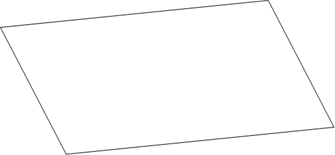
First make a sketch of the quadrilateral to be constructed as shown in the figure below:




Steps of the required construction are stated as follows:
i. Draw DNC = 7cm with DN = 3cm and NC = 4cm
ii. Construct CDM = 105o
iii. With N as centre, radius 5cm draw an arc to cut DM at A
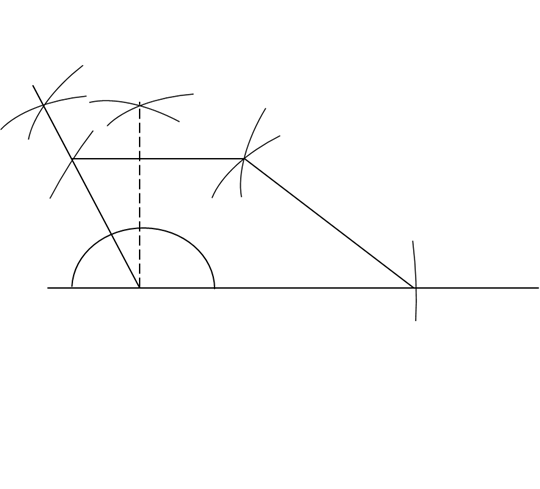 iv. With A as centre and radius of 4cm draw an arc.
With C as centre and a radius of 5cm draw a second arc to cut the first arc at B
v. Join A to B and C to B to complete the quadrilateral ABCD.
By measurement , /BD/= 4.5cm





2)First make a sketch of the parallelogram PQRS
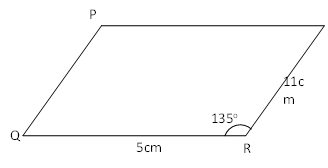
The step of the construction are stated as follows:
- Draw line QR = 5cm
- Construct R = 135o
- With R as centre and radius 11 cm draw an arc to cut the angle 135o line at S.
- With S as centre and radius 5cm, draw an arc
- With Q as centre and radius 11cm, draw a second arc to cut the arc of step iv. This is point P
- Draw lines to join S to P and P to Q
 Draw dotted line through diagonal RP and measure it.
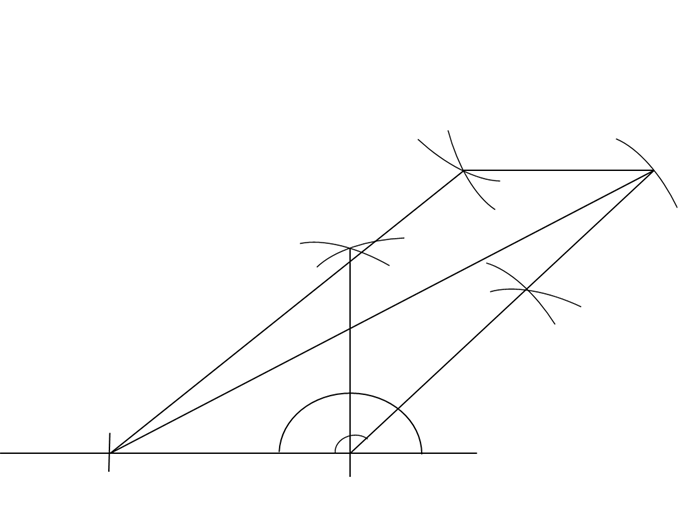 Draw dotted line through diagonal RP and measure it.


By measurement the length of the shorter diagonal PR is 8.7cm
EVALUATION
- Construct quadrilateral ABCD such that /AB/ = 5cm, /BD/= /DC/ =8cm,<ABD =30o and <BCD = 45o.
- Measure the diagonal /AC/.
- Construction of Equilateral Triangle
An equilateral triangle is a triangle in which all the sides are of equal length and each of its angle is 60o.
Examples
- Construct an equilateral triangle XYZ such that /XY/= 5CM
- (a) Construct an equilateral triangle ABC such that /AB/= 7cm
(b) Construct the bisectors of A, B and C
(c) What do you observe?


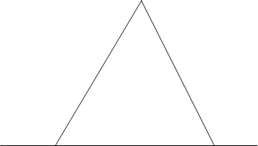
 Solutions
Sketch:

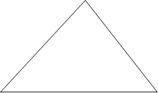


2) Sketch: The required construction is
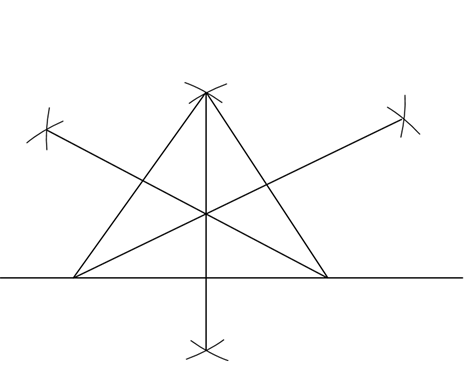
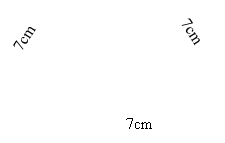


C. The bisectors of each angle meet each other at a point inside the equilateral triangle.
- Construction of Loci of Moving Points
1. Locus of points at a given distance from a fixed point.
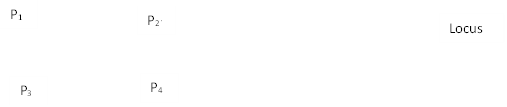
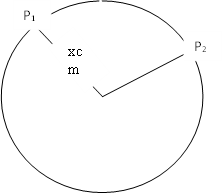 In the figure below, O is a fixed point, Pi, P2 are at a constant distance x cm from O . The locus of the points is a circle of radius x cm.(see the figure below).

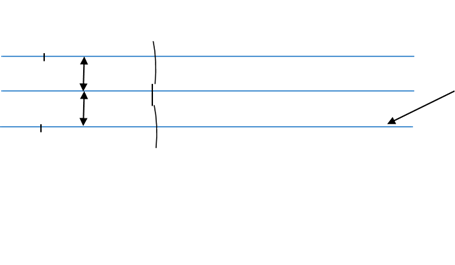
 ii). Locus of point at a given distance from a straight line


In the figure above AB is a straight line which continues indefinitely in both directions. Points Pi, P2, P3, P4 are each a distance x cm from AB. In two dimensions, the locus of the points consist of two straight lines parallel to AB, each at a distance x cm from AB.
Note that this locus consist of two separate lines.


 iii.) Locus of points equidistant from two given points.



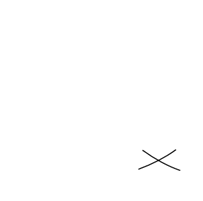




In the figure above, x and y are two fixed points . Points Pi, P2, P3 are such that /PiX/ = /PiY/, /P2X/= /P2Y/and /P3Y. /. P1, P2, P3, lie on the perpendicular bisector of XY. The locus of the points is the perpendicular bisector of XY (shown in the figure above).
iv) Locus of Points Equidistant from two straight lines.


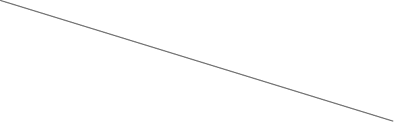





 In the figure above, AB and CD are straight lines which intersect at O. P1 is equidistant from AB and CD . Similarly, P2 is equidistant from the two lines. P1 and P2 lie on the bisector of the acute angle between the two lines.


In the figure above, P3 is equidistant from AB and CD.P3 lies on the bisector of the obtuse angle between the two lines.
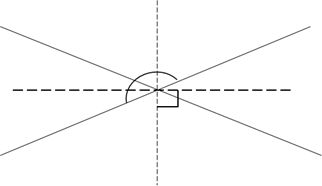
Thus, the complete locus of points which are equidistant from two straight liens is the pair of bisectors of the angles between the lines.( see the figure below).
Note that the two parts of the locus intersect at right angles.


Example
Using ruler and compasses only
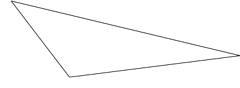
a, Construct ABC such that /AB/ = 6cm, /AC/ = 8.5cm and BAC = 120o
b. Construct the locus l1 of points equidistant from A and B,
c. Construct the locus l2 of points equidistant from AB and AC.
d.Find the points of intersection P1 and P2, of l1 and l2 and measure /P1 P2/
Solution




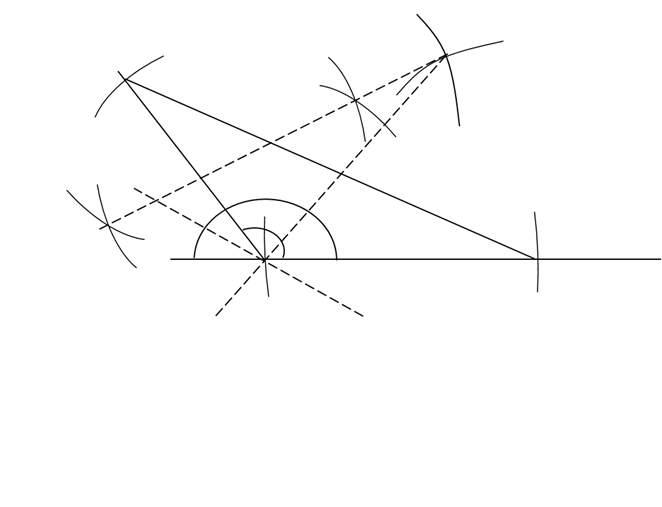








a. Note the construction of BAC = 120o.
b. l1 is the perpendicular bisector of AB
- l2 is in two parts. AP1 is the bisector of BAC. AP2 is perpendicular to AP1, Note that points on AP2 are equidistant from AB and CA produced.
- By measurement /P1P2/ = 6.8cm
EVALUATION
a. Construct an equilateral triangle ABC such that /AB/= 8cm
b. Construct the midpoints of AB, BC, and CA
c. What do you observe?
READING ASSIGNMENT
NGM SS BK 1 pages 176-186 Ex 16e No.6 page 186.
GENERAL EVALUATION
a. Construct a XYZ in which /YZ/ = 8.2cm, XYZ = 45o and XZY = 75o.
measure !XY!.
b. Using ruler and compasses only, construct:
- The locus of a point equidistant from Y and Z.
- A point Q on this locus, equidistant from YX and YZ.
WEEKEND ASSIGNMENT
- A circle centre O, radius 5cm is drawn on a sheet of paper. A point P moves on the paper so that it is always 2cm from the circle . The locus of O A. a circle, centre O, radius 3cm B. two circles,centre O radii 3cm and 7cm C. a circle, centre O, radius 6cm D. two circles,centreO,radii 4cm and 6cm E. a circle, centre O, radius 3.5cm.
- XYZ is a straight line such that /XY/ =/YZ/= 3cm .A point P moves in the plane of XYZ so that /PY/ < /XY/, which of the following describes the locus of P? A. line through X perpendicular to XZ B. line through Y perpendicular to XZ C. line through Z perpendicular to XZ D. circular disc, centre X,radius 3cm E. circular disc, centre 4, radius 3cm.
- Describe the locus of a point which moves so that it is always 5cm from a fixed point O in a plane. A. rectangle which measures 10cm by 5cm B. square of side length 5cm C. a parallelogram whose diagonals are 10cm and 5cm C. a circle of radius 5cm, centre O E. a circle of radius 10cm, centre O.
- Describe the locus of a point which moves along a level floor so that it is 2m from a wall of a room.A. One line, parallel to and 2m from the wall. B. Two lines, one each side of, parallel to and 2m from the wall C. A circle of radius 2m D. A semi-circle of radius ½ m E. Two perpendicular lines, each of length 2m
- Describe the locus of a point which moves so that it is 3cm from a fixed line AB in a plane. A. 2 lines parallel to AB and 6cm apart, joined by semi-circular ends. B. 2 lines parallel to AB and 8cm apart; joined by semi-circular ends C. 2 lines perpendicular to AB D. A circle of radius 6cm E. circle of radius 3cm.
THEORY
- construct a trapezium ABCD in which AB is parallel to DC, AB =4cm BC = 8cm, CD = 11cm, DA = 6cm. (hint: in a rough figure, divide the trapezium into parallelogram AB X D and triangle BCX. (First construct triangle BCX )
- Using ruler and compasses only, construct
- ABC such that /AC/ = 8.5cm and ACB = 135o.
- Using any geometrical instruments, find a point P within ABC which is at a distance 2.8cm from AC and 6cm from B. Measure the length of AP.