WEEK 5 DATE…………………………………………
TOPIC: Deductive proof
Sum of angles in a triangle
The sum of the angles of a triangle is 180.
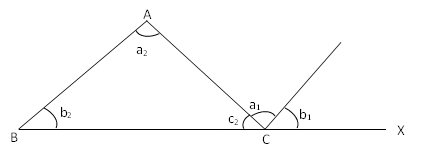 The sum of the angles of a triangle is 180.
Given any triangle ABC
To prove: A+B+C=180
Construction:Produce BC to a point X.Draw CP parallel to BA.
Proof:With the lettering of the figure above
a1=a2 (alternate angles)
b1=b2 (corresponding angles)
c+a1+b1 = 180
C+a2+b2 = 180
ABC + A + B = 180
A + B + C = 180
Relationship to angles on a straight line
The sum of angles on a straight line is 180o.

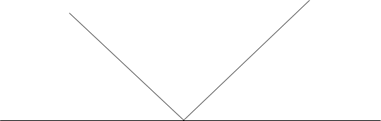
 The sum of angles on a straight line is 180o.


 P + q + r = 180o
Angles on a parallel line cut by a transversal line
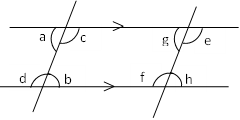
The figure below is parallel lines cut by a transversal line indicating angles a – h
 Corresponding Angles
From the figure above, the following angles are corresponding:
a = g ; b = h ; c = e ; d = f
Alternate Angles
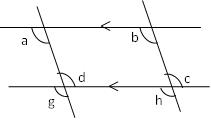 From the figure above, the following angles are alternate
a = d ; b = c
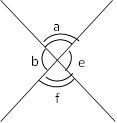
Vertically Opposite Angles
From the figure above, the following angles are vertically opposite
a = f ; b = e ; c = h ; d = g
Example
Isosceles triangles ABC and ABD are drawn on opposite sides of a common base AB. If ABC= 70 and ADB = 118, calculate ACB and CBD.
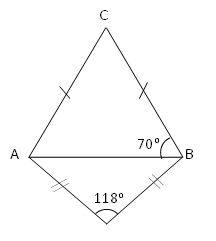 Solution
In triangle ABC,
ABC = 70 (given)
BAC = 70 (base angles of isos. Triangle)
Therefore, ACB = 180 – 70 – 70 (angle sum of triangle)
= 40
In triangle ABD,
ADB = 118 (given)
Therefore, ABD + BAD = 180 – 118 (angle sum of triangle)
= 62
Therefore, 2 X ABD = 62 (base angles of isos. Triangle)
ABD = 31
CBD = CBA + ABD = 70 + 31 = 101
ACB = 40 and CBD = 101
Parallelogram
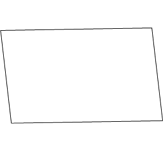 A parallelogram is a quadrilateral which has both pairs of opposite sides parallel.

 b)
b)


 b)
b)


Rhombus, rectangle and square are special examples of parallelogram. A rhombus is a parallelogram with sides of equal length.
Properties of Parallelogram
i) The opposite sides are parallel.
ii) The opposite sides are equal.
iii) The opposite angles are equal.
iv) The diagonals bisect one another.
Properties Of Rhombus
i) All four sides are equal.
ii) The opposite sides are parallel.
iii) The opposite angles are equal.
iv) The diagonals bisect one another at right angles.
v) The diagonals bisect the angles.
NB: In a rectangle, all of the properties of a parallelogram are found and all four angles are right angles. In a square, all of the properties of a rhombus are found and all four angles are right angles.
Intercept
In the figure above, the lines AB and CD cut the transversal PQ into three parts. The part of the transversal cut off between the lines is called an intercept. In the figure above, the line segment XY is the intercept
Intercept Theorem
If three or more parallel lines cut off equal intercepts on a transversal, then they cut off equal intercepts on any other transversal.
Given: Three parallel lines cutting a fourth line at A, B, C so that /AB/=/BC/ and cutting another line at X, Y, Z respectively.
To prove:/XY/ = /YZ/.
Construction: Draw XP and YQ parallel to ABC to cut BY and CZ at P and Q respectively.
Proof:
AXPB is a parallelogram (opp. Sides //)
XP = AB (opp side equal)
Similarly /YQ/ = /BC/ (in //gm YQCB)
/XP/ = /YQ/ (given AB = BC )
In triangles XPY, YQZ
/XP/ =/YQ/ (Proved)
X1 = x2 (corr. angles)
Y1 = y2 (corr. angles)
Therefore, triangle XPY = triangle YQZ (AAS)
/XY/ = /YZ/
EVALUATION

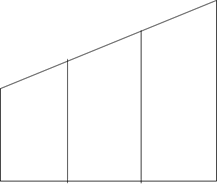 Find the length k, m, n in the figures below


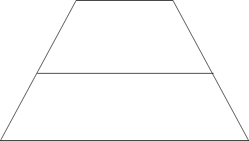


Congruent Triangles
Two figures or triangles are congruent if they have exactly the same shape and size.The following are conditions for congruency:
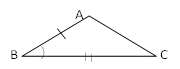

 i)Two sides and the included angle of one are respectively equal to two sides and the included angle of the other.(SAS) e.g in the figures below, triangle ABC is congruent to PQR


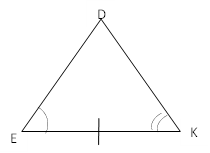
 ii)Two angles and a side of one are respectively equal to two angles and the corresponding side of the other.(ASA or AAS) e.g. the figures below are congruent
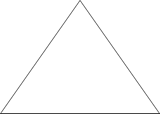


 iii)The three sides of one are respectively equal to the three sides of the other.(SSS)
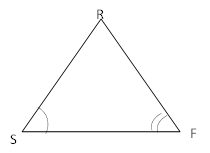
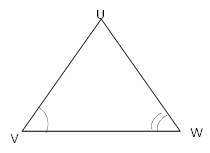


iv)They are right-angled, and have hypotenuse and another side of one respectively equal to the hypotenuse and another side of the other.(RHS)
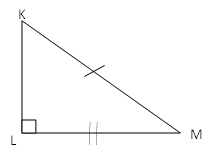
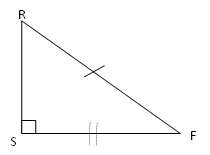
EVALUATION
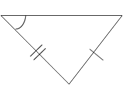
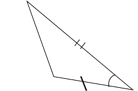
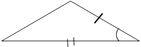
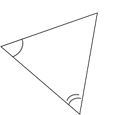 State whether the triangles are congruent, not congruent or not necessarily congruent. If congruent state condition of congruency

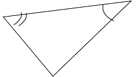
READING ASSIGNMENT
Essential Mathematics for Senior Secondary Schools 1 page 323
GENERAL EVALUATION
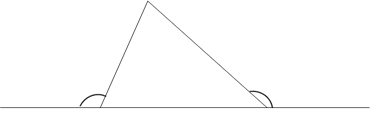
- In the figure below, ABP = <110o and <DCP = 163o. Calculate BPC


- In triangle ABC, <BAC= 68o and <ABC = 30o. BC is produced to X. the bisectors of <ABC and <ACX meet at P. calculate <BCP and <BPC.
 Find the lettered lengths in cm.



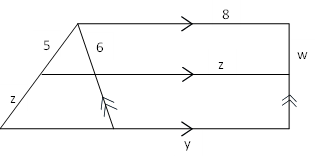 Find the lettered lengths in cm.

WEEKEND ASSIGNMENT

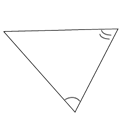
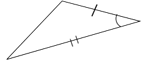
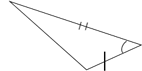
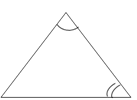 In each pairs of triangles a), b), c), state the condition of congruency



- State the condition of congruency for the pairs of triangle in a)ASA b)SAS c)SSS d)not congruent
- State the condition of congruency for the pairs in b)a)SSS b)SAS c)AAS d)not congruent
- State the condition of congruency for the pairs in c)a)SSS b)SAS c)RHS d)not congruent
Use this figure to answer questions 4 and 5
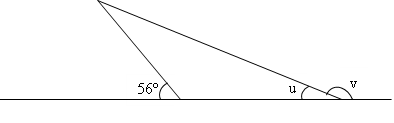


- Calculate the angle marked ua)28 b)38 c)48 d)56
- Calculate the angle marked va)28 b)56 c)152 d)162
THEORY
 Given the data of figure below, prove that triangle PQR is isosceles.
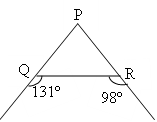 Given the data of figure below, prove that triangle PQR is isosceles.
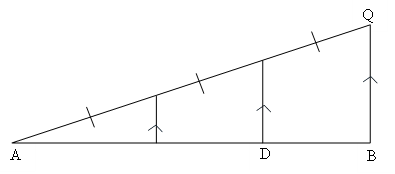
- (a) In figure below, a) what is the ratio /AD/ ÷ /DB/ ?
(b) If /DB/ = 5cm, what is /AB/?