WEEK 8
GAS LAWS
Behaviour of gases is expected to differ from that of solids and liquids. This was investigated by many early scientists e.g. Boyle, Charles, Graham and Dalton, Avogadro’s. They studied the physical behaviour of gases. Gay-Lussac: he studied the chemical behaviour.
Boyle’s Law
- By Robert Boyle in 1662
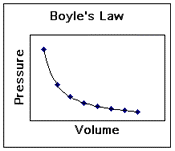
- States that the volume of a given mass of a gas is inversely proportional to its pressure, provided temperature remains constant.
- Law is about the relationship between volume (V) and pressure (P)
As volume of a gas increases, the pressure decreases and vice versa
Mathematical expression
V α 1/p
V α k/p
K = PV
V = volume
P = pressure
K = constant
For initial and final pressure and volume, we have
P1V1 = P2V2
According to the kinetic theory,the gas pressure is caused by molecular collisions with the walls of the container.Therefore, the larger the number of molecules per unit volume,the larger the number of collisions and the higher the pressure.Reducing the volume of a gas container will increase the collisions on the walls of the container per unit time and consequently the pressure of the gas will incr
Using kinetic theory to explain Boyle’s Law
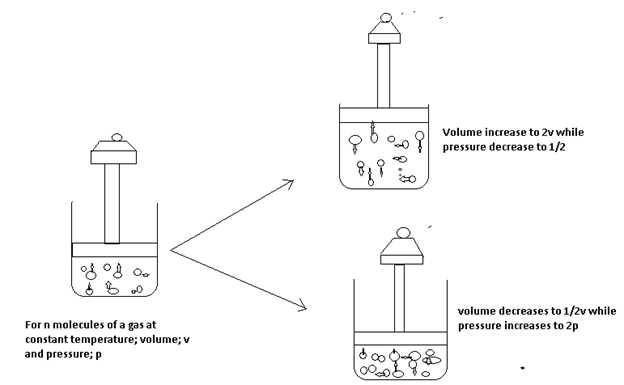
NOTE:
In stage 2:
- The piston is kept stationary by placing a heavy weight on it.
- The space occupied by the molecules is constant i.e. volume is constant.
- The gas exerts constant pressure.
In stage II:
- Weight of piston is replaced with a lighter one, so the piston moves up.
- The space occupied by the gas is doubled (increased volume).
- The pressure exerted by the gas is halved (pressure increases).
In stage III:
- Weight of the piston is now replaced with a heavier one, so the piston moved down.
- The space occupied by the gas is halved (volume decreases)
- The pressure exerted by the gas is doubled (pressure increases)
Therefore, at constant temperature; as the volume of a gas decreases, the pressure the gas exerts increases. Example, Ababio page 31, Fig. 5.15
 V
V
 0 1/P
0 1/P
Calculation Involving Boyle’s Law
The volume of a gas means nothing unless the conditions under which it was measured are known.
Tips for working with gas laws:
- All gas calculations must use Kelvin temperatures.
- The conditions 0 oC and 1 atm are referred to as standard temperature and pressure – STP.
- The volume occupied by one mole of a gas at STP, 22.4 liters, is referred to as molar volume.
- Read the problem to see what conditions change.
- Decide which gas law to use and write its equation.
- Reread the problem to see what question is asked.
- If needed, manipulate the gas law equation.
- Plug numbers and units into the equation.
- Pickup your calculator and punch buttons.
- Write the answer to the problem, don’t forget significant figures, and circle it.
Example 1
A sample of gas occupied 390cm3 ata pressure of 760mmHg.What volume will the gas occupy at 780mmHg, if the temperature remains constant?
Solution
P1V1=P2V2 (T constant)
P1=760mmHg
V1=390cm3
P2=789mmHg
V2=?
P1V1=P2V2 (Boyle’s law)
V2=P1V1/P2
=760mmHg x 390cm3/780mmHg
V2=380 cm3
- 375cm3 of gas has a pressure of 770mmHg, Find its volume if the pressure is reduced to 750mmHg
Ans = 385cm3
ABSOLUTE TEMPERATURE
The temperature at which the volume of a gas would be theoretically reduced to O. This temperature is 0C or 273K.
Note: practically, it is not possible as all gases liquefy above this temperature but it is significant because it is the lowest possible temperature that can be reached.
Temperature Conversion
00C =273K, -2730C =0K (no degree sign)
C =Celsius or centigrade
K = KelvinTo convert:
Celsius to Kelvin =K=0C + 273
Kelvin to Celsius = 0C = K-273


 1000C 373K
 00C 273K -273OC 0K
CELSIUS SCALE KELVIN SCALE



 1000C 373K
 00C 273K
 -273OC 0K
 CHARLE’S LAW
The volume of a given mass of a gas is directly proportional to its absolute temperature provided that pressure remains constant.
MATHEMATICAL EXPRESSION
V α T
V α KT
K= V
T
V = Volume, T = Temperature (in Kelvin), K= constant
For more than one gas, we have
V1 =V2
T1 T2
V2= V1 T2
T1
The volume of a gas is zero at a temperature of -2730C which is zero Kelvin.
Charle’s laws explains that the behavior of gases at differenttemperature changes when the pressure is constant.Gases expand when heated.The rate of expansion or contraction is summaried as follows.At constant pressure,a gas increases by 1/273 of its volume for each Celsius degree rise in temperature and this is true for all gases.For every one degrr centrigrade rise or fall in temperature.
The Kelvin temperature scale has -273oC as its starting point and it is called the absolute temperature scale.
Hence,O0C=273K
-273=0
The Kelvin temperature scale has -273oC as its starting point and it is called the absolute temperature
Charles’ Law Problems
Example1
Whatvolume would be occupied by a given sample of gas at 450C if it occupies 500cm3 at O0c assuming the pressure is constant?
Solution
Acertain mass of gas occupies300cm3 at 350C .At what temperature willit have its volume reduced by half,assuming the pressure remains constant.
Solution
V1/T1=V2/T2
V1=300cm3
T1=350C=(273+35)K=308K
V2=150cm3
T2=?
300cm3/308K=150cm3/T2
T2=308K X 150cm3/300cm3
154K =(-1190C)
USING KINETIC THEORY TO EXPLAIN CHARLE’S LAW. EXAMPLE.
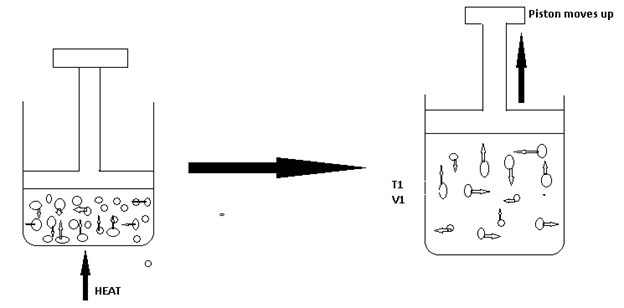
NOTE:
In stage:
The gas is heated, molecules acquire more kinetic energy, move faster and collide more often with the walls of the vessel, and hence, pressure is exerted.
In stage II:
The temperature is increased through heating (T1 –T2).
The pressure is still constant because the piston has been moved up but the volume occupied by the gas has increased.
Conclusion: As temperature increases, the volume increases and vice versa.
Graphical illustration of Charles law.
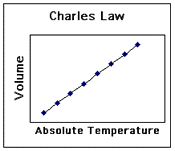

 Ababio page 81, fig 5.16 and page 83
 Vol (dm3) Vol




 -273 O TempoC K
Calculations involving Charles law
- At 170C, a sample of hydrogen gas occupies 125cm3. What will the volume be at 1000C, if the pressure remains constant? Ans. = 161cm3
- To what temperature in Celsius must a gas be raised from 00C in order to double its volume? Ans. = 2730C
- 20cm3 of a gas at 550C exerts 160mm Hg pressure. At the same pressure, calculate the volume of the temperature is doubled? Ans. = 23.35cm3
GENERAL GAS EQUATION
Boyle’s and Charles’s laws show that there is a relationship between the temperature, press and volume. The relationship is expressed by what is called general gas equation I.e.
Boyle’s law – V α 1/P
 Charles Law – V α T i
Multiply (i) x (ii)
V α 1 X Vα T
V α (1/P X T)
V α T/P
V= KT/P
PV= KT
K= PV/T
Formorethan one gas,
P1 V1 = P2 V2V2= P1 V1 T 2
T1 T2 P2 T 1
 Charles Law – V α T i
where P1= initial pressure
V1=initial volume
T1= Initial Kelvin temperature
P2=New pressure
V2=New volume
T2=New Kelvin temperature
STANDARD TEMPERATURE AND PRESSURE (S.T.P)
It is the generally accepted standard temperature (00C or 273K) and pressure (760mmHg or 1.01 x 10⁵Nm-2)
NOTE: if two chemists, one in a temperate country e.g. England and the other in tropical country e.g. Nigeria, should carry out investigations on the same gases. Their gas volumes would differ because of different in temperatures of the two countries. So, scientists decided to have standard temperature and pressure for calculations and experimentation.
CALCULATIONS
- At s.t.p, a certain mass of gas occupies a volume of 790cm3. Find the temperature at which the gas occupies 1000cm3. Ans. = 330.1K
- A given mass of a gas occupies 850cm3 at 320K and 0.92 x 10⁵Nm-2 pressures. Calculate the volume of the gas at s.t.p Ans. = 660.5cm3
- A sample of N2 occupies a volume of 1dm3 at 500k and 1.01 x 10⁵ Nm-2. What will its volume be at 2.02 x 10⁵Nm-2 and 400K?
- To what temperature must a given mass of N2 at 00C be heated so that both its volume and pressure will be doubled?
- 130cm3 of gas at 20oC exerts a pressure of 750mmHg. Calculate its pressure if its volume is increased to 150cm3 at 350C.
- Calculate the volume of hydrogen produced at s.t.p and r.t.p when 25g of zinc are added to excess dilute Hydrochloric acid at 31oCand 778mmHg pressure (H= 1, Zn= 65, Cl= 35.5, GMV= 22.4dm3, 24 dm3 )
 The combustion of butane in oxygen (air) is represented in the equation below: 2C4H10 + 1302 10H20 + 8CO2
IDEAL GAS EQUATION
In all experimental works, measurements or calculation involving gases, four quantities are important-volume, pressure, temperature, and number of moles. The first three have been used in general gas equation. But the combination of four of them gives ideal gas equation as:
PV = nrt
Where
P = Pressure (in atm)
V = Volume (in dm3)
n = No. of moles
R = Gas constant (0.082 atm dm3 k-1 mol-1)
T = Temp (in K)
 The combustion of butane in oxygen (air) is represented in the equation below: 2C4H10 + 1302 10H20 + 8CO2
Gas density can also be calculated using the ideal-gas equation.
Density is equal to mass divided by volume, d = m/v.
The ideal-gas equation can be arranged to give density in g/L:
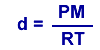
This equations shows the density of a gas depends on its pressure, molar mass, and temperature. The higher the molar mass and pressure, the greater the gas density; the higher the temperature, the less dense the gas.
Even though gases form homogeneous mixtures regardless of their identities, a less dense gas will lie above a more dense one if they are not physically mixed. The differences between the densities of hot and cold gases is responsible for CO2 being able to keep oxygen from reaching combustible materials (thus acting as a fire extinguisher) and for many weather phenomena, such as the formation of large thunderhead clouds during thunderstorms.
- Under a pressure of 3000, Nm-2 a gas has a volume of 250cm3. What will its volume be if the pressure is changed to 100mmHgat the same
Temperature?
Solution to NO.3
Note: The pressure is not in the same unit. So conversion must be done first. 101325 Nm-2 = 760mmHg
 3000Nm-2 =760 x 3000= 22.gmmHg
101325
P1 =22.5mmHg
 Using P1 V1 = P2 V2
T1 T2
P2 = 100mmHg, V1 = 250cm3, V2 =?
Ans= 56.25cm3
Dalton’s Law of Partial Pressures, established by John Dalton, states that if there is a mixture of gases that do not react chemically together, then the total pressure exerted by the mixture is the sum of the partial pressures of the individual gases that make up the mixture i.e.
PTotal =PA + PB + PC +…
Where
PTotal = Total pressure of the mixture
PA = Partial pressure of gas A
PB = Partial pressure of gas B
PC = Partial pressure of gas C
Note:
- Gases A, B and C make up the mixture.
- If a gas is collected by water, it is likely to be saturated with water vapor and the total pressure becomes: Ptotal= Pgas + Pwatervapour
The pressure of the dry gas will now be:
PGAS = PTOTAL -PWATER
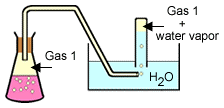 Dalton’s Law is helpful when collecting a gas “over water”. This diagram shows the collection of a gas by water displacement.
A collecting tube is filled with water and inverted in an open pan of water. Gas is then allowed to rise into the tube, displacing the water. By raising or lowering the collecting tube until the water levels inside and outside the tube are the same, the pressure inside the tube is exactly that of the atmospheric pressure.
A gas collected “over water” is a mixture of the gas and water vapor. Dalton’s law of partial pressures describes this situation as:
Ptotal = Pgas + PH2O
Charts like this one are readily available that give water vapor pressure at any common temperature.
EXERCISES
- A certain mass of hydrogen gas collected over water of 6o C and 765mmHg pressure has a volume of 35cm3. Calculate the volume when it is dry at s.t.p. (s.v.p. of water at 6oC=7mmHg).
Solution
To get the real pressure of H2 gas i.e. when it is dry:
PDRY GAS =PTOTAL –PWATER VAPOUR =765 -7 =758mmHg
Apply general gas equation to obtain the volume required in the question. Ans= 34.2cm3
2 .272cm3 of CO2 were collected over water at 15oC and 782mmHg pressure. Calculate the Volume of the dry gas at s. t. p. (s.v.p of water at 15 0C= 12mmHg)
3 .A given amount of gas was collected over water at 302K where the water vapour pressure of was 4.0 KNm-2. Calculate the pressure of the dry gas if the atmospheric pressure at the same temperature was 101.3 KNm-2
4 .200cm-2 of Nitrogen gas at a pressure of 500mmHg and 100cm3 of CO2 at a pressure of 50mmHg were introduced into a 150cm3 vessels. What is the total pressure in the vessel?
Solution for No. 4
For N2
V1 =200 cm3, P1 =500 mmHg
V2=150 cm3, P2 =? mmHg
 P2= P1V1 = 666.67mmHg –Boyles Law
V2
For CO2
V1 =10 cm3, P1=50 mmHg, V2=150 cm3, P2 mmHg=?
P2-33.33mmHg.
Total pressure =666.67 +33.33 =700mmHg
- A gas X was put in a 10dm3 vessel at 400K and 1.015 x 10⁵ Nm-2. . Another gas Y at 400K and 3.035 x 10⁵ Nm-2 is put in a 5dm3 vessels. What will be the total pressure if:
- X and Y are put in a 5dm3 vessel at 400K?
- X and Y are put in a 15dm3 vessel at 400K?
- X and Y are put in a 10dm3 vessel at 400K?
- X and Y are put in a 20dm3 vessel at 400K?
SOLUTION
For X- P1= 1.015 x 10⁵ Nm-2, V1 = 10dm3, V2 = 5dm3, P2=?
 P2 = P1V1 =2.03 X 10⁵ Nm-2. NOTE: Temp is constant
V2
 P2 = P1V1 =2.03 X 10⁵ Nm-2. NOTE: Temp is constant
 For Y
It already in 5 dm3 and it is 3.035 x 10⁵ Nm-2
P total = Px + Py
=2.03 x 10⁵ + 3.035 105
=5.065 x 10⁵ Nm-2
EVALUATION
EXERCISES
1.A certain amount of gas occupies 5.0dm3 at 2 atm and 10 0 C. Calculate the number of moles present (R=0.082atm dm 3 K– 1mol- 1).
- 2.0 moles of an Ideal Gas are at a temperature of -130C and a pressure of 2
Atm. What volume in dm3 will the gas occupy at a temperature?
(R=0.082 atm dm3 K- 1 mol-1)
3.A given mass of nitrogen is 0.12dm3 at 60C and 1.01 X 10⁵ Nm-2. Find its pressure at the same temperature, if its volume is changed to 0.24dm3.
4.A certain mass of gas occupies 600cm3 and exerted 1.325 x 10⁵ Nm-2 pressures. At what pressure would the volume of the gas be halved?
Ans = 2.65 x 10⁵ Nm-2
5.Convert the following Kelvin temperature to Celsius temperature
A. 405K B. 298K
6.Convert the following Celsius temperature to Kelvin temperature
A. 00C B. -1320C