WEEK FOUR DATE…………… TOPIC: LINEAR INEQUALITY (PART TWO) CONTENT
- Linear Inequalities in Two Variables by Graphical Method.
- Graphical Solution of Simultaneous Linear Inequalities in Two Variables.
- Linear Programming
GRAPHICAL SOLUTION OF INEQUALIIES IN TWO VARIABLES
A straight line has the general equation ax+by+c=0, where a,b and c are real numbers.
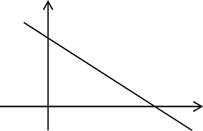
The line ax + by + c =0 partitions the x-y plane into two regions
Worked Examples
1) Show the region representing 2x + y + 1 > 0
Solution
2x + y + 1 > 0
Steps
- make y the subject of the inequality
- convert the inequality into a line equation
- obtain x and y co ordinates of the line
- draw the line and shade the required by the inequality 2x + y + 1 > 0 y > – 2x -1
When x = 0 , y = -2(0) -1
y = -1 (0, 1)
When y = 0, 0 > -2x – 1
1 > -2x
x = – ½ (-½ ,0)
2) Show the region represented by x – 2y + 3 ≤ 0
Solution x- 2y + 3 ≤ 0
2y = – 3 – x → y = -3/-2 – x/-2 → y = 3/2 + x/2 or y = 3 + x
2
When x = 0
y = 3 + 0 = 3 (0, 3/2)
2 2
When y = 0
0 = 3 + x
2
x = -3 (-3, 0)
Evaluation
Show the region which represents the following inequality a) 2x – 3y + 1 ≤ 0 b) x – 4y + 7 ≥0
SIMULTANEOUS INEQUALITIES
The set of simultaneous inequalities in two variables can be found from the intersection of the areas representing the inequalities.
Worked Examples
1) Show graphically the region R which satisfies the set of inequalities 2x + 2y ≤ 2, x + 2y≤ 16, x ≥ 0, y ≥ 0.
Solution 2x + 2y ≤ 2
2y ≤ 2 – 2x y ≤ 2 – 2x 2 y ≤ 2 – 2x 2 2 y ≤ 1 – x
When x = 0, y = 1 – 0 =1 (0, 1 ) When y =0, 0 = 1 – x
1= -x point (1 , 0).
X + 2y ≤ 16
2y ≤ 16 – x, y ≤ 16 – x
2
When x = 0
y = 16 – 0 = 16 = 8 (0,8)
2 2
When y = 0, 0 = 16 – x
2 16 – x = 0 x = – 16
x = 16 (16, 0).
x ≥ 0, x = 0 , y ≥ 0, y = 0
2) Show graphically, the region which satisfies the set of inequalities 4x + y ≤ 15, 8x – y ≥ 9, x ≥ 0, y ≥0.
Solution
4x + y ≥ 15, y ≤ 15 – 4x
When x = 0
. y = 15 – 4(0)
. y = 15 (0, 15)
When y = 0
0 = 15 – 4x
-15 = -4
4 -4
X = 15/4 (3¾, 0)
8x – y ≥ 9
. –y ≥ 9 – 8x, y ≥ 8x – 9
When x = 0 , y = 8(0) – 9
. y = -9 (0, -9)
When y = 0, 0 = 8x – 9 9 = 8x, x = 9/8 = 1⅛ (1⅛, 0 )
. x ≥ 0 or x = 0, y ≥ 0 or x = 0
Evaluation
Show the regions which represent the set of solution of
1) 2y ≤ x + 8, x + 2y + 4 ≥ 0, x ≤ 2y + 12 2) y ≥ 0, x + 2y ≤ 4, -x + 2y ≤ 11, -2x + 5y ≤ 10
LINEAR PROGRAMMING
The linear function z = ax + by is called the objective function while the given set of the inequalities are called the constraint linear programming attempts to maximize or minimize an objective function under the set of given constraints. Example 1
A caterer can make two types of of drinks A and B. A litre of A contains 2gramme of orange juice and 3gramme of pineapple juice. A litre of B contains 4gramme of orange juice and 5gramme of pineapple juice.
There are not more than 16gramme of orange juice and 21gramme of pineapple juice.
The caterer can make a profit of 1ok on 1gramme of A and 15k on 1gramme of B. Assuming that the caterer makes x litres of A and y litres of B. (a) Write all the inequalities connecting x and y.
- Show by shading the required region satisfying the inequalities in (a﴿
- Find the quantity of each type of drink a caterer must make if she is to maximize profit.
Solution
- 2x+4y ≤16, 3x + 5y≤ 21, x≥0, y ≥ 0
- 2x + 4y ≤16, 4y = 16 – 2x, y = 16-2x
4
When x = 0
.y = 16 – 2(0) = 16 = 4 (0,4)
4
When y = 0 , 0 = 16 – 2x
 x = 8 (8, 0)
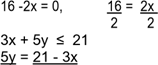
- 5
 x = 8 (8, 0)
 y = 21-3x
5
When x =0 , y = 21- 0 = 21 (0, 21/5)
5 5
When y = 0, 0 = 21 – 3x
5
21 – 3x = 0
3x = -21, x = -21 = 7 (7,0)
3
(c) 7 litres of A and none of B.
Example 2.
A fashion designer makes two types of dresses X and Y by making use of two types of materials P and Q. The quantity of material used for each unit of dress in m2, and the profit on each dress in N are as shown in the following table.
| P | Q | Profit | |
| X | 3 | 2 | 2 |
| Y | 4 | 5 | 3 |
| Quantity available | 18 | 19 |
- Assuming that the designer makes x unit of X and y and units of Y. write down the four inequalities connecting x and y.
- Find how many of each type of dresses the fashion designer should make in order to maximize Profit.
Solution
The quantity of material P used in making x units of dress X and y units of dress Y is 3x+ 4y, since the quantity of material P available is 18m2.
3x+ 4y ≤ 18
Similarly for material Q
2x + 5y ≤ 19
Also, x ≥0, y ≥0
3x + 4y = 18, 4x = 18 -3x
y = 18 – 3x
4
When x = 0, y = 18 – 3(0) = 18 = 4½
- 4 (0, 4½)
When y = 0, 18 – 3x = 0
3x = -18
. x = -18 = 6 (6, 0)
3
2x + 5y = 19 → 5y = 19 -2x, → y = 19 – 2x
5
When x = 0, y = 19 – 2(0) = 19 (0, 19/5)
- 5
When y= 0, 19 – 2x = 0
2x = – 19
x = -19 = 19
2 2 (19/2, 0)
Let z be the profit, then z = 2x + 3y at the point C(2, 3) z = 2(2) + 3(3 ) z = 4+ 9 = 13
Hence the fashion designer should make 2 dresses of type X and 3 dresses of type Y in order to make a maximum profit of N13.00
Evaluation
A petty trader sells two types of detergents A and B. a dm3 of A contains 2gm of Omo detergent and 5gm of Surf detergent. A dm3 of B contains 3gm of omo detergent and 2gm of surf detergent. Altogether she has at most 26g of omo detergent and 32g of surf detergent, the trader makes a profit of 2k per gm on A and 1k per gm on B. If the trader sells x dm3 of A and y dm3 of B 1. Write down all the inequalities connecting x and y.
- Indicate by shading the region R satisfying all the inequalities in (a)
- Determine the values of x and y which maximises the traders profit.
Solution
| Omo | Surf | Profit | |
| A | 2 | 5 | 2 |
| B | 3 | 2 | 1 |
| Total | 26 | 32 |
x≥ 0, y ≥ 0, 2x + 3y ≤ 26, 5x + 2y ≤ 32 2x + 3y = 26,
3y = 26 – 2x, y = 26 – 2x
3
When x = 0 , y = 26 – 2(0) = 26 = 8⅔ (0, 8⅔)
3 3
When y = 0, 26 – 2x = 0
– 2x = – 26, x = – 26 = 13 (13, 0) – 2
5x + 2y ≤ 32
2y = 32 – 5x, y = 32 – 5x
2
When x = 0, y = 32 – 5(0) = 32/2 = 16 (0, 16) When y = 0, 32 – 5x = 0
-5x = -32, x = -32/-5 = 32 (32/5, 0) 5
The corner points are A(0, 8.6) , B(4, 6), C(6.4,0) , D(0,0)
Profit Z = 2x + y
At A, Z = 2(0 + 8.6) = 8.6
At B, Z = 2(4 + 6) = 14
At C, Z = 2(6.4 + 0)= 12.8 At D, Z = 2(0 + 0) = 0
Hence, the trader should sell 4 of detergent A and 6 of detergent B to make a profit of 14k.
Evaluation
1) Show graphically the region represented by the inequalities (a) y ≥ 4x2 + 11x – 3 (b) y ≥ 6x2 – x – 2 2) Show graphically the region R which satisfies the set of inequalities: 2x + 3y ≤ 26, x + 2y ≤ 16, x ≥ 0, y ≤ 0.
General Evaluation
1. show the region R which satisfies the following simultaneous inequalities y + x ≤ 3, y+ x ≥ 1, y – x ≤ 1, x ≥ 0, y ≥ 0. 2. show the region R which satisfies simultaneously 2x + y ≤ 7, 3x – 4y ≥ – 6, x ≥ 0, y ≥ 0.
- 3x2 + 7x – 3 = 0 solve using formula method
- Using completing the square and formula method solve 3x2 – 12x + 10 = 0
- Solve the following exponential equations (a) 22x – 6(2x) + 8 = 0 (b) 22x+1 – 5 (2x) + 2 = 0
- Janet buys p sweet and q marbles. The sweets cost ₦5 each and the marbles cost ₦6 each. Janet has ₦90. She wants to share the sweets with her friends, so she needs at least 5sweets, she needs more than 4 marbles to be able to join in the game. (a) Write down three inequalities connecting p and q (b) Draw the graph to show their inequalities (c) What is the highest number of sweets she can buy? (d) What is the highest number of marbles she can buy?
Reading Assignment : F/maths Project 1 pg 113 – 119 Exercise 8c Q1, 16 and 17
WEEKEND ASSIGNMENT 1) Find the range of x for which │2x – 1│> 3
(a) 1< x < 3/2 b) -3/2 < x < -1 c) -3/2 < x < 1 d) x > 3/2 and x < -1
- Find the range of the value that satisfies the inequality x2 + 3x – 18 < 0
- -3 < x < 6 (b)-3 > x <6 (c)-6 >x >3 (d)-6 >x < 3 (e)-6 < x <3
- Find the range of values of x for which 2x2 – 5x + 2 ≥ 0
- -2 < x < -½ (b) ½ < x < 2 (c) x < -½ or x ≥ -2 (d) x ≤ ½ or x ≥ 2
- Find the range of values of y which satisfies the inequality 2y – 1 < 3 and 2 – y ≤ 5
- – 3 ≤ y ≤ 1 (b) – 2 ≤y ≤ 3 (c) -3≤ y ≤ 4 (d) -3 ≤ y ≤ 2
- Find the range of values of x for which 1/x + 3 < 2x is satisfy (a) – 3 < x < 5/2 (b) x < -3 and x > -5/2 (c) x < 1 and x < ½
THEORY
- Illustrate graphically the set P of all points ( x, y) which satisfy simultaneously the following inequalities:
2y ≤ x + 8, x + 2y + 4 ≥ 0, 3x ≤ 2y + 12. Using your diagram, calculate on the set P the maximum values of (i) x (ii) y (iii) 12x + 5y
- Determine the values of x satisfying |x + 3| ≥ 8