CLASS; J S S 2 WEEK 5
TOPIC; TIME SIGNATURE
Time signature consists of 2 figures written in form of fraction 2/2 at the left side of a piece of music to indicate the tuning of the music. E.g. 2/2, 2/4, 3/8, etc.
2 Numerator and 2 Denominator.
The time signature (also known as meter signature, meter signature, or measure signature) is a notational convention used in Western musical notation to specify how many beats (pulses) are to be contained in each bar and which note value is to be given one beat. In a musical score, the time signature appears at the beginning of the piece, as a time symbol or stacked numerals, such as  or 34 (read common time and three-four time, respectively), immediately following the key signature or immediately following the clef symbol if the key signature is empty. A mid-score time signature, usually immediately following a bar line, indicates a change of meter.
There are various types of time signatures, depending on whether the music follows simple rhythms or involves unusual shifting tempos, including:
Simple (such as 3 4 or 44), compound (e.g., 9 8 or 12
8), complex (e.g., 5
4 or 78), mixed (e.g., 5
8 & 3
8 or 6
8 & 34), additive (e.g., 3+2+38), fractional (e.g., 2½4), and irrational meters (e.g., 3 10 or 5
24).
The upper figure represents the number beats in a bar while the figure below represents the value of the notes. In another way, it can be written in this form 2=2 of the notes below in the bar. I.e. 0 1
2 minim beats in bar
There are two types of time signature
- Simple Time Signature
- Compound Time Signature.
Simple time signature is grouped into three (3)
I Simple double time
Ii Simple triple time
Iii Simple quadruple time.
Compound Time Signature.
Simple time signatures
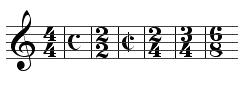
Basic time signatures: 44, also known as common time ( ); 22, also known as cut time or cut-common time (
 ); plus 24; 34; and 68
Simple time signatures consist of two numerals, one stacked above the other:
- The lower numeral indicates the note value that represents one beat (the beat unit).
- The upper numeral indicates how many such beats there are grouped together in a bar.
For instance, 24 means two quarter-note (crotchet) beats per bar—38 means three eighth-note (quaver) beats per bar.
The most common simple time signatures are 24, 34, and 44.
Notational variations in simple time.
The symbol  is sometimes used for 44 time, also called common time or imperfect time. The symbol is derived from a broken circle used in music notation from the 14th through 16th centuries, where a full circle represented what today would be written in 32 or 34 time, and was called tempus perfectum (perfect time). The symbol
 is also a carry-over from the notational practice of late-Medieval and Renaissance music, where it signified tempus imperfect diminutum (diminished imperfect time)—more precisely, a doubling of the speed, or proportion duple, in duple meter. In modern notation, it is used in place of 22 and is called all a brave or, colloquially, cut time or cut common time.
Compound time signatures
in compound meter, subdivisions (which are what the upper number represents in these meters) of the main beat are in three equal parts, so that a dotted note (half again longer than a regular note) becomes the beat unit. Compound time signatures are named as if they were simple time signatures, in which the one-third part of the beat unit is the beat, so the top number is commonly 6, 9 or 12 (multiples of 3). The lower number is most commonly an 8 (an eighth-note): as in 98 or 12 8.
An example
4 is a simple signature that represents three quarter notes. It has a basic feel of (Bold denotes a stressed beat):
One two three (as in a waltz)
Each quarter note might comprise two eighth-notes (quavers) giving a total of six such notes, but it still retains that three-in-a-bar feel:
One and two and three and
68: Theoretically, this can be thought of as the same as the six-quaver form of 34 above with the only difference being that the eighth note is selected as the one-beat unit. But whereas the six quavers in 34 had been in three groups of two, 68 is practically understood to mean that they are in two groups of three, with a two-in-a-bar feel (Bold denotes a stressed beat):
One and a, two and a or one two three, four five six.
Beat and time.
Time signatures indicating two beats per bar (whether it is simple or compound) are called duple time; those with three beats to the bar are triple time. To the ear, a bar may seem like one singular beat. For example, a fast waltz, notated in 34 time, may be described as being one in a bar. Terms such as quadruple (4), quintuple (5), and so on are also occasionally used.
In compound time signature, each beat is dotted note which can be further sub-divided but this time, it split into three.
I Compound duple time
Ii Compound triple time
Iii Compound quadruple time.